The Stamp Act of 1765, requiring all legal documents, permits, commercial contracts, newspapers, pamphlets, and playing cards in the American colonies to carry a tax stamp, was a significant turning point in the relationship between Great Britain and its colonies. It represented the first direct internal tax levied by Parliament on the colonists, as opposed to external taxes like the Sugar Act, which regulated trade. This new form of taxation, intended to raise revenue for British military expenses following the French and Indian War, introduced the concept of “taxation without representation” into the colonial lexicon, as colonists argued they had no elected representatives in Parliament to voice their interests regarding these taxes.
This acts significance lies in its catalytic effect on the growing discontent within the colonies. It fueled the flames of resistance by uniting colonists from diverse backgrounds and social classes against a common grievance. The resulting boycotts, protests, and formation of groups like the Sons of Liberty demonstrated the strength of colonial opposition and marked a crucial step towards the development of a unified American identity. These actions, spurred by the tax, directly contributed to the escalating tension that ultimately culminated in the American Revolution.
Understanding this pivotal piece of legislation provides critical context for exploring the broader themes of colonial resistance, the growth of revolutionary sentiment, and the events leading to the American Revolution. Further exploration might include examining the specific grievances articulated by the colonists, the economic and political consequences of the act, and its influence on subsequent revolutionary movements.
Understanding the Stamp Act’s Significance
Grasping the importance of the Stamp Act requires examining its multifaceted impact on colonial America. The following tips offer different perspectives on its historical significance:
Tip 1: Focus on the Concept of Direct Taxation: Unlike previous taxes that regulated trade, the Stamp Act represented a direct attempt by Parliament to raise revenue from the colonies. This shift in policy directly challenged colonial autonomy and established a precedent for future taxation.
Tip 2: Consider the Cry of “No Taxation Without Representation”: The Stamp Act became a rallying cry for colonists who lacked direct representation in the British Parliament. This concept became a cornerstone of revolutionary ideology and fueled resistance movements.
Tip 3: Examine the Economic Impact: The tax burdened colonists across various social classes, impacting legal transactions, commercial activities, and the dissemination of information through newspapers and pamphlets. This widespread impact further fueled resentment and contributed to collective resistance.
Tip 4: Explore the Rise of Colonial Resistance: The Stamp Act spurred the formation of groups like the Sons of Liberty and widespread boycotts of British goods. These actions demonstrated the growing strength and organization of colonial resistance.
Tip 5: Connect the Stamp Act to the American Revolution: The act served as a critical catalyst in the escalating tensions between Great Britain and the colonies, contributing to the chain of events that ultimately led to the American Revolution.
Tip 6: Analyze the Act’s Legal and Political Ramifications: The Stamp Act raised complex legal and political questions regarding the authority of Parliament over the colonies and the rights of colonial citizens. Debates surrounding these questions shaped the evolving political landscape.
Tip 7: Investigate the Global Context: The Stamp Act’s impact resonated beyond the American colonies, influencing political thought and resistance movements in other parts of the world struggling with issues of representation and self-governance.
By considering these perspectives, one gains a more comprehensive understanding of the Stamp Act’s multifaceted significance and its role in shaping the course of American history. This deeper understanding allows for a more nuanced interpretation of the events and ideologies that defined the era.
This exploration of the Stamp Act’s importance provides essential background for a comprehensive understanding of the American Revolution. Further analysis might include examining primary source documents, exploring the perspectives of various historical actors, and considering the long-term consequences of this pivotal legislation.
1. Taxation without representation

The Stamp Act’s core issue, taxation without representation, became a central tenet of colonial resistance and a driving force behind the American Revolution. The act, imposing a direct tax on the colonies without their consent or representation in the British Parliament, ignited widespread outrage. Colonists argued that being taxed without having elected representatives to voice their interests violated fundamental rights as British subjects. This principle, articulating the injustice of contributing financially to a government without having a voice in its policies, resonated deeply within colonial society. The phrase “No taxation without representation” encapsulated this grievance and became a powerful rallying cry, uniting colonists from diverse backgrounds in opposition to British rule.
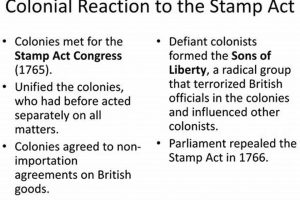
The practical significance of this principle lies in its contribution to the development of a distinct American political identity. Colonists, forced to confront the issue of their own political and economic autonomy, began to question the legitimacy of British authority. Real-life examples, such as the boycotts of British goods organized in protest against the Stamp Act, demonstrate the tangible impact of this principle. These boycotts, driven by the belief that economic pressure could force a change in British policy, disrupted transatlantic trade and exerted considerable pressure on British merchants. The Stamp Act Congress, convened in 1765, further exemplified colonial unity by bringing together representatives from nine colonies to formally protest the act and assert colonial rights. This collective action, fueled by the shared grievance of taxation without representation, laid the groundwork for future intercolonial cooperation during the revolution.
The link between “taxation without representation” and the Stamp Act’s importance is undeniable. The act, by embodying this principle in concrete policy, transformed theoretical discussions about representation into a tangible, lived experience for colonists. This experience, coupled with the resulting economic hardship and political mobilization, significantly escalated tensions with Great Britain. The Stamp Act’s legacy extends beyond its immediate impact; the principle of “no taxation without representation” continues to resonate in discussions about political legitimacy and the rights of citizens to participate in their own governance.
2. Direct Taxation

The Stamp Act’s significance is inextricably linked to its nature as a direct tax. Unlike earlier taxes like the Sugar Act, which regulated trade and were considered external taxes, the Stamp Act represented a novel approach by the British Parliament: directly taxing the colonies’ internal economic activity. This distinction is critical to understanding the colonists’ reaction and the act’s lasting impact.
- Parliamentary Authority over Colonial Finances
The Stamp Act asserted Parliament’s authority to directly tax the colonies, a power previously untested and unprecedented. This assertion challenged the existing colonial understanding of self-governance, where local assemblies traditionally held control over internal taxation. This challenge to colonial autonomy directly fueled resistance as colonists viewed it as an infringement on their rights.
- Impact on Colonial Commerce and Daily Life
The direct tax affected a wide range of commercial activities and everyday transactions, requiring stamps for legal documents, newspapers, pamphlets, and even playing cards. This pervasive impact brought the issue of taxation into the daily lives of colonists from various social classes, fostering widespread resentment and creating a shared experience of grievance against British policies.
- Financial Burden and Economic Disruption
The financial burden imposed by the Stamp Act, while arguably modest in its overall scope, created economic hardship for many colonists. The added cost of stamps disrupted businesses, hindered trade, and added to the financial pressures faced by printers, merchants, and legal professionals. This economic disruption fueled opposition to the act and further exacerbated tensions with Great Britain.
- Catalyst for Collective Action and Resistance
The imposition of a direct tax acted as a catalyst for collective action, uniting colonists in opposition to British policies. The formation of groups like the Sons of Liberty, the organization of boycotts, and the convening of the Stamp Act Congress demonstrate how the direct nature of the tax galvanized resistance and fostered intercolonial cooperation. These collective actions laid the foundation for future revolutionary movements.
The Stamp Acts classification as a direct tax is central to understanding its historical importance. By directly impacting colonial finances and challenging established norms of self-governance, the act fueled resistance, fostered colonial unity, and laid the groundwork for the American Revolution. This shift in British policy from indirect trade regulation to direct internal taxation proved a critical turning point in the relationship between the colonies and Great Britain, contributing significantly to the escalating tensions that ultimately led to war.
3. Colonial Resistance

Colonial resistance played a pivotal role in the Stamp Act’s historical significance. The act, viewed as an overreach of British authority, ignited widespread opposition in the American colonies. Examining the diverse forms of resistance reveals the act’s profound impact on the relationship between Great Britain and its American colonies, and sets the stage for understanding its contribution to the eventual revolution.
- Boycotts of British Goods
Colonists organized widespread boycotts of British goods, targeting merchants who sold stamped paper and other imported products. These boycotts, enforced through social pressure and intimidation, disrupted transatlantic trade and exerted significant economic pressure on British merchants. The boycotts demonstrated the colonists’ willingness to engage in collective action and economic resistance to challenge British policies.
- Formation of Protest Groups
Groups like the Sons of Liberty emerged in response to the Stamp Act. These organizations, composed of artisans, merchants, and laborers, mobilized popular opposition through public demonstrations, protests, and acts of defiance against British officials. The Sons of Liberty played a key role in coordinating resistance efforts and disseminating revolutionary ideas, contributing to the growing sense of colonial unity.
- The Stamp Act Congress
Representatives from nine colonies convened the Stamp Act Congress in 1765, marking a significant step toward intercolonial cooperation. The Congress drafted petitions to the King and Parliament, asserting colonial rights and protesting the Stamp Act’s perceived unconstitutionality. This collective action demonstrated a growing sense of shared grievance and laid the groundwork for future coordinated resistance efforts.
- Acts of Violence and Intimidation
Resistance occasionally manifested as violence and intimidation against British officials and stamp distributors. These actions, while not universally condoned, reflected the intensity of colonial opposition to the Stamp Act. The threat of violence and social unrest further pressured British authorities to reconsider the act’s implementation and highlighted the potential for escalating conflict.
The various forms of colonial resistance ignited by the Stamp Act underscore its significance as a catalyst for the American Revolution. These acts of defiance, ranging from economic boycotts to organized protests and acts of violence, demonstrated the depth of colonial opposition to British policies and the growing sense of colonial unity. The Stamp Act, by provoking such widespread resistance, ultimately contributed to the escalating tensions that culminated in the American Revolution. The acts legacy lies not just in its content but also in the colonial reaction it generated, solidifying the colonies resolve to resist what they perceived as unjust and tyrannical rule.
4. Unifying Grievance

The Stamp Act’s power as a unifying grievance is central to its historical importance. While diverse economic and social divisions existed within the colonies, the act’s imposition of a direct tax without representation fostered a shared sense of injustice across these disparate groups. This unifying effect significantly strengthened colonial resistance and propelled the movement towards revolution. The shared experience of being subjected to what was perceived as an unjust tax transcended regional, economic, and social differences, forging a collective colonial identity focused on opposing British policies.
This unifying grievance manifested in several crucial ways. Merchants, directly impacted by the tax’s economic ramifications, joined forces with laborers and artisans, who felt the broader effects of increased costs and restricted trade. The Sons of Liberty, a diverse group encompassing various social classes, effectively mobilized this cross-sectional opposition through organized protests and boycotts. The convening of the Stamp Act Congress further exemplified this unity, bringing together representatives from different colonies to coordinate a collective response. This collaboration demonstrated a burgeoning sense of shared American identity and laid the groundwork for future intercolonial cooperation during the revolution. One can analyze specific examples like the widespread boycotts of British goods, which involved coordinated action by merchants, consumers, and laborers across different colonies. This collective action exerted significant economic pressure on Great Britain and demonstrated the potential for unified resistance.
Understanding the Stamp Act’s role as a unifying grievance offers crucial insights into the dynamics of the American Revolution. The act’s ability to galvanize opposition across diverse segments of colonial society transformed isolated grievances into a powerful collective movement. This newfound unity significantly strengthened the colonists’ position against British rule and created the social and political momentum necessary to challenge imperial authority. The legacy of this unified resistance extends beyond the repeal of the Stamp Act itself, influencing subsequent revolutionary movements and shaping the development of American national identity. The act’s capacity to bridge social and economic divides remains a testament to its power as a unifying force in colonial America.
5. Precursor to Revolution

The Stamp Act’s role as a precursor to the American Revolution is crucial to understanding its historical significance. The act’s implementation and the subsequent colonial resistance marked a turning point in the relationship between Great Britain and the American colonies. It fostered a climate of defiance, solidified colonial unity against perceived British oppression, and escalated tensions that ultimately led to war. Examining the specific ways in which the Stamp Act foreshadowed revolution provides critical insight into its lasting impact.
- Development of Revolutionary Ideology
The Stamp Act fueled the development of key revolutionary ideals, most notably the concept of “no taxation without representation.” This principle, articulating the injustice of taxation without political representation, became a cornerstone of revolutionary thought and galvanized colonial resistance. The act’s perceived violation of this principle fostered a sense of shared grievance and contributed to the growing belief in the necessity of self-governance.
- Mobilization of Colonial Resistance
The Stamp Act spurred the creation of organized resistance groups like the Sons of Liberty and fostered widespread participation in boycotts of British goods. These collective actions demonstrated the growing strength and organization of colonial resistance, laying the groundwork for future revolutionary movements. The act’s impact on colonial mobilization provided a tangible demonstration of the colonists’ capacity for collective action and their determination to resist British policies.
- Erosion of British Authority
Colonial defiance of the Stamp Act, exemplified through boycotts, protests, and the formation of resistance groups, directly challenged British authority. The widespread disregard for the act and the inability of British officials to effectively enforce it weakened British control over the colonies and contributed to a growing sense of colonial autonomy. This erosion of British authority created a power vacuum that revolutionary leaders would eventually fill.
- Escalation of Tensions with Great Britain
The Stamp Act crisis significantly escalated tensions between Great Britain and the colonies. The British government’s response, characterized by a combination of intransigence and attempts at coercion, further alienated the colonists and solidified their resolve to resist British rule. The act’s contribution to this escalating tension set the stage for the future armed conflict of the American Revolution.
The Stamp Act’s significance lies not just in its immediate consequences but in its long-term impact as a catalyst for revolution. By fostering revolutionary ideology, mobilizing colonial resistance, eroding British authority, and escalating tensions, the Stamp Act laid the groundwork for the American Revolution. Understanding its role as a precursor to revolution provides essential context for interpreting the subsequent events that led to American independence. The act’s legacy extends far beyond its repeal, shaping the course of American history and inspiring future movements for self-determination and political autonomy.
Frequently Asked Questions
The following addresses common inquiries regarding the Stamp Act’s significance:
Question 1: Was the Stamp Act the sole cause of the American Revolution?
While a major catalyst, the Stamp Act was not the sole cause. It was part of a series of events, including the Sugar Act, the Townshend Acts, and the Boston Massacre, that cumulatively escalated tensions and fueled revolutionary sentiment.
Question 2: Why did the colonists react so strongly to what some considered a small tax?
The issue was not the tax amount itself, but the principle of taxation without representation. Colonists argued that being taxed by a Parliament in which they lacked representation violated their fundamental rights as British subjects.
Question 3: How did the Stamp Act unite the colonies?
The shared grievance of taxation without representation transcended social and economic divisions, fostering a collective colonial identity. This unity manifested in coordinated boycotts, protests, and the formation of groups like the Sons of Liberty.
Question 4: What were the immediate consequences of the Stamp Act?
Widespread boycotts of British goods, protests, formation of resistance groups, and the convening of the Stamp Act Congress were immediate consequences. These actions demonstrated colonial opposition and disrupted transatlantic trade.
Question 5: Why did the British government eventually repeal the Stamp Act?
Colonial resistance, particularly the economic pressure exerted by boycotts, significantly impacted British merchants and manufacturers. This pressure, combined with political opposition within Great Britain, led to the act’s repeal in 1766.
Question 6: What is the lasting legacy of the Stamp Act?
The Stamp Act’s legacy lies in its contribution to the development of revolutionary ideology, its role in mobilizing colonial resistance, and its impact on the escalating tensions that culminated in the American Revolution. The principle of “no taxation without representation” continues to resonate in discussions about political legitimacy and citizen rights.
Understanding these key aspects of the Stamp Act provides a more comprehensive understanding of its historical significance and its role as a pivotal event leading to the American Revolution.
Further exploration might include examining primary source documents from the period, analyzing the perspectives of various historical actors, and considering the long-term consequences of this pivotal legislation.
The Enduring Importance of the Stamp Act
The Stamp Act’s importance transcends its status as a mere tax. Its implementation and the subsequent colonial resistance ignited a chain of events that irrevocably altered the relationship between Great Britain and the American colonies. The act’s core issuetaxation without representationbecame a rallying cry, uniting colonists from diverse backgrounds and fueling the development of revolutionary ideology. The economic disruption caused by boycotts, the formation of resistance groups like the Sons of Liberty, and the convening of the Stamp Act Congress demonstrated the growing strength and organization of colonial opposition. These events, spurred by the Stamp Act, significantly eroded British authority and escalated tensions, laying the groundwork for the American Revolution.
The legacy of the Stamp Act serves as a potent reminder of the importance of political representation, the power of collective action, and the enduring consequences of policies perceived as unjust. Its impact resonates far beyond its repeal in 1766, shaping the course of American history and inspiring future struggles for self-determination and political autonomy. Continued examination of the Stamp Act’s multifaceted impact remains essential for understanding the origins of the American Revolution and the enduring principles upon which the nation was founded.