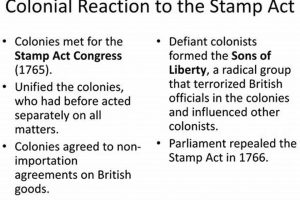
The Stamp Act of 1765 imposed a tax on all printed materials in the American colonies, including newspapers, legal documents, pamphlets, and playing cards. These materials were required to bear an embossed revenue stamp purchased from British authorities, demonstrating proof of payment. This direct taxation, without colonial representation in the British Parliament, ignited widespread resentment and resistance.
This levy represented a significant departure from previous British policies toward colonial taxation. Earlier taxes had primarily focused on regulating trade. The Stamp Act, however, was viewed as an internal tax designed solely to raise revenue for the British Crown. Colonists argued that they should not be subjected to taxation without representation in the body levying the tax a principle encapsulated in the cry, “No taxation without representation!” This became a rallying cry against perceived British tyranny and played a crucial role in the growing discontent that ultimately led to the American Revolution. Understanding this historical context is fundamental to comprehending the escalating tensions between Great Britain and its American colonies.
Exploring the multifaceted colonial response to the Stamp Act unveils a complex tapestry of protests, boycotts, and political maneuvering. These actions encompassed diverse groups and strategies, ranging from organized resistance by prominent figures to grassroots mobilizations that demonstrated the breadth and depth of colonial opposition. Examining these diverse responses provides crucial insight into the evolution of revolutionary sentiment in the American colonies.
Understanding Colonial Opposition to the Stamp Act
Gaining a deeper understanding of the colonial response to the Stamp Act requires examining specific elements of the tax and its impact. The following tips provide focal points for further investigation.
Tip 1: Explore the concept of “virtual representation.” British authorities argued that colonists were virtually represented in Parliament, meaning that members of Parliament represented the interests of all British subjects, including those in the colonies. Investigate why colonists rejected this argument.
Tip 2: Analyze the economic impact of the Stamp Act. The tax affected a wide range of printed materials crucial to colonial commerce and legal activities. Research how this economic burden fueled resentment and resistance.
Tip 3: Examine the role of the Sons of Liberty. This organization played a vital role in mobilizing opposition to the Stamp Act. Research their activities, including protests, boycotts, and dissemination of information.
Tip 4: Investigate the Stamp Act Congress. This gathering of colonial representatives marked a significant step towards unified resistance. Explore the Congress’s declarations and resolutions against the Stamp Act.
Tip 5: Research the impact of colonial boycotts of British goods. These boycotts proved a powerful tool in pressuring British merchants and Parliament. Analyze the effectiveness of these boycotts and their contribution to the eventual repeal of the Stamp Act.
Tip 6: Consider the legal arguments against the Stamp Act. Colonists raised legal challenges based on traditional British rights and principles. Investigate these legal arguments and their influence on the debate surrounding the tax.
Tip 7: Explore the diverse forms of protest. Colonial resistance ranged from peaceful demonstrations to more radical actions. Research the range of protest tactics employed and their impact on British policy.
By exploring these specific aspects, a more comprehensive understanding of the Stamp Act crisis and its significance in the path towards American independence can be achieved.
Understanding the complexities of colonial opposition provides valuable insight into the political and social climate of the era, underscoring the importance of this historical turning point.
1. Taxation without Representation

“Taxation without representation” served as the central rallying cry against the Stamp Act, encapsulating the colonists’ core grievance. The British government insisted on Parliament’s right to tax all British subjects, including colonists, regardless of their lack of representation in that body. Colonists argued that consenting to such taxation would acknowledge Parliament’s absolute authority over them, a precedent they vehemently rejected. This principle resonated deeply within colonial society, as it struck at the heart of their understanding of political rights and self-governance. The Stamp Act became a tangible symbol of this perceived injustice, transforming abstract political theory into a concrete point of contention.
The practical application of “taxation without representation” manifested in various forms of resistance to the Stamp Act. Colonists organized boycotts of British goods, staged protests, and formed groups like the Sons of Liberty to challenge British authority. The Stamp Act Congress, convened in 1765, further solidified colonial opposition by issuing declarations and petitions against the tax. These actions demonstrate the direct link between the principle of representation and the tangible resistance to the Stamp Act. The colonists’ refusal to pay taxes without representation underscored their commitment to self-governance and laid the groundwork for future challenges to British rule, ultimately contributing to the American Revolution.
The legacy of “taxation without representation” extends beyond the Stamp Act crisis. It became a foundational principle of American political thought, emphasizing the importance of citizen participation and consent in governance. The struggle against the Stamp Act and the articulation of this principle contributed significantly to the development of a distinct American identity and the eventual fight for independence. Understanding this connection provides essential context for comprehending the American Revolution and the enduring values of American democracy.
2. Direct Taxation

The Stamp Act of 1765 stands as a pivotal moment in the growing tensions between Great Britain and its American colonies. Central to colonial opposition was the nature of the tax itself: a direct tax. Unlike previous taxes, such as the Sugar Act, which primarily regulated trade, the Stamp Act directly taxed the colonists on internal transactions. This distinction proved crucial in understanding the colonists’ vehement resistance and its contribution to the burgeoning revolutionary sentiment.
- Internal vs. External Taxation
Prior to the Stamp Act, taxes imposed on the colonies were primarily external, focusing on regulating trade and generating revenue for the British Empire. The Stamp Act, however, was an internal tax, levied directly upon the colonists for internal transactions, such as legal documents and newspapers. This difference was perceived as a significant infringement on colonial autonomy, as it represented a direct attempt by Parliament to raise revenue from the colonies without their consent.
- Principle of Self-Governance
The imposition of a direct tax challenged the colonists long-held belief in self-governance. Colonial assemblies had traditionally held the power to levy internal taxes. The Stamp Act circumvented these established practices, directly undermining colonial legislative authority and fueling resentment against British interference in internal colonial affairs.
- Economic Burden
The Stamp Act placed a significant financial burden on colonists. The tax applied to a wide range of everyday items, impacting merchants, printers, lawyers, and ordinary citizens. This widespread economic impact further fueled opposition, uniting diverse segments of colonial society against the tax.
- Precedent for Future Taxation
Colonists feared that accepting the Stamp Act would set a dangerous precedent, opening the door for further direct taxation by Parliament without colonial consent. This concern heightened anxieties about the erosion of colonial autonomy and the potential for future exploitation by the British government.
The colonists’ opposition to direct taxation embodied in the Stamp Act stemmed from a combination of economic, political, and ideological factors. The tax was viewed not merely as a financial burden but as a direct assault on colonial self-governance and a violation of traditional British rights. This resistance marked a critical turning point in the relationship between Great Britain and its American colonies, laying the groundwork for the revolutionary struggle that would follow.
3. Infringement of Colonial Autonomy

The Stamp Act of 1765 ignited fierce resistance in the American colonies, not solely due to its financial burden, but significantly because it represented a perceived infringement on colonial autonomy. Colonists had long enjoyed a degree of self-governance through their elected assemblies, which held the power to levy taxes and manage internal affairs. The Stamp Act, imposed by the British Parliament without colonial consent, directly challenged this established practice and fueled anxieties about the erosion of colonial self-rule.
- Legislative Independence Undermined
Colonial assemblies had historically exercised control over internal taxation. The Stamp Act bypassed these established legislative bodies, asserting Parliament’s authority to tax the colonies directly. This act was viewed as a direct assault on colonial legislative independence and a violation of long-standing tradition. Colonists saw this as a dangerous precedent, fearing further encroachment on their self-governing powers.
- Erosion of Established Practices
For decades, colonists had managed their internal affairs with minimal interference from the British government. The Stamp Act disrupted this established practice, raising concerns about the future of colonial self-governance. This perceived infringement on colonial autonomy fueled resistance as colonists sought to protect their traditional rights and privileges.
- Threat to Local Control
The Stamp Act represented a centralized approach to governance, shifting power away from local colonial assemblies and towards the distant British Parliament. This centralized control was seen as a threat to colonial autonomy, raising concerns about the potential for increased British interference in colonial affairs and the erosion of local control over vital matters.
- Implications for Future Governance
Colonists recognized the broader implications of the Stamp Act, fearing that acquiescence to this tax would embolden Parliament to further encroach on colonial autonomy. This concern about future governance fueled resistance as colonists sought to safeguard their right to self-determination and prevent further erosion of their traditional liberties.
The infringement on colonial autonomy inherent in the Stamp Act served as a powerful catalyst for colonial resistance. It was not merely a tax but a symbol of British overreach and a threat to the colonists’ established way of life. This perceived violation of colonial self-governance fueled the growing discontent that ultimately culminated in the American Revolution, highlighting the pivotal role of autonomy in shaping the course of American history.
4. Economic Burden

The Stamp Act presented a substantial economic burden to colonists, contributing significantly to their opposition. The tax, levied on all printed materials, including legal documents, newspapers, pamphlets, and even playing cards, impacted a broad spectrum of colonial society. Merchants faced increased costs for essential business transactions, printers saw their operations hampered, and lawyers encountered higher expenses for legal proceedings. This widespread economic impact fueled resentment against the British government and fostered a sense of shared grievance among diverse colonial groups.
The economic burden extended beyond the direct cost of the stamps. Colonial merchants, heavily reliant on trade with Britain, faced disruptions due to boycotts of British goods, a key tactic employed by colonists to protest the Stamp Act. These boycotts, while effective in pressuring the British government, also created economic hardship for colonial merchants. The combined impact of the tax itself and the resulting trade disruptions exacerbated the economic strain on the colonies, further solidifying opposition to the Stamp Act and contributing to the growing unrest.
Understanding the economic burden imposed by the Stamp Act is crucial for comprehending the depth of colonial resistance. The tax represented not merely an abstract political grievance but a tangible financial hardship for many colonists. This economic reality fueled the widespread opposition, uniting diverse segments of colonial society in a common cause. The Stamp Act crisis demonstrated the potent role of economic factors in shaping political resistance and underscores the interconnectedness of economic grievances and revolutionary movements.
5. Restriction of Press Freedom
The Stamp Act of 1765, while designed to generate revenue for the British Crown, also had a significant impact on colonial press freedom. By requiring a tax stamp on all printed materials, including newspapers, pamphlets, and legal documents, the Act placed a financial burden on printers and publishers. This economic constraint, coupled with the potential for censorship through selective enforcement of the tax, raised concerns about the suppression of dissenting voices and the restriction of public discourse. The perceived threat to press freedom played a substantial role in galvanizing colonial opposition to the Stamp Act and fueled the broader movement for independence.
- Financial Burden on Printers
The cost of the stamps imposed a significant financial burden on printers, particularly smaller operations and those publishing dissenting opinions. This economic hardship threatened the viability of independent newspapers and pamphlets, essential platforms for expressing diverse viewpoints and challenging British policies. The financial strain imposed by the Stamp Act directly hampered the free flow of information and hindered the ability of the press to serve as a watchdog against government overreach.
- Potential for Censorship
The Stamp Act provided a mechanism for potential censorship through the control and distribution of stamps. British authorities could selectively enforce the tax, targeting publications critical of British policies while favoring those aligned with the Crown. This potential for selective enforcement created a chilling effect on the press, discouraging the publication of dissenting opinions and limiting the free exchange of ideas.
- Suppression of Dissenting Voices
The colonial press played a crucial role in disseminating information and mobilizing opposition to British policies. The Stamp Act, through its financial burden and potential for censorship, threatened to silence dissenting voices and restrict the free flow of information crucial for organizing resistance. This perceived threat to free expression further fueled colonial opposition and solidified the importance of a free press in the fight for liberty.
- Violation of Fundamental Rights
Colonists viewed the Stamp Act’s impact on the press as a violation of fundamental rights. Freedom of expression and access to information were considered essential for a functioning democracy and for holding the government accountable. The Stamp Act’s perceived infringement on these rights resonated deeply within colonial society, further solidifying opposition to the Act and bolstering support for independence.
The Stamp Act’s restriction of press freedom proved to be a significant factor in galvanizing colonial resistance. By threatening the financial viability of the press and creating the potential for censorship, the Act fueled anxieties about the suppression of dissent and the violation of fundamental rights. This perceived attack on free expression became a rallying point for colonists, contributing significantly to the growing movement for independence and highlighting the crucial role of a free press in a democratic society.
6. Violation of British Rights
Central to colonial opposition to the Stamp Act was the conviction that it violated fundamental rights guaranteed to all British subjects. Colonists argued that the tax, imposed without their consent, infringed upon established principles of British common law and tradition. These perceived violations included the right to representation in matters of taxation, the right to trial by jury, and the right to property. Colonists viewed these rights, enshrined in documents like the Magna Carta and English Bill of Rights, as inherent and inviolable, not privileges granted by Parliament. The Stamp Act, by circumventing these established rights, was seen as an act of tyranny and a betrayal of the British constitution.
The argument that the Stamp Act violated British rights resonated powerfully within colonial society. Colonists pointed to historical precedents and legal doctrines to support their claims. The principle of “no taxation without representation” became a rallying cry, encapsulating the belief that Parliament lacked the authority to tax colonists who had no elected representatives in that body. Furthermore, the Stamp Act required those accused of violating the Act to be tried in admiralty courts, denying them the right to a jury trial, a cornerstone of British legal tradition. This denial further inflamed colonial resentment and reinforced the perception that their fundamental rights were being unjustly curtailed.
The colonists’ assertion of their British rights played a crucial role in shaping the response to the Stamp Act. It provided a legal and philosophical framework for resistance, allowing colonists to frame their opposition not as rebellion but as a defense of their inherent rights as British subjects. This emphasis on legal and constitutional principles contributed significantly to the growing movement for greater autonomy and ultimately laid the groundwork for the American Revolution. Understanding this connection between the Stamp Act and the violation of British rights is essential for comprehending the complexities of the era and the events that led to American independence.
Frequently Asked Questions about the Stamp Act
This section addresses common inquiries regarding colonial opposition to the Stamp Act of 1765, providing further insight into this pivotal period in American history.
Question 1: Was the Stamp Act the only tax levied on the colonies by Great Britain?
No. The Stamp Act was not the sole tax imposed on the colonies. Previous taxes, such as the Sugar Act and the Molasses Act, focused primarily on regulating trade. However, the Stamp Act differed significantly as it represented a direct internal tax intended solely to raise revenue, a distinction that fueled colonial resistance.
Question 2: How did colonial assemblies react to the Stamp Act?
Colonial assemblies responded with strong opposition, passing resolutions condemning the tax and asserting their right to self-governance. These resolutions often echoed the principle of “no taxation without representation” and served as a platform for unified resistance.
Question 3: Beyond formal protests, how did ordinary colonists demonstrate their opposition?
Ordinary colonists demonstrated opposition through a variety of actions, including boycotts of British goods, public demonstrations, and acts of defiance against tax collectors. These grassroots efforts played a crucial role in pressuring British authorities.
Question 4: Did all colonists oppose the Stamp Act?
While widespread opposition existed, not all colonists opposed the Stamp Act. Some individuals, often with strong ties to the British government or who benefited from British policies, remained loyal to the Crown and supported the tax. However, the overwhelming majority of colonists viewed the Act as unjust and actively resisted its implementation.
Question 5: Why was the principle of “no taxation without representation” so central to colonial opposition?
The principle of “no taxation without representation” encapsulated the colonists’ belief in self-governance and their right to control their own finances. They argued that being taxed by a Parliament in which they had no elected representatives violated fundamental British principles of representation and consent.
Question 6: What role did the Stamp Act play in the lead-up to the American Revolution?
The Stamp Act served as a catalyst for the American Revolution. It galvanized colonial resistance, united diverse segments of society against British policies, and fueled the growing movement for independence. The crisis over the Stamp Act significantly escalated tensions between Great Britain and the American colonies, laying crucial groundwork for the revolutionary struggle that would follow.
The Stamp Act crisis provides a crucial lens through which to understand the growing divide between Great Britain and its American colonies. The opposition to this tax represented a pivotal moment in the development of American identity and the eventual fight for independence.
Further exploration of primary source documents and historical accounts can provide a deeper understanding of the intricacies of this period and the significance of colonial resistance to the Stamp Act.
Conclusion
Colonial opposition to the Stamp Act stemmed from a confluence of factors, each reflecting deeply held beliefs about governance and individual liberties. The tax, levied without colonial representation in Parliament, was seen as a violation of fundamental rights. Direct taxation, a departure from established British policy, challenged colonial autonomy and threatened local control over financial matters. The economic burden imposed by the tax, combined with the perceived threat to press freedom and established legal rights, fueled widespread resentment and galvanized resistance across colonial society. These grievances, rooted in principles of self-governance, representation, and individual liberty, collectively fueled the opposition that ultimately led to the Act’s repeal.
The legacy of the Stamp Act crisis extends far beyond its immediate impact. The arguments and actions surrounding this pivotal event laid the groundwork for future conflicts between Great Britain and the American colonies. The principles championed by colonistsrepresentation, autonomy, and individual rightsresonate through American history, shaping the nation’s political and social landscape. Understanding the multifaceted reasons behind colonial resistance to the Stamp Act provides crucial insight into the origins of the American Revolution and the enduring principles upon which the United States was founded. Continued exploration of this historical period offers valuable lessons about the importance of civic engagement, the defense of individual liberties, and the ongoing pursuit of a just and equitable society.