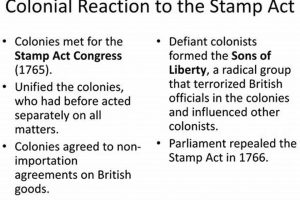
The legislation enacted by the British Parliament in 1765, requiring all printed materials in the American colonies to carry a tax stamp, aimed to raise revenue to offset the costs of stationing British troops in North America following the French and Indian War. Affected items included legal documents, newspapers, pamphlets, playing cards, and even dice. This duty was not a novel concept, as similar taxes existed in Britain. However, its application to the colonies without their consent ignited widespread resentment.
This levy represented a significant shift in British colonial policy. Previously, taxes had primarily focused on regulating trade. This new internal tax directly impacting colonists’ daily lives sparked outrage and contributed to the growing movement for colonial independence. The perceived violation of colonial rights and the lack of representation in Parliament became rallying cries for resistance. The ensuing protests, boycotts, and formation of groups like the Sons of Liberty demonstrated the depth of colonial opposition, laying the groundwork for future conflict. The eventual repeal of the act in 1766, while a victory for the colonists, did little to quell the underlying tensions.
Further exploration of this period can delve into topics such as the colonial arguments against taxation without representation, the economic impact of the boycotts, the role of key figures in the resistance movement, and the long-term consequences leading to the American Revolution.
Understanding the 1765 Stamp Act’s Significance
Gaining a deeper understanding of the 1765 Stamp Act requires exploring its multifaceted implications and the ripple effects it had on the relationship between Great Britain and its American colonies. The following points offer valuable perspectives on this pivotal historical event.
Tip 1: Research the historical context. Examining the political and economic climate preceding the act, including the financial strain on Britain after the French and Indian War, provides crucial background for understanding the motivation behind its implementation.
Tip 2: Analyze the colonial perspective. Understanding the colonists’ arguments regarding taxation without representation and their perception of violated rights illuminates the core issues that fueled their resistance.
Tip 3: Explore the various forms of resistance. From boycotts of British goods to the formation of protest groups like the Sons of Liberty, the diverse methods employed by colonists demonstrate the widespread opposition to the act.
Tip 4: Consider the British perspective. Investigating the rationale behind the act from the British government’s viewpoint, including their perceived need to raise revenue and maintain control over the colonies, offers a more nuanced understanding of the situation.
Tip 5: Investigate the economic impact. The boycotts and disruptions to trade resulting from the act had significant economic consequences for both Britain and the colonies. Exploring these effects reveals the practical implications of the political conflict.
Tip 6: Examine the repeal of the act. Understanding the factors that led to the repeal in 1766, and the subsequent Declaratory Act asserting British authority, helps to contextualize the ongoing tensions between Britain and the colonies.
Tip 7: Connect the Stamp Act to the broader revolution. Recognizing the Stamp Act as a critical precursor to the American Revolution underscores its significance as a catalyst for colonial independence.
By considering these points, one can develop a more comprehensive understanding of the 1765 Stamp Act and its role in shaping the course of American history. Its implications extend beyond mere taxation, revealing fundamental principles of self-governance and the enduring struggle for liberty.
This exploration of the Stamp Act provides a foundation for further investigation into the events that ultimately led to the American Revolution.
1. Repeal

The repeal of the 1765 Stamp Act in 1766 represents a pivotal moment in the escalating tensions between Great Britain and its American colonies. While the act itself lasted just over a year, its impact and subsequent repeal significantly shaped the course of events leading to the American Revolution. Examining the facets of this repeal provides crucial insight into its historical significance.
- Economic Pressure
Colonial boycotts of British goods, coupled with pressure from British merchants suffering significant financial losses, played a substantial role in Parliament’s decision to repeal the Stamp Act. The economic ramifications demonstrated the potential power of colonial resistance.
- Political Considerations
The growing unrest in the colonies and the increasing volume of protests against taxation without representation contributed to the political pressure on the British government. The potential for further escalation and violence likely influenced the decision to repeal.
- Colonial Arguments
The colonists’ articulate arguments against the Stamp Act, centered on principles of self-governance and the right to representation, resonated with some members of Parliament and contributed to the growing sentiment favoring repeal. These arguments laid the groundwork for future revolutionary thought.
- The Declaratory Act
While the repeal signaled a victory for the colonists, the simultaneous passage of the Declaratory Act, asserting Parliament’s right to legislate for the colonies “in all cases whatsoever,” undermined the conciliatory nature of the repeal and sowed the seeds of future conflict. This act highlighted the unresolved issues of colonial autonomy and parliamentary authority.
The repeal of the Stamp Act, while seemingly resolving the immediate crisis, ultimately served to further expose the underlying tensions between Great Britain and the American colonies. The interplay of economic pressure, political maneuvering, colonial arguments, and the assertion of parliamentary authority through the Declaratory Act set the stage for the continued escalation toward revolution.
2. Colonial Victory

The repeal of the 1765 Stamp Act in 1766 constituted a significant colonial victory. This victory, however, must be understood within a complex historical context. While the colonists succeeded in achieving their immediate goal of repealing the act, the underlying tension between Great Britain and the colonies regarding parliamentary authority remained unresolved. The perceived victory fueled colonial confidence and solidified resistance strategies, such as boycotts, which proved effective against British policies. This success contributed to a growing sense of colonial unity and identity, fostering a belief in their collective power to challenge British rule. Examples of colonial celebrations and expressions of triumph following the repeal illustrate the profound impact of this perceived victory on colonial morale. However, the British government’s simultaneous passage of the Declaratory Act, asserting its right to legislate for the colonies “in all cases whatsoever,” significantly tempered the colonial victory. This act underscored the fundamental disagreement over parliamentary sovereignty and foreshadowed future conflicts.
The colonial victory surrounding the Stamp Act repeal can be viewed as a double-edged sword. While it emboldened the colonists and demonstrated the potential effectiveness of organized resistance, it also hardened British resolve to maintain control. This dynamic contributed to the escalating cycle of resistance and repression that ultimately led to the American Revolution. The events of 1766, therefore, represent not a conclusive resolution, but a crucial turning point in the relationship between Great Britain and the American colonies. The repeal itself offered a temporary reprieve, but the underlying conflict remained, further fueled by the colonists’ taste of victory and the British government’s assertion of its ultimate authority. This period illustrates the complexities of historical interpretation, where a perceived victory can simultaneously contribute to both short-term gains and the escalation of underlying tensions.
Understanding the nuances of the “colonial victory” associated with the 1766 Stamp Act repeal offers critical insights into the dynamics that propelled the colonies toward revolution. It highlights the interplay of successful resistance strategies, evolving colonial identity, and the persistent challenge of unresolved political disagreements. Analyzing this period requires acknowledging both the symbolic importance of the repeal and its limitations in addressing the fundamental issues that ultimately led to the American Revolutionary War. This understanding provides a more nuanced perspective on the complexities of the era and the multifaceted factors that shaped the course of American history.
3. Declaratory Act

The Declaratory Act, passed by the British Parliament in 1766, is inextricably linked to the repeal of the 1765 Stamp Act. While the repeal represented a concession to colonial demands, the Declaratory Act served as a forceful assertion of Parliament’s ultimate authority over the American colonies. Understanding the connection between these two acts is crucial for comprehending the escalating tensions that led to the American Revolution.
- Assertion of Parliamentary Supremacy
The Declaratory Act explicitly stated Parliament’s right to legislate for the colonies “in all cases whatsoever.” This broad claim of authority directly countered colonial arguments against taxation without representation and aimed to reassert British control following the Stamp Act crisis. This assertion set the stage for future conflicts over colonial autonomy and parliamentary power.
- Undermining the Repeal’s Impact
By passing the Declaratory Act alongside the Stamp Act’s repeal, the British government sought to diminish the perceived colonial victory. While acknowledging the economic and political pressures necessitating the repeal, the Declaratory Act aimed to prevent the colonists from interpreting the repeal as a sign of British weakness or a relinquishment of control.
- Constitutional Principles
The Declaratory Act raised fundamental questions about the nature of the British constitution and the relationship between the colonies and Parliament. The colonists argued that their rights as Englishmen included representation in Parliament, a principle seemingly contradicted by the Declaratory Act’s sweeping assertion of parliamentary power. This clash of constitutional interpretations further fueled the growing divide between Britain and the colonies.
- Foreshadowing Future Conflict
The Declaratory Act’s assertion of parliamentary supremacy, coupled with the continued colonial resistance to external authority, laid the groundwork for future confrontations. The act did not resolve the underlying tensions but rather solidified opposing viewpoints, creating a volatile political climate that ultimately contributed to the outbreak of the American Revolution. It signaled that the fundamental disagreements regarding representation and governance remained unresolved.
The relationship between the Declaratory Act and the 1766 Stamp Act repeal reveals a critical turning point in British-American relations. The repeal, while addressing the immediate crisis, was significantly undermined by the Declaratory Act’s assertion of parliamentary power. This combination of concession and control ultimately failed to resolve the underlying tensions and instead contributed to the escalating conflict that culminated in the American Revolution. The Declaratory Act, intended to clarify parliamentary authority, ultimately served to exacerbate existing tensions and foreshadow the inevitable break between Great Britain and its American colonies.
4. Lingering Resentment

The 1766 repeal of the Stamp Act, while celebrated as a colonial victory, failed to fully quell underlying tensions. The accompanying Declaratory Act, asserting Parliament’s absolute authority over the colonies, fostered lingering resentment among colonists. This resentment stemmed from the perceived disregard for colonial autonomy and the principle of “no taxation without representation.” While the immediate financial burden of the Stamp Act was removed, the Declaratory Act cemented the ideological divide between the colonies and Great Britain. This act, seen as a threat to colonial self-governance, became a source of continuous friction. Colonists viewed it as a warning that Parliament could impose further taxes at any time, creating an atmosphere of distrust and apprehension. This lingering resentment fueled ongoing resistance efforts and contributed to a growing sense of colonial identity separate from British rule. Instances of continued protests, boycotts, and pamphlets criticizing British policies illustrate the sustained opposition despite the Stamp Act’s repeal. These actions demonstrate that the resentment persisted not solely due to the tax itself, but rather because of the broader implications for colonial self-determination.
The practical significance of understanding this lingering resentment lies in its direct link to the eventual outbreak of the American Revolution. The Stamp Act crisis, while seemingly resolved by the repeal, served as a catalyst for the growing revolutionary movement. The resentment fueled by the Declaratory Act ensured that the underlying issues of representation and autonomy remained at the forefront of colonial discourse. This sustained opposition created a climate ripe for further conflict, demonstrating that the repeal was a temporary reprieve rather than a true resolution. The unresolved tension created by the Declaratory Act’s assertion of parliamentary authority laid the groundwork for future clashes, such as the Townshend Acts, further escalating the conflict and solidifying colonial resolve. Understanding this lingering resentment offers critical insights into the trajectory of events leading to the American Revolution, highlighting the significance of ideological principles in shaping historical outcomes.
In summary, the lingering resentment stemming from the Declaratory Act, passed alongside the Stamp Act’s repeal, played a pivotal role in the escalation towards the American Revolution. While the repeal addressed the immediate economic grievance, the Declaratory Act’s assertion of parliamentary supremacy fueled ongoing opposition and solidified colonial resistance. This resentment became a driving force behind future conflicts, demonstrating the enduring power of ideological principles and the limitations of short-term political solutions in addressing fundamental disagreements. Understanding this historical context offers crucial insights into the complex dynamics that shaped the relationship between Great Britain and the American colonies, ultimately leading to the fight for independence.
5. Revolutionary Foreshadowing
The 1766 repeal of the Stamp Act, coupled with the passage of the Declaratory Act, holds significant weight as a foreshadowing element of the American Revolution. While the repeal offered a temporary reprieve from the immediate tax burden, the Declaratory Act’s assertion of Parliament’s absolute authority over the colonies ignited a spark that would eventually ignite the flames of revolution. This seemingly contradictory legislative approachconceding to colonial demands while simultaneously asserting ultimate controlcreated a volatile political climate. The repeal demonstrated the potential effectiveness of colonial resistance, emboldening future actions. Simultaneously, the Declaratory Act fueled resentment and solidified colonial opposition to British rule, hardening ideological stances on both sides. This dynamic created an environment ripe for escalating conflict.
The colonial reaction to the Declaratory Act provides concrete evidence of its role in foreshadowing the revolution. Widespread protests, pamphlets criticizing British policies, and continued boycotts illustrate sustained colonial resistance despite the Stamp Act’s repeal. These actions demonstrate that the core issue was not solely the tax itself, but the broader principle of self-governance and representation. The Declaratory Act’s direct challenge to this principle became a rallying cry for colonial leaders, further solidifying the ideological divide and laying the groundwork for future revolutionary action. The Sons of Liberty, for instance, continued their activism, focusing on the Declaratory Act as a symbol of British oppression. This sustained resistance, fueled by the Declaratory Act, contributed to the growing revolutionary sentiment and the eventual break from British rule. The Stamp Act crisis, therefore, served as a crucial training ground for future revolutionary leaders and solidified intercolonial communication networks, essential components for organizing the resistance movement that would culminate in the American Revolution.
Understanding the 1766 Stamp Act and Declaratory Act as foreshadowing the American Revolution provides critical insights into the complex dynamics that led to the conflict. The events of 1766 were not merely a political compromise, but a pivotal turning point that exposed and exacerbated fundamental disagreements regarding colonial autonomy and parliamentary authority. The repeal and the Declaratory Act, taken together, represent a microcosm of the broader issues that ultimately led to the revolution. Recognizing this connection allows for a deeper understanding of the escalating tensions, the role of ideology in shaping historical events, and the multifaceted factors that propelled the American colonies toward independence. The seemingly small spark ignited in 1766, through the combination of repeal and assertion of power, ultimately grew into the inferno of revolution, underscoring the importance of recognizing these early warning signs in understanding historical trajectories. The Stamp Act episode served as a crucial dress rehearsal, preparing both sidesGreat Britain and the coloniesfor the inevitable confrontation that would redefine their relationship forever.
Frequently Asked Questions
The following addresses common inquiries regarding the 1765 Stamp Act and its historical context. Understanding these points provides further insight into this pivotal period leading up to the American Revolution.
Question 1: Why was the Stamp Act implemented?
The British government faced substantial financial burdens following the French and Indian War. The Stamp Act aimed to raise revenue from the American colonies to offset these costs, specifically to fund the continued presence of British troops in North America. This marked a departure from previous colonial taxation, which primarily focused on regulating trade rather than directly taxing the colonists.
Question 2: How did the colonists react to the Stamp Act?
The Stamp Act sparked widespread outrage and resistance throughout the American colonies. Colonists viewed the act as a violation of their rights as Englishmen, particularly the principle of “no taxation without representation” since they lacked direct representation in the British Parliament. This resistance manifested in various forms, including boycotts of British goods, protests, and the formation of groups like the Sons of Liberty.
Question 3: What arguments did the colonists use against the Stamp Act?
Central to the colonial arguments was the principle of representation in government. Colonists asserted that, as Englishmen, they could not be taxed by a Parliament in which they had no elected representatives. This argument became a cornerstone of the growing movement for colonial independence and resonated with broader philosophical discussions about self-governance and liberty.
Question 4: Why was the Stamp Act repealed?
Several factors contributed to the Stamp Act’s repeal in 1766. Colonial boycotts significantly impacted British merchants, leading to economic pressure on Parliament. Furthermore, growing unrest and potential for further escalation in the colonies influenced the political decision to repeal the act. While the repeal addressed the immediate economic grievance, the simultaneous passage of the Declaratory Act asserting Parliament’s authority undermined the conciliatory gesture and fueled lingering resentment.
Question 5: What was the significance of the Declaratory Act?
Passed alongside the Stamp Act’s repeal, the Declaratory Act asserted Parliament’s right to legislate for the colonies “in all cases whatsoever.” This act aimed to reinforce British authority and prevent the colonists from interpreting the repeal as a sign of weakness. However, it also fueled colonial resentment by contradicting their claims to self-governance and foreshadowing future conflicts over parliamentary power.
Question 6: How did the Stamp Act crisis contribute to the American Revolution?
The Stamp Act crisis served as a pivotal turning point in the relationship between Great Britain and the American colonies. It solidified colonial resistance strategies, such as boycotts, and fostered a growing sense of colonial unity and identity. The underlying issues of representation and autonomy remained unresolved, contributing to the escalating tensions that ultimately led to the American Revolution. The crisis acted as a catalyst, demonstrating the potential for organized resistance and highlighting the irreconcilable differences between colonial aspirations for self-governance and British assertions of parliamentary authority.
The Stamp Act’s legacy extends beyond its brief existence. It offers crucial insights into the principles that fueled the American Revolution and the complexities of British colonial policy. Understanding this historical context provides valuable perspective on the events that shaped the course of American history.
This exploration of frequently asked questions about the Stamp Act provides a solid foundation for further research into the events and ideologies that shaped the American Revolution.
The Legacy of the 1765 Stamp Act’s Repeal
Examination of the 1765 Stamp Act’s 1766 repeal reveals a pivotal moment in the escalating tensions between Great Britain and the American colonies. While representing a colonial victory against perceived unjust taxation, the repeal’s complexities, particularly the accompanying Declaratory Act, solidified underlying resentment and foreshadowed the inevitable revolution. This period underscores the interplay of legislative action, colonial resistance, and unresolved issues of representation and autonomy, ultimately shaping the trajectory towards the American Revolutionary War. The repeal, rather than resolving the fundamental conflict, served as a catalyst, exposing the deep-seated ideological divide and contributing to the growing momentum for independence.
The legacy of the 1765 Stamp Act and its 1766 repeal serves as a potent reminder of the enduring power of principles like self-governance and representation. This historical episode encourages further reflection on the delicate balance between governmental authority and individual liberties, offering valuable insights applicable to contemporary political discourse. The events of 1765 and 1766 underscore the importance of understanding historical context, recognizing the complexities of seemingly simple legislative actions, and acknowledging the potential for unintended consequences that can reshape the course of nations.