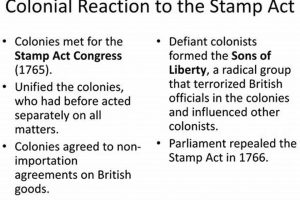
The Stamp Act of 1765 required all printed materials in the American colonies, including legal documents, newspapers, pamphlets, and playing cards, to carry a tax stamp purchased from British authorities. This act aimed to raise revenue to support the British military presence in the colonies following the French and Indian War. Colonists viewed the tax as an infringement on their rights as British subjects, arguing they were being taxed without representation in Parliament. Their protests ranged from boycotts of British goods to acts of civil disobedience, culminating in the famous cry, “No taxation without representation.” This act serves as a prime example of the growing tensions between Great Britain and its American colonies.
The controversy surrounding the acts legitimacy fueled the flames of colonial resistance. It significantly contributed to the development of a unified colonial identity and served as a catalyst for the escalating conflict that ultimately led to the American Revolution. Understanding the arguments for and against the acts fairness offers valuable insights into the political, economic, and social climate of the era. It highlights the core principles underlying the colonists’ fight for self-governance and the fundamental concepts that shaped the foundation of the United States.
Examining this historical debate requires exploring several key areas. These include the financial burdens placed upon the colonies by the British Empire, the philosophical arguments for and against taxation without representation, and the various forms of resistance employed by the colonists. By analyzing these facets, a more comprehensive understanding of the era and its implications can be achieved.
Tips for Analyzing the Justification of the Stamp Act
Evaluating the Stamp Act requires careful consideration of multiple perspectives and historical context. The following tips offer guidance for a thorough analysis:
Tip 1: Consider the British Perspective. Examine the financial pressures facing the British Empire after the French and Indian War. Explore the rationale behind imposing taxes on the colonies and the perceived need for increased revenue to maintain military presence and administrative control.
Tip 2: Understand Colonial Grievances. Analyze the colonists’ arguments against taxation without representation. Research the development of colonial political thought and the influence of Enlightenment ideals on their concepts of liberty and self-governance.
Tip 3: Explore Economic Impacts. Investigate the economic consequences of the Stamp Act on different colonial groups, such as merchants, printers, and ordinary citizens. Assess the role of boycotts and other forms of economic resistance in shaping colonial responses.
Tip 4: Analyze Legal and Constitutional Arguments. Examine the legal basis of the Stamp Act from both the British and colonial perspectives. Consider how arguments about parliamentary sovereignty and colonial charters shaped the debate.
Tip 5: Study the Role of Propaganda. Investigate how pamphlets, newspapers, and other forms of media were used to influence public opinion on both sides of the Atlantic. Analyze the rhetoric employed and the effectiveness of these propaganda efforts.
Tip 6: Consider Long-Term Consequences. Explore how the Stamp Act contributed to the growing tensions between Great Britain and the colonies. Analyze its role as a catalyst for future acts of resistance and its contribution to the eventual outbreak of the American Revolution.
By considering these factors, one can develop a comprehensive understanding of the complexities surrounding the Stamp Act and its historical significance. This multifaceted approach enables a nuanced evaluation of the act’s justification and its impact on the course of American history.
Through careful examination and critical analysis, the historical debate surrounding the Stamp Act continues to offer valuable insights into the principles of representative government and the origins of the American nation.
1. Revenue Generation

Revenue generation formed the core rationale behind the Stamp Act. The British Empire, facing significant financial strain after the French and Indian War, sought to defray the costs of maintaining a military presence in the American colonies. The act, designed to directly tax the colonists, aimed to contribute to these expenses. This financial burden imposed upon the colonies, however, became a major point of contention. While the British government viewed this as a necessary measure for imperial defense, the colonists perceived it as an unjust levy, particularly given their lack of direct representation in the British Parliament. This difference in perspective ignited debates over the act’s justification.
The act’s implementation resulted in widespread resistance, highlighting the practical significance of understanding the revenue aspect. Colonists argued that contributing financially to the empire without having a voice in parliamentary decisions violated their rights as British subjects. Boycotts, protests, and the rallying cry of “No taxation without representation” demonstrated the depth of colonial opposition to the revenue-generating measure. The revenue generated by the Stamp Act, though arguably necessary from the British perspective, proved insufficient to offset the growing discontent and ultimately contributed to the escalating tensions between the colonies and the mother country.
The Stamp Act’s focus on revenue generation underscores the complex relationship between financial burdens, political representation, and colonial governance. The acts failure to achieve its financial goals while simultaneously provoking widespread colonial resistance reveals the challenges inherent in imposing taxes without considering the broader political and social context. Examining the revenue aspect of the Stamp Act offers critical insight into the factors that propelled the colonies toward revolution.
2. Colonial Representation

The concept of colonial representation played a pivotal role in the debate surrounding the Stamp Act’s justification. The act, imposed by the British Parliament, levied taxes on the American colonies without granting them direct representation in the legislative body enacting the tax. This absence of colonial voices within the British government fueled resentment and became a central argument against the act’s legitimacy. The colonists contended that being subjected to taxation without representation violated fundamental rights enjoyed by British subjects residing in Great Britain.
- Virtual Representation:
The British government maintained that the colonists were “virtually” represented in Parliament, meaning that members of Parliament represented the interests of all British subjects, regardless of their location. However, colonists argued that only direct representation, with elected colonial representatives voting on legislation directly affecting them, could adequately protect their interests. This divergence in understanding representation became a key point of contention, highlighting the differing political philosophies between the colonies and the mother country.
- “No Taxation Without Representation”:
This slogan became the rallying cry of colonial resistance against the Stamp Act. It encapsulated the colonists’ core grievance: the imposition of taxes without their consent, given through elected representatives. The phrase underscored the perceived injustice of the act and galvanized colonial opposition. This powerful articulation of colonial discontent resonated throughout the colonies and became a symbol of their struggle for greater autonomy.
- Development of Colonial Assemblies:
Colonial assemblies, while existing prior to the Stamp Act, gained greater prominence as a result of the controversy. These assemblies, representing local interests within each colony, provided a platform for colonists to voice their opposition to the act. The assemblies’ role in organizing resistance and coordinating boycotts further strengthened their political influence and contributed to the development of a stronger sense of colonial identity.
- Influence of Enlightenment Ideals:
Enlightenment thinkers, such as John Locke, emphasized the importance of individual rights and government by consent. These ideas resonated deeply within the colonies and provided intellectual justification for their resistance to the Stamp Act. The concept of natural rights, including the right to property and self-governance, fueled colonial arguments against taxation without representation and contributed to the growing movement toward independence.
The debate over colonial representation reveals the fundamental ideological differences that fueled the growing divide between Great Britain and its American colonies. The Stamp Act, by highlighting the issue of taxation without representation, served as a catalyst for colonial resistance and ultimately contributed to the outbreak of the American Revolution. The lack of colonial representation underscored the perceived injustice of the act, galvanized colonial opposition, and played a crucial role in shaping the political landscape that led to American independence.
3. Economic Impact

The Stamp Act’s economic impact significantly influenced the debate surrounding its justification. The act, by imposing a tax on printed materials, directly affected colonial merchants, printers, lawyers, and newspaper publishers. This broad economic burden fueled resentment and contributed to widespread opposition. The act’s perceived negative economic consequences became a key argument against its justification, particularly in the context of existing mercantilist policies that already restricted colonial trade. The act exacerbated economic hardships within the colonies, further fueling the flames of discontent. For example, merchants faced increased costs for shipping documents, while printers saw a decline in business due to the added expense of stamped paper. These direct economic consequences fostered a sense of injustice and contributed to the growing movement for colonial resistance.
The economic repercussions extended beyond individual businesses and impacted the colonial economy as a whole. The boycotts organized in response to the Stamp Act, while demonstrating colonial unity and resolve, also disrupted transatlantic trade and negatively impacted both colonial and British merchants. This economic disruption underscored the interconnectedness of the colonial and British economies and highlighted the potential for colonial resistance to have far-reaching economic consequences. The boycotts, though effective in demonstrating colonial opposition, also served as an early indicator of the potential economic instability that could arise from escalating tensions between the colonies and Great Britain. This economic instability further contributed to the debate surrounding the act’s justification, with some arguing that the economic damage caused by the act outweighed any potential revenue benefits.
The Stamp Act’s economic impact provides crucial insight into the complexities of the relationship between Great Britain and its American colonies. The act’s negative economic consequences, coupled with the lack of colonial representation in Parliament, fueled widespread resistance and contributed to the growing movement for greater colonial autonomy. The economic hardship experienced by colonists as a result of the act served as a powerful catalyst for change, highlighting the practical significance of understanding the economic dimensions of the debate surrounding the act’s justification. This understanding underscores the interconnectedness of economic grievances and political ideals in the lead-up to the American Revolution.
4. British Perspective
Understanding the British perspective is crucial for analyzing the justifications surrounding the Stamp Act. The British government’s rationale stemmed from a combination of financial pressures, evolving imperial policies, and perceived colonial obligations. Examining these factors provides essential context for evaluating the act’s perceived legitimacy within the British political and economic landscape.
- Financial Burden of Empire:
The British Empire faced substantial financial burdens following the French and Indian War. Protecting and administering the expanded colonial territories required increased revenue. The British government viewed the colonies as beneficiaries of this protection and, therefore, obligated to contribute financially. The Stamp Act represented an attempt to distribute the costs of imperial defense more equitably, from the British perspective. This perspective, however, failed to account for the colonists’ lack of direct representation in Parliament and their growing desire for greater autonomy.
- Mercantilist Policies:
The prevailing economic theory of mercantilism shaped British imperial policy. Mercantilism emphasized maximizing national wealth through trade and colonial exploitation. The colonies were seen as sources of raw materials and markets for British goods. The Stamp Act, within this framework, represented a means of regulating colonial trade and generating revenue for the benefit of the mother country. This perspective prioritized the economic interests of Great Britain over the economic well-being of the colonies, further exacerbating tensions.
- Parliamentary Sovereignty:
The British government upheld the principle of parliamentary sovereignty, asserting Parliament’s ultimate authority over all British subjects, including colonists. From this perspective, Parliament had the legitimate right to levy taxes on the colonies regardless of their lack of direct representation. This principle clashed directly with the colonists’ evolving understanding of self-governance and their belief in the right to representation in matters of taxation. This fundamental disagreement over political authority became a central point of contention in the escalating conflict.
- Colonial Dependence:
The British government viewed the colonies as dependent entities requiring guidance and control from the mother country. This paternalistic view shaped their perception of colonial obligations and justified, in their eyes, the imposition of taxes without direct representation. The British government believed that it acted in the best interests of the colonies, even if the colonists themselves disagreed. This perception of colonial dependence fueled resentment and further solidified colonial desires for greater autonomy and self-determination.
Examining these facets of the British perspective reveals the complex interplay of financial, political, and ideological factors that shaped their justification for the Stamp Act. While the British government viewed the act as a necessary measure for maintaining imperial stability and generating needed revenue, the colonists perceived it as an infringement upon their rights and a symbol of unjust governance. This fundamental disconnect in perspective fueled the escalating tensions that ultimately led to the American Revolution. Understanding the British perspective, therefore, is essential for a comprehensive analysis of the Stamp Act’s justification and its historical significance.
5. Colonial Resistance

Colonial resistance played a pivotal role in shaping the historical narrative surrounding the Stamp Act’s justification. Resistance to the act stemmed from a confluence of factors, including economic grievances, philosophical objections to taxation without representation, and concerns about encroaching imperial control. These factors coalesced to create a powerful movement that challenged the legitimacy of the act and ultimately contributed to its repeal. Understanding colonial resistance provides essential context for evaluating the act’s justification and its broader historical significance.
Forms of resistance varied, ranging from organized boycotts of British goods to acts of civil disobedience and public demonstrations. The Sons of Liberty, a prominent colonial organization, played a key role in mobilizing popular opposition to the act. Their activities, including protests, pamphlet distribution, and intimidation of tax collectors, effectively disrupted the act’s implementation and exerted pressure on British authorities. These acts of resistance demonstrated the colonists’ resolve and their willingness to challenge British authority. Real-life examples, such as the Stamp Act Congress, illustrate the colonists’ organized and unified approach to challenging the act’s legitimacy. The Congress, comprised of representatives from nine colonies, issued declarations and petitions outlining their objections to taxation without representation, demonstrating a collective and coordinated effort to resist British policies.
The practical significance of understanding colonial resistance lies in its demonstration of the power of collective action and its contribution to the development of a distinct American identity. Colonial resistance to the Stamp Act laid the groundwork for future acts of resistance and contributed significantly to the growing movement for independence. By challenging the act’s justification, colonists asserted their rights as British subjects and articulated core principles of self-governance that would later shape the foundation of the United States. The legacy of colonial resistance underscores the importance of civic engagement and the power of collective action in challenging unjust laws and shaping the course of history. It served as a crucial turning point in the relationship between Great Britain and its American colonies, ultimately contributing to the outbreak of the American Revolution.
Frequently Asked Questions about the Stamp Act’s Justification
This section addresses common inquiries regarding the historical debate surrounding the Stamp Act’s justification. Examining these questions offers further insight into the complexities of this pivotal period in colonial American history.
Question 1: Why did the British government believe they were justified in imposing the Stamp Act?
The British government considered the act a necessary measure to raise revenue for defense following the French and Indian War. They believed the colonies, as beneficiaries of British military protection, should contribute financially to the empire’s expenses. This perspective stemmed from the prevailing principles of mercantilism and parliamentary sovereignty.
Question 2: How did the colonists justify their resistance to the Stamp Act?
Colonists argued that taxation without representation in Parliament violated their rights as British subjects. They emphasized that only elected representatives, chosen by the colonists themselves, could legitimately impose taxes. This principle, encapsulated in the slogan “No taxation without representation,” became a cornerstone of colonial resistance.
Question 3: Did the Stamp Act generate significant revenue for the British Empire?
The Stamp Act generated some revenue, but widespread colonial resistance, including boycotts and protests, significantly limited its effectiveness. The economic disruption caused by the boycotts arguably outweighed the financial gains from the tax, contributing to the act’s eventual repeal.
Question 4: What role did the Stamp Act play in the escalating tensions between Great Britain and the colonies?
The Stamp Act served as a major catalyst for escalating tensions. It crystallized colonial grievances regarding taxation without representation and fueled growing resentment towards British rule. The act’s implementation and the subsequent colonial resistance marked a significant turning point in the relationship between Great Britain and the American colonies, pushing them closer to revolution.
Question 5: Were there any legal arguments against the Stamp Act from the colonial perspective?
Colonists argued that the Stamp Act violated their traditional rights as Englishmen and contradicted established colonial charters guaranteeing certain liberties. They also questioned the authority of Parliament to tax them without direct representation, raising fundamental constitutional questions about the nature of imperial governance.
Question 6: What alternatives to the Stamp Act could have been considered by the British government?
Alternatives could have included negotiating with colonial assemblies for voluntary contributions, exploring other forms of taxation with greater colonial input, or granting the colonies greater representation in Parliament. These alternative approaches might have mitigated colonial resistance and potentially averted the escalating conflict.
Examining the multifaceted perspectives surrounding the Stamp Act reveals the complexities of balancing imperial authority with colonial autonomy. The act’s ultimate failure underscores the importance of considering diverse viewpoints and the potential consequences of imposing policies without sufficient consensus.
Further exploration of related topics, such as the Townshend Acts and the Intolerable Acts, can provide a more comprehensive understanding of the events leading to the American Revolution.
Conclusion
The question of whether the Stamp Act was justified remains a complex and contested historical debate. Analysis reveals the multifaceted nature of the issue, encompassing financial pressures on the British Empire, evolving colonial political thought, and the economic consequences of the act. British justifications centered on the perceived need for colonial financial contributions to imperial defense and the principle of parliamentary sovereignty. However, colonial resistance, rooted in the cry of “No taxation without representation,” highlighted fundamental disagreements over political representation and the right to self-governance. The act’s economic impact, including widespread boycotts and trade disruptions, further complicated the debate and contributed to the act’s eventual repeal.
The Stamp Act’s legacy extends far beyond its short-lived implementation. The act serves as a crucial case study in the dynamics of imperial power, colonial resistance, and the evolution of revolutionary ideals. Exploration of this historical debate provides valuable insights into the factors that propelled the American colonies toward independence and shaped the foundational principles of the United States. Continued scholarly inquiry and critical analysis of the Stamp Act remain essential for understanding this pivotal period in American history and its enduring relevance to contemporary discussions of governance, representation, and the pursuit of liberty.