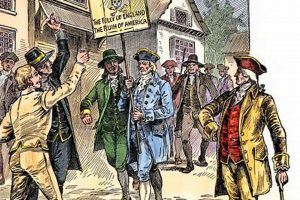
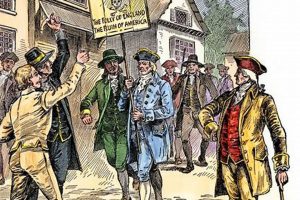
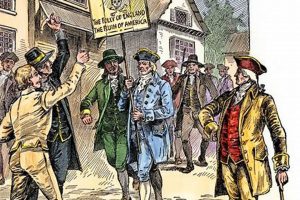
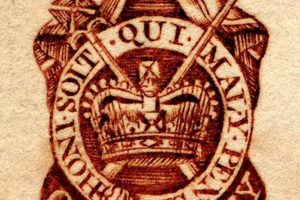
The Stamp Act of 1765 imposed a tax on all printed materials in the American colonies, including legal documents, newspapers, pamphlets, and even playing cards. Colonists were required to purchase and affix stamps to these items, certifying payment of the tax. This direct taxation by the British Parliament, without colonial representation, sparked widespread outrage and resistance in the colonies.
Colonial resentment stemmed from the perceived violation of their rights as Englishmen, particularly the principle of “no taxation without representation.” The economic burden of the tax further fueled discontent, contributing to boycotts of British goods, protests, and the formation of groups like the Sons of Liberty. This resistance significantly disrupted transatlantic trade and put pressure on British merchants and manufacturers who, in turn, lobbied Parliament for a change in policy. The Act’s repeal demonstrated the power of colonial resistance and became a key turning point in the events leading up to the American Revolution. It underscored the growing tensions between Great Britain and its American colonies and the colonists’ increasing desire for self-governance.
Further exploration of this period reveals the complex interplay of economic, political, and social factors that shaped the relationship between Great Britain and the American colonies. Understanding the motivations behind the Stamp Act, the colonial response, and the ultimate decision to repeal it provides valuable insight into the origins of the American Revolution.
Tips for Understanding the Stamp Act’s Repeal
Gaining a deeper understanding of the Stamp Act’s repeal requires examining various perspectives and historical contexts. The following tips offer guidance for a more comprehensive analysis.
Tip 1: Consider the economic impact. Analyze the disruption to transatlantic trade caused by colonial boycotts of British goods. Explore how this economic pressure influenced British merchants and manufacturers to lobby for repeal.
Tip 2: Explore the philosophical arguments. Investigate the colonists’ arguments against taxation without representation. Research how Enlightenment ideals influenced colonial thought and fueled resistance to British policies.
Tip 3: Examine the role of colonial resistance. Research the activities of groups like the Sons of Liberty and their impact on public opinion. Analyze how different forms of protest contributed to the growing unrest in the colonies.
Tip 4: Study the British political landscape. Research the debates and discussions within the British Parliament regarding colonial policy. Understand the various viewpoints and pressures that influenced the decision to repeal the Act.
Tip 5: Analyze the long-term consequences. Consider how the repeal of the Stamp Act shaped the relationship between Great Britain and the American colonies. Explore how this event contributed to the growing movement towards independence.
Tip 6: Compare and contrast with other Acts. Study other British legislation, such as the Townshend Acts, to understand the broader context of British colonial policy. Compare and contrast the colonial responses to these different acts.
By considering these various perspectives, one can develop a more nuanced understanding of the factors that led to the repeal of the Stamp Act and its significance in the broader narrative of American history.
This exploration provides a foundation for understanding the complex events that shaped the American Revolution.
1. Colonial Resistance
Colonial resistance played a pivotal role in the repeal of the Stamp Act. Understanding the diverse forms of resistance employed by colonists is crucial for comprehending the Act’s ultimate demise and its broader significance in the escalating tensions between Great Britain and the American colonies. This resistance encompassed a range of actions, each contributing to the pressure on Parliament to reconsider its policy.
- Boycotts of British Goods
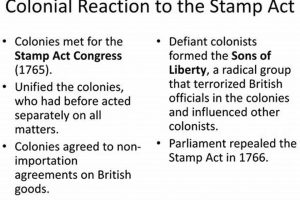
Colonists organized widespread boycotts of British goods, significantly impacting transatlantic trade. These boycotts, coordinated through non-importation agreements, targeted British merchants and manufacturers, applying economic pressure to influence policy change in London. The economic repercussions demonstrated the colonists’ collective power and determination to resist the Stamp Act.
- Formation of Protest Groups
Groups like the Sons of Liberty emerged as organized forces of resistance. These groups mobilized public opinion against the Stamp Act, often employing public demonstrations, intimidation tactics, and acts of defiance to challenge British authority and exert pressure on colonial officials charged with enforcing the Act.
- Legal Challenges and Petitions
Colonists challenged the legality of the Stamp Act through legal channels and formal petitions. Colonial assemblies passed resolutions asserting their rights and protesting the tax. Petitions sent to the King and Parliament articulated colonial grievances and arguments against taxation without representation, contributing to the broader political debate surrounding the Act.
- Pamphlets and Propaganda
The dissemination of pamphlets and other forms of propaganda played a critical role in shaping public opinion and galvanizing resistance. Writers and intellectuals articulated arguments against the Stamp Act, emphasizing principles of self-governance and highlighting the perceived injustices of British policies. These publications helped foster a sense of shared identity and purpose among colonists.
These multifaceted forms of colonial resistance collectively contributed to the pressure on the British government to repeal the Stamp Act. The economic disruption caused by boycotts, combined with the growing unrest in the colonies and the persuasive arguments against taxation without representation, ultimately proved decisive in Parliament’s decision. The success of colonial resistance in achieving the repeal foreshadowed future conflicts and set the stage for the American Revolution.
2. Economic Pressure
Economic pressure played a crucial role in the repeal of the Stamp Act. The colonial boycotts of British goods created significant financial hardship for British merchants and manufacturers, who in turn exerted pressure on Parliament to reconsider the Act. Understanding the mechanisms of this economic pressure is essential for grasping the dynamics that led to the Act’s repeal.
- Declining Trade Volumes
The colonial boycotts led to a sharp decline in the volume of goods exported from Britain to the American colonies. This reduction in trade volume translated directly into lost revenue for British merchants and manufacturers, creating a powerful incentive for them to seek a resolution to the impasse.
- Warehousing Costs and Inventory Buildup
With colonial ports effectively closed to British goods, merchants faced increasing warehousing costs in Britain. Unsold inventory accumulated, tying up capital and further exacerbating the financial strain caused by the boycotts. This economic burden fueled their desire for a swift repeal of the Stamp Act.
- Pressure on British Manufacturers
The decline in demand for British goods had a ripple effect throughout the British manufacturing sector. Reduced production led to layoffs and economic hardship for workers, adding another layer of pressure on Parliament to address the colonial crisis. The potential for social unrest in Britain itself became a factor in the political calculus.
- Lobbying Efforts by Merchants and Manufacturers
Facing significant financial losses, British merchants and manufacturers organized lobbying efforts to influence Parliament. They petitioned for the repeal of the Stamp Act, arguing that the economic damage caused by the colonial boycotts outweighed the potential revenue gains from the tax. Their collective voice proved influential in the political debate surrounding the Act.
The economic pressure generated by the colonial boycotts proved to be a decisive factor in the repeal of the Stamp Act. The financial losses suffered by British merchants and manufacturers, combined with the broader economic consequences for the British economy, created a compelling case for repeal. This episode underscored the power of collective economic action as a tool for political change and foreshadowed the escalating tensions that would ultimately lead to the American Revolution.
3. Boycotts
Boycotts played a central role in the repeal of the Stamp Act. By refusing to purchase British goods, colonists exerted significant economic pressure on British merchants and manufacturers, ultimately influencing the political decision to repeal the Act. Examining the specific facets of these boycotts reveals their effectiveness and importance in the broader context of growing colonial resistance.
- Non-Importation Agreements
Colonists organized formal non-importation agreements, pledging to abstain from purchasing British goods. These agreements, circulated and signed throughout the colonies, demonstrated a unified front against the Stamp Act and provided a structured framework for collective action. The agreements often included detailed lists of prohibited goods and mechanisms for enforcing compliance within communities.
- Impact on British Merchants
The boycotts significantly reduced the demand for British goods in the American colonies, directly impacting the profitability of British merchants and manufacturers. The economic hardship experienced by these businesses motivated them to lobby Parliament for the repeal of the Stamp Act, recognizing that the continued unrest in the colonies posed a serious threat to their livelihoods.
- Role of Women in Boycotts
Women played a crucial role in the boycotts, often taking on the responsibility of enforcing non-consumption within their households and communities. They actively participated in producing homespun goods as alternatives to British imports, demonstrating their commitment to the cause and further reducing reliance on British manufactured goods.
- Symbolic Importance of Boycotts
Beyond their economic impact, the boycotts held symbolic importance as an expression of colonial resistance and unity. The collective action demonstrated the colonists’ resolve to challenge British authority and assert their rights. The success of the boycotts in contributing to the repeal of the Stamp Act empowered colonists and further fueled the growing movement toward greater autonomy.
The boycotts orchestrated by the colonists proved to be a highly effective tool of resistance, directly contributing to the economic pressures that ultimately led to the repeal of the Stamp Act. The success of this collective action served as a powerful example of the potential for organized resistance to effect political change and laid the groundwork for future acts of defiance in the years leading up to the American Revolution.
4. "No taxation without representation"
The cry of “No taxation without representation” encapsulates the core grievance at the heart of colonial resistance to the Stamp Act and directly contributed to its eventual repeal. The Act, which imposed taxes on printed materials, was seen as a violation of fundamental British constitutional principles, as colonists lacked elected representation in the British Parliament. This perceived injustice fueled widespread opposition and served as a rallying cry for various forms of protest, including boycotts, demonstrations, and the formation of groups like the Sons of Liberty. The Stamp Act Congress, convened in 1765, formally articulated this grievance, asserting the colonists’ right to be taxed only by their own elected representatives. For example, pamphlets and speeches circulated throughout the colonies emphasized the unfairness of taxation without consent, comparing the colonists’ situation to that of their British counterparts who enjoyed representation in Parliament. This resonated deeply within colonial society, fostering a sense of shared identity and purpose in opposing the Act.
The widespread adoption of the “No taxation without representation” slogan galvanized colonial resistance and put immense pressure on the British government. British merchants and manufacturers, facing economic hardship due to colonial boycotts, added their voices to the growing calls for repeal. The principle itself became a central point of contention in the political debate within Britain, forcing Parliament to confront the underlying issue of colonial representation. The eventual repeal of the Stamp Act, though motivated by a combination of factors, including economic pressure, acknowledged the power of this argument and its resonance within the colonies. This served as a significant victory for the colonists, demonstrating the potential effectiveness of organized resistance based on principled arguments.
Understanding the central role of “No taxation without representation” in the repeal of the Stamp Act provides critical insight into the growing tensions between Great Britain and the American colonies. The controversy surrounding the Act and its eventual repeal laid bare fundamental disagreements about the nature of colonial governance and the rights of colonists. This principled argument became a cornerstone of the American Revolution, highlighting the importance of representation and self-governance in the development of American political thought. The legacy of “No taxation without representation” extends beyond the Stamp Act, shaping future debates about political representation and individual liberties.
5. British Merchant Lobbying
British merchant lobbying played a critical role in the repeal of the Stamp Act. The Act, intended to raise revenue from the American colonies, inadvertently triggered colonial boycotts of British goods. These boycotts, organized in protest against taxation without representation, severely impacted British merchants’ profitability. Faced with declining sales, mounting inventories, and the prospect of financial ruin, these merchants formed powerful lobbying groups to pressure Parliament for a change in policy. Their efforts focused on demonstrating the economic repercussions of the Stamp Act, arguing that the lost revenue from colonial trade far exceeded the potential gains from the tax itself. For example, merchants presented petitions to Parliament detailing the sharp decline in exports to the colonies and the resulting financial hardship faced by British businesses and workers.
The lobbying campaign gained momentum as the economic consequences of the boycotts became increasingly apparent. Merchants highlighted the interconnectedness of the British and colonial economies, emphasizing the detrimental effects of the colonial unrest on British manufacturing and employment. They argued that the Stamp Act, rather than generating revenue, was actively harming British economic interests. Moreover, the merchants’ lobbying efforts coincided with growing concerns within Parliament about the escalating tensions in the colonies and the potential for further unrest. The combination of economic pressure and political expediency created a receptive audience for the merchants’ arguments.
The effectiveness of British merchant lobbying underscores the complex interplay of economic and political factors that led to the Stamp Act’s repeal. While colonial resistance played a crucial role in highlighting the injustice of the Act, the merchants’ lobbying provided a pragmatic, economic argument for repeal that resonated within Parliament. This episode demonstrates the influence of organized interest groups on political decision-making and highlights the significance of economic considerations in shaping policy outcomes. Understanding the role of British merchant lobbying provides a crucial perspective on the events leading up to the American Revolution, demonstrating how economic self-interest can become a powerful catalyst for political change.
6. Parliamentary Debate
Parliamentary debate played a crucial role in the repeal of the Stamp Act. The Act, passed in 1765, sparked immediate and widespread resistance in the American colonies, leading to boycotts of British goods and escalating tensions. News of this colonial unrest reached Britain, forcing the issue onto the parliamentary agenda. The ensuing debates within Parliament reflected a complex interplay of competing interests and perspectives. Supporters of the Act, primarily those aligned with the Grenville ministry, argued that it was a necessary measure to raise revenue for the defense of the colonies and to assert parliamentary authority over colonial affairs. They emphasized the precedent of taxation in other parts of the British Empire and the perceived need to control colonial trade. For example, arguments were made highlighting the costs incurred by the British government during the French and Indian War and the perceived obligation of the colonies to contribute to their own defense. Opponents of the Act, including prominent figures like William Pitt the Elder, argued that it violated the principle of “no taxation without representation” and would inevitably lead to further unrest in the colonies. They highlighted the potential damage to British trade and the risk of alienating loyal colonists. Testimony from British merchants, suffering financial losses due to the colonial boycotts, provided compelling evidence of the Act’s negative economic impact. These testimonies, alongside impassioned speeches emphasizing the colonists’ grievances, swayed public opinion and influenced the political calculus within Parliament.
The debates surrounding the Stamp Act became a focal point for broader discussions about the relationship between Great Britain and its American colonies. The arguments put forth during these debates exposed fundamental disagreements about the nature of colonial governance, the extent of parliamentary authority, and the rights of colonists. The repeal of the Stamp Act in 1766, a direct result of these intense parliamentary debates, demonstrated the power of reasoned argument and political pressure to influence policy outcomes. The repeal, however, was accompanied by the Declaratory Act, which asserted Parliament’s right to legislate for the colonies “in all cases whatsoever,” leaving the underlying issue of colonial representation unresolved. This act of assertion, while intended to reaffirm parliamentary sovereignty, further fueled colonial discontent and laid the groundwork for future conflicts.
The parliamentary debates surrounding the Stamp Act offer valuable insights into the political and economic climate of the time. They reveal the complexities of decision-making within the British government and the challenges of managing a vast and increasingly restive empire. Examining these debates provides a crucial understanding of the factors that led to the Act’s repeal and its lasting significance in the escalating tensions that culminated in the American Revolution. The debates also highlight the importance of parliamentary process in addressing complex political issues and the role of public discourse in shaping policy outcomes.
Frequently Asked Questions
The repeal of the Stamp Act often generates questions about its historical context and significance. This section addresses some common inquiries surrounding the Act’s demise.
Question 1: Why was the Stamp Act repealed despite its revenue-raising purpose?
The Stamp Act, while intended to generate revenue, faced significant resistance in the American colonies, leading to boycotts that disrupted transatlantic trade. This economic pressure, coupled with arguments against taxation without representation, led to its repeal.
Question 2: How did colonial boycotts contribute to the Act’s repeal?
Colonial boycotts of British goods significantly impacted British merchants and manufacturers. Facing financial losses, these groups lobbied Parliament for repeal, emphasizing the economic damage caused by the boycotts.
Question 3: What was the significance of “No taxation without representation”?
“No taxation without representation” encapsulated the colonists’ core grievance. The principle argued that colonists should not be subjected to taxes imposed by a Parliament in which they lacked elected representatives. This argument fueled colonial resistance and resonated within British political circles.
Question 4: How did the repeal impact the relationship between Great Britain and the colonies?
While the repeal temporarily eased tensions, it also underscored the power of colonial resistance. The underlying issue of colonial representation remained unresolved, contributing to future conflicts and ultimately the American Revolution.
Question 5: What role did British merchants play in the Act’s repeal?
British merchants, facing economic hardship due to colonial boycotts, actively lobbied Parliament for the Act’s repeal. Their advocacy demonstrated the influence of economic interests on political decision-making.
Question 6: Did the repeal resolve the underlying issues between Great Britain and the colonies?
The repeal addressed the immediate issue of the Stamp Act but did not resolve the underlying tension regarding colonial representation and self-governance. The passage of the Declaratory Act, asserting Parliament’s right to legislate for the colonies, further complicated the relationship and foreshadowed future conflict.
Understanding the reasons behind the Stamp Act’s repeal is crucial for grasping the escalating tensions that ultimately led to the American Revolution. The interplay of economic pressure, colonial resistance, and political debate shaped this pivotal moment in history.
Further exploration of the events surrounding the Stamp Act can provide a deeper understanding of the origins of the American Revolution.
The Repeal of the Stamp Act
Examination of the Stamp Act’s repeal reveals a confluence of factors that underscore the growing tensions between Great Britain and its American colonies. Colonial resistance, manifested through boycotts and fueled by the principle of “no taxation without representation,” exerted significant economic pressure on British merchants. These merchants, facing financial hardship, became powerful advocates for repeal, lobbying Parliament to reconsider its policy. The debates within Parliament exposed fundamental disagreements about the nature of colonial governance and the extent of parliamentary authority. The repeal, while addressing the immediate crisis, failed to resolve the underlying issue of colonial representation, foreshadowing the escalating conflict that would culminate in the American Revolution.
The Stamp Act’s repeal serves as a crucial case study in the dynamics of resistance, economic pressure, and political decision-making. It underscores the power of collective action and the complex interplay of interests that shape historical events. Further exploration of this period remains essential for understanding the origins of the American Revolution and the enduring legacy of the struggle for self-governance.