The Stamp Act of 1765 imposed a tax on all paper documents in the American colonies, including legal documents, newspapers, pamphlets, playing cards, and even dice. This required colonists to purchase embossed revenue stamps affixed to these items, demonstrating payment of the tax. Colonists were required to pay the tax in valid British currency, not colonial paper money, adding another layer of difficulty. This act aimed to raise revenue for the British government following the costly French and Indian War. For example, a newspaper would have a visible stamp to indicate that the tax had been paid.
This seemingly minor tax had significant consequences. It ignited widespread resentment and resistance in the colonies as it was perceived as taxation without representation. Colonists argued they had no voice in the British Parliament that levied the tax, fueling the growing flames of dissent that would ultimately lead to the American Revolution. The act fostered unity among the colonies as they organized boycotts of British goods and formed groups like the Sons of Liberty to protest the tax and advocate for colonial rights. The Stamp Act became a pivotal moment in the relationship between Britain and its American colonies, demonstrating the colonists’ increasing unwillingness to accept what they viewed as unjust policies.
Understanding this historical context is crucial for exploring related topics such as colonial resistance, the development of American identity, and the path to independence. The details of the act itself, the reaction it provoked, and its ultimate repeal offer valuable insights into the political and economic climate of the era.
Tips for Researching the Stamp Act
Effective research regarding the Stamp Act requires a focused approach. The following tips provide guidance for navigating the historical context and significance of this pivotal legislation.
Tip 1: Primary Sources: Explore original documents from the period. These include letters, diaries, pamphlets, and official records from both British and colonial perspectives, providing direct insight into the events and reactions surrounding the Act.
Tip 2: Secondary Sources: Consult scholarly articles and books analyzing the Stamp Act. These resources offer interpretations and context, aiding in a deeper understanding of its causes, consequences, and historical significance.
Tip 3: Consider the Broader Context: Research the political and economic relationship between Great Britain and the American colonies before, during, and after the Stamp Act’s implementation. Examining events like the French and Indian War helps illuminate the underlying tensions.
Tip 4: Focus on Colonial Resistance: Investigate the various forms of resistance employed by colonists, from boycotts and protests to the formation of groups like the Sons of Liberty. Analyze the effectiveness of these strategies and their contribution to growing revolutionary sentiment.
Tip 5: Explore the Act’s Repeal: Research the factors leading to the repeal of the Stamp Act in 1766, including pressure from British merchants and the growing unrest in the colonies. Understanding the repeal’s significance helps to contextualize subsequent British policies toward the colonies.
Tip 6: Compare and Contrast: Compare the Stamp Act to other British revenue-raising measures, such as the Townshend Acts, to understand the evolving relationship between the colonies and the Crown.
By utilizing these research strategies, one can gain a comprehensive understanding of the Stamp Act’s role in shaping the course of American history. The act serves as a crucial example of the tensions that ultimately led to the American Revolution.
These insights provide a strong foundation for further exploration of the American Revolution and its underlying causes.
1. Tax on Paper Goods
The tax on paper goods forms a central component of the Stamp Act’s description. This tax was not a general tax on all paper, but a targeted levy on specific types of paper documents used in legal and commercial transactions, as well as printed materials intended for public consumption. Understanding the scope and application of this tax is essential for grasping the Act’s impact and the colonial response it elicited.
- Legal Documents:
Legal documents such as contracts, wills, and licenses required stamps. This directly impacted merchants, landowners, and anyone engaging in legal proceedings, making the tax’s reach pervasive within colonial society. The added cost of legal transactions burdened colonists and underscored the British government’s authority.
- Commercial Papers:
Bills of lading, shipping manifests, and other commercial documents were also subject to the stamp tax. This affected trade and commerce directly, impacting merchants and shippers involved in transatlantic trade and intercolonial commerce.
- Printed Materials:
Newspapers, pamphlets, almanacs, and playing cards were also taxed. This element of the Stamp Act targeted a broader audience, impacting the dissemination of information and popular forms of entertainment. It also restricted the press’s ability to operate freely, contributing to discontent among printers and publishers who played a significant role in shaping public opinion.
- Enforcement and Evasion:
Designated distributors sold the stamps, and officials were tasked with enforcing compliance. However, colonists found ways to evade the tax, including using unstamped paper and creating alternative methods for legal documentation. This resistance demonstrated the colonists’ growing defiance of British authority.
These facets of the tax on paper goods highlight its pervasiveness and impact on colonial society. The tax affected multiple spheres of life, from legal and commercial activities to the dissemination of information and leisure pursuits. This broad scope contributed to the widespread opposition to the Stamp Act and its eventual repeal, ultimately shaping the course of events leading to the American Revolution.
2. Revenue for Britain

The Stamp Act’s primary objective was generating revenue for the British Crown. Following the costly French and Indian War, the British government faced significant financial burdens. The war, fought to defend British colonial interests in North America, required substantial expenditure. The British government believed the colonies should contribute to offsetting these costs, leading to the implementation of the Stamp Act as a means to raise revenue directly from the American colonies. This rationale, however, neglected colonial representation in Parliament and sparked resentment among colonists who felt unjustly burdened by taxation without representation.
The expected revenue from the Stamp Act was intended to fund the continued presence of British troops in North America. Maintaining a standing army in the colonies was deemed necessary to defend against potential threats from Native American tribes and other European powers. The British government argued that the colonies benefited from this military protection and should therefore contribute financially. However, many colonists viewed the continued military presence as a means of control rather than protection, further fueling opposition to the Stamp Act. For instance, the Quartering Act, which required colonists to provide housing and supplies for British troops, added to the growing resentment over perceived British overreach.
The Stamp Act’s failure to generate the anticipated revenue stemmed largely from widespread colonial resistance. Boycotts of British goods, organized protests, and the refusal of colonial assemblies to cooperate with the Act’s implementation significantly hampered its effectiveness. The resulting economic pressure on British merchants, who faced declining sales due to the boycotts, played a key role in the eventual repeal of the Act. The Stamp Act’s legacy lies not in its financial success, but in its contribution to the escalating tensions that culminated in the American Revolution. The Act underscored the fundamental disagreements over representation and governance between the British government and the American colonies, highlighting the growing divide that would eventually lead to war.
3. Colonial Resistance

Colonial resistance forms an integral part of the Stamp Act’s narrative. The Act’s implementation in 1765 triggered widespread opposition throughout the American colonies. This resistance stemmed from the perceived injustice of taxation without representation, a core principle that underscored colonial grievances against British rule. The Stamp Act became a symbol of British oppression, galvanizing colonists from diverse backgrounds and social classes to unite against what they viewed as an infringement on their rights. This unified resistance is crucial for understanding the Act’s significance and its contribution to the growing revolutionary sentiment.
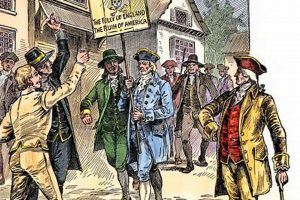
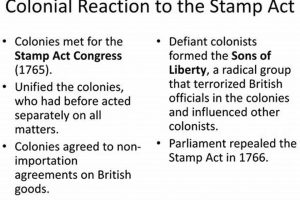
Several forms of resistance emerged in response to the Stamp Act. Boycotts of British goods, organized by groups like the Sons of Liberty, exerted economic pressure on British merchants, impacting trade and contributing to the eventual repeal of the Act. Public protests and demonstrations, often involving symbolic acts of defiance, served to express colonial discontent and raise awareness of the issue. The formation of colonial assemblies and committees of correspondence facilitated communication and coordination among the colonies, strengthening the collective resistance movement. For instance, the Stamp Act Congress, held in 1765, brought together representatives from nine colonies to discuss and coordinate their response, marking a significant step towards intercolonial unity. These varied forms of resistance demonstrated the colonists’ resolve and their growing willingness to challenge British authority.
Understanding colonial resistance is essential for comprehending the broader historical context surrounding the Stamp Act. The Act’s failure to generate revenue and its eventual repeal in 1766 can be directly attributed to the effectiveness of colonial resistance efforts. The Stamp Act episode served as a catalyst for future revolutionary movements, demonstrating the power of collective action and shaping the evolving relationship between Great Britain and the American colonies. The legacy of colonial resistance during the Stamp Act era laid the groundwork for the American Revolution, highlighting the importance of this period in the fight for independence. The Act’s legacy extends beyond its immediate consequences, shaping the political and ideological landscape that would ultimately lead to the colonies’ break from British rule.
4. "No Taxation Without Representation"

The phrase “No taxation without representation” encapsulates the core of colonial resistance to the Stamp Act. The Act, which imposed taxes on various printed materials, was perceived as unjust because colonists lacked direct representation in the British Parliament. This meant that decisions regarding colonial taxation were made without the consent or participation of those who bore the financial burden. The cry of “No taxation without representation” became a rallying cry, articulating the colonists’ fundamental grievance and fueling their resistance efforts. This principle underscored the colonists’ belief in self-governance and their right to have a voice in matters directly affecting them. For example, the Stamp Act Congress, convened in 1765, explicitly cited the lack of representation as a primary justification for their opposition to the Act. The Congress’s resolutions, circulated throughout the colonies, solidified the connection between the Stamp Act and the principle of representation, galvanizing opposition and demonstrating the unifying power of this grievance.
The practical significance of understanding this connection lies in recognizing its role as a catalyst for the American Revolution. The Stamp Act, and the subsequent resistance it provoked, highlighted the growing divide between Great Britain and its American colonies. The principle of “No taxation without representation” resonated deeply within colonial society, transcending social and economic boundaries. It served as a powerful mobilizing force, uniting colonists in their opposition to British policies perceived as unjust and tyrannical. The Stamp Act became a pivotal moment in the path toward independence, demonstrating the colonists’ increasing unwillingness to accept taxation without representation and laying the groundwork for future revolutionary movements. The denial of this fundamental right served as a constant source of tension, ultimately contributing to the outbreak of hostilities in 1775.
The Stamp Act and the rallying cry of “No taxation without representation” remain potent symbols of the struggle for self-governance and the fight against unjust policies. The principle underscores the importance of representation in a just and equitable society and continues to resonate in contemporary political discourse. The historical context surrounding the Stamp Act provides valuable insights into the development of democratic ideals and the enduring relevance of the fight for fair and representative governance. The challenges faced by colonists during this era serve as a reminder of the fragility of liberty and the ongoing need to safeguard the principles of democratic governance.
5. Catalyst for Revolution

The Stamp Act, while seemingly a simple tax on paper goods, acted as a catalyst for the American Revolution. Its implementation ignited a firestorm of protest and resistance throughout the colonies, fundamentally shifting the relationship between Great Britain and its American subjects. Exploring the specific ways in which the Stamp Act fueled revolutionary sentiment provides crucial context for understanding the events leading up to the war for independence. The Act’s significance lies not just in its economic impact, but in its symbolic representation of British overreach and colonial defiance.
- Taxation Without Representation:
The Stamp Act embodied the core colonial grievance of taxation without representation. Colonists argued that being taxed by a Parliament in which they had no elected representatives violated their fundamental rights as Englishmen. This perceived injustice fueled widespread resentment and mobilized resistance movements. The Stamp Act Congress, formed in response to the Act, directly challenged the British government’s authority to tax the colonies without their consent, marking a critical step towards colonial unity and eventual independence. This principle, central to the American Revolution’s ideology, transformed the Stamp Act from a mere tax dispute into a fight for fundamental political rights.
- Economic Hardship:
The Stamp Act placed a financial burden on colonists, particularly merchants, printers, and legal professionals. The tax on paper goods affected a wide range of commercial and legal transactions, adding costs and hindering economic activity. This economic hardship fueled resentment against British policies and contributed to the growing sense of discontent among colonists. The boycotts organized in response to the Stamp Act, which targeted British imports, demonstrated the colonists’ willingness to use economic pressure as a tool of resistance and significantly impacted British trade, further escalating tensions.
- Erosion of Trust:
The Stamp Act eroded trust between the colonies and the British government. The Act, perceived as a violation of colonial rights, fueled suspicion of British intentions and undermined the legitimacy of British rule in the eyes of many colonists. This erosion of trust created a climate of hostility and suspicion, making reconciliation increasingly difficult. The heavy-handed enforcement of the Act, including the use of Admiralty Courts, which bypassed colonial juries, further exacerbated tensions and deepened the divide between the colonies and the Crown.
- Rise of Radicalism:
The Stamp Act fostered the rise of radical political thought and action in the colonies. Groups like the Sons of Liberty, who organized protests and boycotts, played a significant role in mobilizing popular resistance and challenging British authority. These radical groups, fueled by the perceived injustices of the Stamp Act, became increasingly influential in shaping public opinion and advocating for greater colonial autonomy. The Stamp Act provided a platform for these groups to organize, gain support, and ultimately contribute to the growing revolutionary fervor that would culminate in the Declaration of Independence.
The Stamp Act’s significance extends beyond its immediate economic impact. By crystallizing colonial grievances, fostering resistance movements, and exacerbating tensions with Great Britain, the Stamp Act served as a pivotal catalyst for the American Revolution. The legacy of the Stamp Act lies in its contribution to the political and ideological climate that ultimately led to the colonies’ break from British rule. It stands as a stark reminder of the power of collective action and the importance of safeguarding fundamental rights and liberties. The Act’s role in fueling the revolution underscores its crucial place in American history and its enduring relevance in understanding the foundations of American independence.
6. Repealed in 1766

The repeal of the Stamp Act in 1766 forms a crucial component of its historical narrative and offers key insights into the dynamics between Great Britain and its American colonies. While the Act itself aimed to raise revenue for the British crown following the French and Indian War, its implementation sparked widespread resistance throughout the colonies. This resistance, rooted in the principle of “no taxation without representation,” took various forms, including boycotts of British goods, public protests, and the formation of organizations like the Sons of Liberty. These actions exerted significant pressure on British merchants, who faced declining sales due to the colonial boycotts. Merchants, in turn, lobbied Parliament for the Act’s repeal, highlighting the economic consequences of colonial resistance. For example, the boycott of British textiles significantly impacted the British textile industry, prompting manufacturers to pressure Parliament for a change in policy. This interplay of economic and political factors ultimately led to the Act’s repeal, demonstrating the power of colonial resistance and the responsiveness of the British government to economic pressures.
Beyond the immediate economic impact, the repeal of the Stamp Act had significant political ramifications. It signaled a temporary retreat by the British government and offered a brief respite from escalating tensions. However, the underlying issue of colonial representation remained unresolved. The Declaratory Act, passed alongside the Stamp Act’s repeal, asserted Parliament’s right to legislate for the colonies “in all cases whatsoever.” This assertion, while seemingly a victory for the colonies in the short term, laid the groundwork for future conflicts. The Declaratory Act’s claim of absolute legislative authority foreshadowed future attempts by the British government to impose taxes and regulations, reigniting colonial resistance and further contributing to the path toward revolution. For instance, the Townshend Acts, passed just a few years later, revived the debate over taxation and representation, demonstrating the fragility of the peace achieved through the Stamp Act’s repeal.
Understanding the Stamp Act’s repeal requires acknowledging its multifaceted nature. While marking a victory for colonial resistance, it also highlighted the underlying tensions that continued to simmer beneath the surface. The repeal, a direct consequence of colonial action, underscored the potential for collective action to influence political decisions. However, the accompanying Declaratory Act foreshadowed future conflicts, indicating that the fundamental issues of representation and colonial autonomy remained unresolved. Analyzing the repeal within this broader context offers crucial insights into the complex relationship between Great Britain and the American colonies, setting the stage for the escalating tensions that would ultimately culminate in the American Revolution. The repeal, therefore, serves not as an end to the conflict but as a critical turning point in the narrative of American independence.
Frequently Asked Questions about the Stamp Act
The following addresses common inquiries regarding the Stamp Act, providing concise and informative responses.
Question 1: What specific items were subject to the Stamp Act?
The Stamp Act taxed legal documents (contracts, wills, licenses), commercial papers (bills of lading, shipping manifests), printed materials (newspapers, pamphlets, almanacs, playing cards), and even dice.
Question 2: Why did the British government implement the Stamp Act?
The primary objective was to raise revenue to offset the costs incurred during the French and Indian War and to fund the continued presence of British troops in North America.
Question 3: How did the colonists react to the Stamp Act?
Colonists reacted with widespread resistance, employing boycotts of British goods, organizing protests and demonstrations, and forming groups like the Sons of Liberty to challenge the Act’s implementation.
Question 4: What does “No taxation without representation” mean?
This phrase encapsulates the core colonial grievance. Colonists argued that being taxed by a Parliament in which they lacked elected representatives violated their fundamental rights.
Question 5: Why was the Stamp Act repealed?
Colonial resistance, particularly the boycotts that negatively impacted British merchants, pressured Parliament to repeal the Act. British merchants, facing economic hardship, lobbied for the Act’s revocation.
Question 6: Did the repeal resolve the underlying issues between Great Britain and the colonies?
While the repeal provided temporary relief, the underlying issue of colonial representation and the extent of Parliament’s authority remained unresolved, contributing to future conflicts.
Understanding the Stamp Act is crucial for comprehending the events leading to the American Revolution. This pivotal piece of legislation, while repealed, ignited a firestorm of protest and laid bare the fundamental disagreements over representation and governance that would ultimately lead to the colonies’ fight for independence.
Further research into related topics, such as the Townshend Acts and the Intolerable Acts, will deepen one’s understanding of the escalating tensions that culminated in the American Revolution.
Conclusion
Examination of the Stamp Act reveals its multifaceted nature and enduring significance. From its initial purpose as a revenue-raising measure to its unintended consequences as a catalyst for revolution, the Act offers a crucial lens through which to understand the escalating tensions between Great Britain and its American colonies. The tax on paper goods, seemingly minor, ignited widespread resistance rooted in the principle of “no taxation without representation.” This resistance, manifested through boycotts, protests, and the formation of influential groups, ultimately forced Parliament to repeal the Act. However, the underlying issues of colonial autonomy and representation remained unresolved, foreshadowing future conflicts and laying the groundwork for the American Revolution. The Stamp Act’s legacy lies not only in its direct impact on the events of the time but also in its enduring relevance to contemporary discussions about governance, representation, and the delicate balance between individual liberties and government authority.
The Stamp Act serves as a potent reminder of the power of collective action and the importance of safeguarding fundamental rights. Its story continues to resonate, offering valuable lessons about the fragility of political stability and the enduring need for vigilance in protecting the principles of democratic governance. Further exploration of this era, including the events leading up to and following the American Revolution, provides essential context for understanding the ongoing struggle for liberty and self-determination throughout history. The echoes of the Stamp Act’s legacy continue to shape political discourse and inspire movements for social and political change, underscoring its enduring relevance in the pursuit of a more just and equitable world.