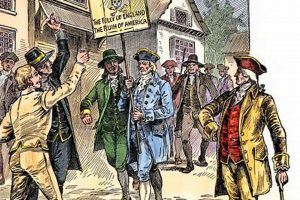
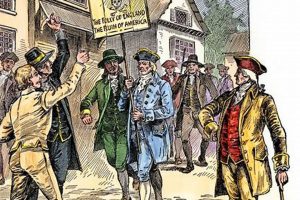
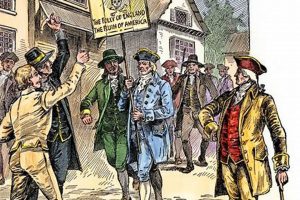
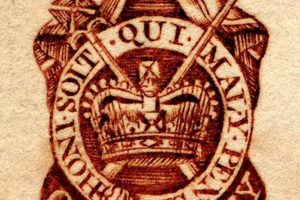
The Stamp Act of 1765, along with several other taxes levied by the British Parliament upon the American colonies, sparked widespread resistance due to the colonists’ belief that these measures represented unjust and oppressive taxation without representation. These acts mandated taxes on various printed materials, including legal documents, newspapers, pamphlets, and playing cards, requiring the purchase of embossed revenue stamps to prove payment. This impacted a wide swathe of colonial society, from merchants and lawyers to printers and everyday citizens.
The colonists’ objections were rooted in their understanding of British constitutional principles. They argued that as British subjects, they could not be taxed by a Parliament in which they had no elected representatives. This cry of “No taxation without representation” encapsulated the core of their grievances and became a rallying cry for colonial resistance. These protests, ranging from boycotts of British goods and organized demonstrations to acts of defiance and the formation of groups like the Sons of Liberty, ultimately contributed to the growing tensions that led to the American Revolution. Understanding this historical context is crucial for comprehending the foundations of American independence and the development of democratic ideals.
This resistance to perceived unfair taxation sheds light on several key themes in early American history, including the development of colonial identity, the evolving relationship between Great Britain and its American colonies, and the philosophical underpinnings of the American Revolution. Examining these themes offers a deeper understanding of the events that shaped the nation’s founding.
Understanding Colonial Resistance to Taxation
Gaining insight into the reasons behind colonial resistance to acts like the Stamp Act provides a deeper understanding of the political and social climate leading up to the American Revolution. The following tips offer perspectives on approaching this crucial period in history.
Tip 1: Consider the economic impact. Taxes like the Stamp Act directly affected colonists’ finances, impacting businesses and individuals. Examine how these economic burdens fueled resentment and resistance.
Tip 2: Explore the concept of virtual representation. The British government argued that colonists were virtually represented in Parliament, even without elected representatives. Research this argument and understand why colonists rejected it.
Tip 3: Analyze the role of propaganda and public opinion. Pamphlets, newspapers, and public speeches played a significant role in shaping colonial opinion. Investigate how these mediums fueled resistance movements.
Tip 4: Examine the various forms of protest. Colonial resistance ranged from boycotts and petitions to more radical actions. Explore the spectrum of responses and their effectiveness.
Tip 5: Investigate the legal arguments against the taxes. Colonists argued that the taxes violated their rights as British subjects. Research the legal basis of these arguments and their impact on the debate.
Tip 6: Consider the long-term consequences. The resistance to these taxes had far-reaching consequences, ultimately leading to the American Revolution. Reflect on how these events shaped the future of the colonies.
Tip 7: Connect the resistance to broader Enlightenment ideals. Explore how Enlightenment philosophies concerning liberty, representation, and self-governance influenced colonial thought and action.
By understanding these various facets of colonial resistance, one gains a more comprehensive understanding of the forces that propelled the colonies toward independence.
This exploration of colonial resistance provides crucial context for understanding the events that culminated in the American Revolution. Further investigation into specific events and individuals will enrich this understanding.
1. Taxation without representation

“Taxation without representation” served as the central rallying cry against the Stamp Act and other taxes imposed upon the American colonies. It encapsulated the colonists’ core grievance: they were being subjected to taxes levied by the British Parliament, a body in which they had no elected representatives to voice their interests or concerns. This was perceived as a fundamental violation of their rights as British subjects, who believed they were entitled to the same rights and protections as those residing in Great Britain. The concept of consent to taxation through elected representatives was deeply ingrained in British political thought, and the colonists argued that by denying them representation, Parliament was infringing upon this established principle. The Stamp Act, requiring a tax stamp on printed materials, became a potent symbol of this perceived injustice, directly impacting a wide segment of colonial society and fueling widespread resentment.
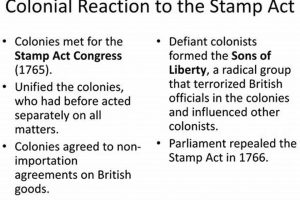
The practical significance of understanding “taxation without representation” lies in its direct connection to the outbreak of the American Revolution. The colonists viewed these taxes not merely as an economic burden, but as a deliberate attempt to undermine their political autonomy and fundamental rights. The Stamp Act Congress, formed in response to the Act, exemplified the growing intercolonial unity against British policies. The boycotts, protests, and acts of defiance that followed demonstrated the depth of colonial opposition and laid the groundwork for the eventual break with Great Britain. The phrase itself became a powerful mobilizing force, uniting diverse groups of colonists under a shared grievance and propelling them toward revolution. For instance, the Sons of Liberty, a prominent protest group, effectively utilized the slogan to rally support and organize resistance against British policies.
In conclusion, “taxation without representation” was not simply a slogan; it represented a fundamental principle of British constitutionalism that the colonists believed was being violated. Understanding this principle is crucial for grasping the root causes of the American Revolution. The protests against the Stamp Act and other taxes were not isolated incidents but rather manifestations of a deeper struggle for political self-determination and recognition of colonial rights. This struggle ultimately reshaped the political landscape of the Atlantic world and led to the birth of a new nation founded on the principles of liberty and self-governance.
2. Violation of British Rights

Colonial protests against the Stamp Act and other taxes stemmed from a profound sense of injustice, rooted in the belief that these measures infringed upon their rights as British subjects. Understanding this perceived violation of rights is crucial for comprehending the escalating tensions that led to the American Revolution. The colonists argued that Parliament’s actions contravened established British legal and political principles, thereby justifying their resistance.
- Taxation without Representation:
Central to the colonists’ grievances was the principle of “no taxation without representation.” They argued that being taxed by a Parliament in which they lacked elected representatives violated their fundamental rights as Englishmen. This principle, deeply embedded in British constitutional thought, held that individuals could not be subjected to taxes without the consent of their elected representatives. The Stamp Act, by imposing taxes without colonial consent, became a symbol of this perceived violation. The colonists drew parallels to historical struggles against arbitrary taxation within England itself, reinforcing their claim to these traditional rights.
- Trial by Jury:
The Sugar Act of 1764, while lowering the existing tax on molasses, strengthened enforcement mechanisms, including trials in admiralty courts. These courts, lacking juries, were viewed by colonists as a denial of their right to a trial by their peers, a cornerstone of British legal tradition. This perceived infringement further fueled colonial discontent and contributed to a growing sense that their rights were being systematically eroded. The fear that other traditional legal protections might also be stripped away contributed to the escalating resistance.
- Writs of Assistance:
The use of writs of assistance, general search warrants that allowed customs officials to search homes and businesses for smuggled goods without specific probable cause, further inflamed colonial anxieties about their rights. Colonists considered these writs a violation of their right to privacy and security in their homes, a right deeply valued in English common law. These writs became a symbol of British overreach and arbitrary power, exacerbating tensions between the colonies and the Crown.
- Restriction of Colonial Assemblies:
Parliament’s attempts to restrict the power of colonial assemblies, seen as the legitimate voice of the people in the colonies, were also interpreted as a violation of colonial rights. The colonists viewed these assemblies as their equivalent to Parliament in England, essential for local self-governance. Any attempt to curtail their authority was seen as an affront to their right to manage their own affairs. This perceived attack on colonial self-governance strengthened the growing resistance movement and further fueled the flames of revolution.
These perceived violations of British rights formed the bedrock of colonial resistance to the Stamp Act and other taxes. The colonists viewed these actions not as isolated incidents, but as a systematic assault on their liberties and a betrayal of the principles of British governance. This sense of betrayal played a critical role in galvanizing colonial opposition, uniting diverse groups under a shared sense of grievance, and ultimately paving the path toward revolution. The struggle against these perceived infringements laid the foundation for the American ideal of self-government and the protection of individual liberties.
3. Economic burden

The economic burden imposed by the Stamp Act and other taxes levied by the British Parliament played a significant role in fueling colonial resistance. These taxes represented a direct financial strain on colonists, impacting various segments of society, from merchants and printers to ordinary citizens. The Stamp Act, in particular, targeted a wide range of printed materials, including legal documents, newspapers, and commercial papers, increasing the cost of essential transactions and hindering economic activity. This financial burden was perceived not only as oppressive but also as a threat to the colonists’ livelihoods and economic prosperity. The Sugar Act, while lowering the existing tax on molasses, aimed to increase revenue collection through stricter enforcement, impacting colonial merchants engaged in trade, particularly those involved in the rum distilling industry. The Currency Act of 1764, which prohibited the colonies from issuing their own paper money, further exacerbated economic difficulties by restricting the money supply and hindering trade within the colonies.
Several factors amplified the negative economic impact of these taxes. The colonial economy was largely dependent on trade, and the new taxes and trade restrictions disrupted established commercial networks, reducing profitability and creating economic uncertainty. The lack of colonial representation in Parliament meant that colonists had no voice in the design or implementation of these economic policies, further fueling resentment and perceptions of unfair treatment. For example, merchants, heavily impacted by the Stamp Act and Sugar Act, organized boycotts of British goods, impacting transatlantic trade and demonstrating the economic power of collective resistance. The economic hardship caused by these measures contributed to social unrest and fostered a sense of shared grievance among diverse groups of colonists, uniting them in opposition to British policies. The colonies’ growing reliance on credit from British merchants added another layer of complexity, as the new taxes and economic downturn made it more difficult for colonists to repay their debts, increasing financial strain on both sides of the Atlantic.
Understanding the economic grievances of the colonists is essential for comprehending the underlying causes of the American Revolution. The economic burden imposed by the Stamp Act and other taxes was not merely a financial matter; it represented a broader political and ideological conflict over colonial autonomy and self-governance. The economic hardships fueled colonial resistance, contributing to the growing tensions that ultimately led to the outbreak of revolution. These economic factors, combined with the colonists’ concerns about their rights and liberties, created a powerful catalyst for change, ultimately shaping the course of American history. The economic consequences of these policies, including the disruption of trade and the restriction of currency, laid the groundwork for the colonists’ eventual demands for economic and political independence.
4. Restriction of colonial autonomy
The Stamp Act and other taxes imposed by the British Parliament were not merely revenue-generating measures; they represented a broader attempt to assert greater control over the American colonies and restrict their long-held autonomy. This perceived infringement on colonial self-governance became a central grievance fueling resistance and contributing significantly to the escalating tensions that culminated in the American Revolution. Understanding this context is crucial for grasping the colonists’ motivations and the broader implications of their actions.
- Legislative Authority of Colonial Assemblies:
The British government’s efforts to exert greater control over colonial legislatures were met with fierce resistance. Colonists viewed their elected assemblies as the legitimate governing bodies responsible for local affairs, mirroring the role of Parliament in England. Acts like the Stamp Act, passed without colonial consent, were seen as undermining the authority of these assemblies and infringing upon established practices of self-governance. This direct challenge to local authority fueled resentment and strengthened colonial resolve to resist external interference.
- Financial Independence:
The imposition of taxes like the Stamp Act and the Sugar Act, coupled with measures like the Currency Act, which restricted the colonies’ ability to issue their own currency, threatened colonial financial independence. Colonists saw these measures as an attempt by Parliament to exert greater control over their economies and limit their ability to manage their own financial affairs. This perceived economic overreach further fueled resistance and solidified the colonists’ determination to protect their economic autonomy.
- Trade Regulations:
British trade regulations, including the Navigation Acts, which restricted colonial trade to benefit the mother country, were a long-standing source of tension. The Stamp Act and other revenue-generating measures were seen as further extensions of this mercantilist policy, reinforcing the perception that the colonies were being exploited for the benefit of Great Britain. These restrictions on trade, coupled with the new taxes, fueled colonial resentment and contributed to a growing sense of economic injustice.
- Enforcement of British Policies:
The increased presence of British officials and the use of measures like writs of assistance to enforce new taxes and trade regulations further eroded colonial autonomy. The colonists viewed these actions as an intrusion on their liberties and a demonstration of British disregard for colonial self-governance. The enforcement of these policies, often perceived as heavy-handed and arbitrary, fueled resistance and heightened tensions between the colonies and the Crown.
The restriction of colonial autonomy became a focal point of colonial resistance. The various acts imposed by Parliament, perceived as a systematic effort to curtail colonial self-governance, united diverse groups within the colonies against a common enemy. This collective resistance, fueled by a desire to protect their established liberties and traditional rights, ultimately laid the groundwork for the American Revolution. The struggle against these restrictive measures shaped the colonists’ understanding of their own political identity and solidified their resolve to pursue self-determination. This fight for autonomy would ultimately transform the political landscape of the Atlantic world and give birth to a new nation founded on principles of self-government and individual liberty.
5. Influence of Enlightenment ideas

Enlightenment ideals, emphasizing natural rights, reason, and individual liberty, profoundly influenced colonial resistance to the Stamp Act and other taxes imposed by the British Parliament. These philosophical principles, disseminated through writings of John Locke, Montesquieu, and other Enlightenment thinkers, provided a framework for colonists to articulate their grievances and justify their resistance. Locke’s concept of natural rights, including the right to life, liberty, and property, resonated deeply with colonists who viewed the taxes as an infringement upon these fundamental rights. Montesquieu’s ideas on the separation of powers and the importance of checks and balances influenced colonial arguments against the concentration of power in the hands of Parliament. The Enlightenment emphasis on reason and individual autonomy empowered colonists to question the legitimacy of British rule and assert their right to self-governance.
The practical application of Enlightenment ideals manifested in various forms of colonial resistance. The concept of natural rights provided a philosophical basis for the colonists’ claim to representation in Parliament, encapsulated in the slogan “No taxation without representation.” Pamphlets and newspapers, circulating Enlightenment ideas throughout the colonies, played a crucial role in shaping public opinion and mobilizing resistance. The formation of groups like the Sons of Liberty demonstrated the colonists’ willingness to organize and act collectively to defend their perceived rights. The Stamp Act Congress, convened in 1765, exemplified the growing intercolonial unity and the colonists’ determination to assert their political autonomy. These actions demonstrate how Enlightenment principles translated into concrete political action, challenging the established order and laying the groundwork for the American Revolution. For instance, the arguments presented in the Declaration of Independence, drafted by Thomas Jefferson, reflect the profound influence of Enlightenment thought on the colonists’ understanding of their rights and their justification for independence.
Understanding the influence of Enlightenment ideas provides crucial insight into the intellectual and ideological underpinnings of the American Revolution. The colonists’ resistance was not simply a reaction to specific taxes but reflected a deeper philosophical shift towards self-determination and individual liberty. The Enlightenment provided the intellectual tools and vocabulary for colonists to articulate their grievances and justify their struggle for independence. This intellectual ferment, combined with the practical realities of British policies, created a powerful catalyst for change, transforming the political landscape of the Atlantic world and shaping the course of American history. The legacy of the Enlightenment continues to resonate in contemporary political discourse, underscoring the enduring relevance of these foundational principles.
6. Growing colonial identity

A burgeoning sense of colonial identity played a crucial role in the widespread protests against the Stamp Act and other taxes levied by the British Parliament. While colonists initially identified primarily as British subjects, shared experiences, including economic hardship, political grievances, and increasing social interaction amongst the colonies, fostered a distinct American identity. This evolving sense of collective identity significantly shaped colonial responses to British policies. The perceived injustices of taxation without representation, coupled with restrictions on colonial autonomy and trade, fueled a sense of shared grievance and solidified a collective “us versus them” mentality, where “us” represented the American colonies and “them” represented the British government. This growing sense of a shared American identity distinct from British identity provided a powerful impetus for collective action and resistance.
The Stamp Act Congress of 1765 exemplifies the practical manifestation of this growing colonial identity. Representatives from nine colonies convened to coordinate resistance against the Stamp Act, demonstrating a nascent sense of intercolonial unity and shared purpose. This collective action signaled a significant shift away from individual colonial identities towards a broader American identity, united by common grievances and a shared desire for self-determination. Boycotts of British goods, organized across multiple colonies, further solidified this collective identity and demonstrated the power of unified action. These boycotts, impacting British merchants and trade, underscored the potential for collective resistance and further fueled the colonists’ sense of shared identity and purpose. The formation of groups like the Sons of Liberty, active throughout the colonies, provided a platform for expressing shared grievances and organizing resistance, further strengthening colonial identity and fostering a sense of collective action.
Understanding the development of colonial identity is crucial for comprehending the underlying causes of the American Revolution. The protests against the Stamp Act and other taxes were not isolated incidents but rather expressions of a broader movement towards self-determination and independence. This growing sense of shared identity, forged through shared experiences and common grievances, provided the foundation for the colonists’ eventual break with Great Britain. The struggle against British policies fostered a sense of unity and purpose that transcended individual colonies, ultimately leading to the creation of a new nation founded on principles of self-governance and individual liberty. The legacy of this shared colonial identity continues to shape American national identity and political discourse to this day.
Frequently Asked Questions about Colonial Resistance to Taxation
This section addresses common questions regarding the colonial resistance to the Stamp Act and other taxes imposed by the British Parliament, providing further context for understanding this pivotal period in American history.
Question 1: Were the taxes imposed on the colonies truly excessive?
While the financial burden of the taxes was a factor, colonial resistance stemmed more from the principle of taxation without representation and the perceived violation of their rights as British subjects. The taxes themselves were not necessarily exorbitant, but the lack of colonial consent made them unacceptable to many colonists.
Question 2: Why did the colonists react so strongly to the Stamp Act compared to earlier taxes?
The Stamp Act differed from earlier taxes like the Sugar Act in its direct and widespread impact on colonial society. It affected a broad range of printed materials, impacting merchants, lawyers, printers, and ordinary citizens. This widespread impact made the Stamp Act a particularly potent symbol of British overreach.
Question 3: Was colonial resistance to the Stamp Act unified?
While the Stamp Act Congress demonstrated growing intercolonial unity, colonial resistance was not entirely monolithic. Loyalists remained supportive of British rule, and opinions varied among those who opposed the tax. However, the shared grievance created a powerful impetus for collective action.
Question 4: Did all colonists object to taxation without representation?
While the principle of “no taxation without representation” became a central rallying cry, not all colonists opposed British rule. Loyalists maintained allegiance to the Crown and believed that Parliament had the right to tax the colonies. However, the majority of colonists felt their rights were being violated.
Question 5: How effective were colonial boycotts of British goods?
The boycotts played a significant role in pressuring British merchants and Parliament to repeal the Stamp Act. The economic impact of the boycotts demonstrated the potential power of colonial resistance and contributed to the growing tensions between the colonies and Great Britain.
Question 6: How did British policies contribute to a growing sense of American identity?
British policies, including the Stamp Act and other taxes, paradoxically contributed to a growing sense of American identity. The shared experience of resisting these policies fostered a sense of unity and common purpose among colonists from different regions, laying the groundwork for a distinct American identity separate from British identity.
Understanding the nuances of colonial resistance to taxation provides essential context for understanding the events that culminated in the American Revolution. Further research into specific events, individuals, and the complex interplay of political, economic, and social factors will enhance this understanding.
Continuing this exploration, the following sections delve deeper into the specific events and key figures that shaped this crucial period in American history.
Conclusion
Colonial resistance to the Stamp Act and other taxes stemmed from a complex interplay of economic grievances, political principles, and evolving identities. The taxes, perceived as unjust and oppressive due to the lack of colonial representation in Parliament, became a flashpoint for broader anxieties about British control over colonial affairs. This resistance, fueled by Enlightenment ideals and a growing sense of shared American identity, manifested in various forms, from boycotts and petitions to organized protests and acts of defiance. The economic burden of these taxes, coupled with restrictions on colonial autonomy and trade, further exacerbated tensions and solidified colonial resolve to resist British policies. The struggle against these measures laid bare fundamental disagreements about the nature of imperial governance and the rights of colonial subjects, ultimately setting the stage for the American Revolution.
The legacy of colonial resistance to taxation resonates far beyond the confines of the eighteenth century. The principles of self-governance, individual liberty, and the right to representation, central to the colonists’ struggle, continue to shape political discourse and inspire movements for social and political change worldwide. Examining this pivotal period in history offers valuable insights into the dynamics of power, the importance of civic engagement, and the enduring struggle for human rights and self-determination. Further exploration of this era remains crucial for understanding not only the origins of the United States but also the ongoing evolution of democratic ideals and the pursuit of a more just and equitable world.