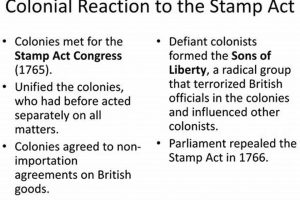
The Stamp Act, requiring embossed revenue stamps on various printed materials in the American colonies, was enacted by the British Parliament in 1765 and repealed in 1766. This legislation mandated that legal documents, newspapers, pamphlets, playing cards, and other paper goods carry a tax represented by a physical stamp, demonstrating payment to the British crown. For example, a newspaper publisher would have been required to purchase these stamps and affix them to each printed edition.
This relatively brief period had a profound impact on the relationship between Great Britain and its American colonies. The tax was widely viewed as an unjust imposition by a distant Parliament without colonial representation, fueling resentment and contributing significantly to the growing movement for independence. The colonial outcry, expressed through boycotts, protests, and the formation of groups like the Sons of Liberty, demonstrated a burgeoning sense of American identity and solidified resistance to British policies. The eventual repeal, a result of colonial pressure and economic disruption, underscored the power of collective action but also foreshadowed future conflicts over taxation and representation.
Understanding this historical timeline provides crucial context for exploring broader themes of the American Revolution, including the development of colonial resistance, the arguments for and against parliamentary authority, and the evolving concept of self-governance. Further examination of the events surrounding the Acts implementation and revocation offers valuable insights into the political and economic dynamics of the era.
Tips for Researching the Stamp Act’s Timeline
Effective research regarding the Stamp Act requires precision concerning its timeframe. The following tips offer guidance for navigating relevant historical resources and understanding the Act’s brief but impactful existence.
Tip 1: Distinguish between Enactment and Repeal: Research should clearly differentiate between the date the Stamp Act became law (1765) and its subsequent revocation (1766). Confusing these dates can lead to misinterpretations of the colonial response and the Act’s overall significance.
Tip 2: Consider the Context of British Policy: Examining the Stamp Act in isolation can be misleading. It’s crucial to consider its place within a broader series of British policies implemented in the colonies during this period, such as the Sugar Act and the Townshend Acts, to understand the escalating tensions.
Tip 3: Explore Primary Sources: Consulting primary sources, including letters, diaries, newspapers, and official documents from the period, offers valuable firsthand accounts of the colonial reaction to the Stamp Act. These sources provide insights into the diverse perspectives and motivations of those affected by the legislation.
Tip 4: Analyze the Economic Impact: Research should consider the economic consequences of the Stamp Act on various colonial groups, including merchants, printers, and ordinary citizens. This analysis illuminates the practical implications of the tax and its contribution to colonial discontent.
Tip 5: Focus on Colonial Resistance: The Stamp Act played a pivotal role in galvanizing colonial resistance. Examining the various forms of protest, from boycotts to the formation of organizations like the Sons of Liberty, provides a deeper understanding of the growing movement for independence.
Tip 6: Understand the Role of Parliamentary Debate: Investigating the debates within the British Parliament surrounding the enactment and repeal of the Stamp Act reveals the differing viewpoints on colonial governance and taxation, shedding light on the political dynamics at play.
Accurate understanding of the Stamp Act’s duration facilitates a more comprehensive analysis of its impact on colonial America. These tips promote a nuanced perspective on this crucial period in American history.
By considering these points, a richer and more accurate understanding of the Stamp Act’s impact on the trajectory towards American independence can be achieved.
1. 1765

The year 1765 marks the commencement of the Stamp Act’s troubled existence and serves as a critical starting point for understanding the escalating tensions between Great Britain and its American colonies. This enactment provides crucial context for the broader question of the Act’s lifespan and its impact on the path towards revolution. Examining the specifics of the enactment reveals the core issues that fueled colonial resistance and ultimately led to the Act’s repeal.
- The Mechanics of the Act:
The Stamp Act, passed by the British Parliament, imposed a tax on all printed materials in the colonies, including newspapers, legal documents, pamphlets, and even playing cards. This required colonists to purchase and affix embossed revenue stamps to these items, demonstrating payment of the tax. This direct taxation, without colonial representation in Parliament, became a central point of contention.
- Colonial Reaction and Resistance:
The enactment triggered immediate and widespread resistance throughout the colonies. Protests, boycotts of British goods, and the formation of groups like the Sons of Liberty demonstrated the colonists’ strong opposition to the tax. These actions underscore the Act’s role as a catalyst for unifying colonial sentiment against British policies.
- Arguments Against Taxation Without Representation:
The cry of “No taxation without representation” encapsulated the colonists’ core grievance. They argued that being taxed by a Parliament in which they had no elected representatives violated their fundamental rights as Englishmen. This principle became a cornerstone of the American Revolution’s ideological foundations. The enactment of the Stamp Act brought this abstract concept into stark reality.
- Economic Implications:
The Stamp Act’s economic burden fell disproportionately on certain colonial groups, such as printers, merchants, and lawyers, who relied heavily on printed materials. The tax disrupted commerce and fueled resentment, further contributing to the growing unrest and resistance to British rule. This economic hardship fueled further discontent and solidified opposition to the Act.
The enactment of the Stamp Act in 1765 ignited a firestorm of protest and laid the groundwork for the subsequent struggle for independence. By understanding the specifics of the Act’s implementation and the immediate colonial response, one gains a clearer perspective on the larger question of its lifespan and its crucial role in shaping the course of American history. The events of 1765 underscore the significance of this period as a turning point in the relationship between Great Britain and its American colonies.
2. 1766

The repeal of the Stamp Act in 1766 marks the culmination of a period of intense colonial resistance and parliamentary debate. Understanding this event is essential for answering “when did the Stamp Act start and end,” as it signifies the Act’s endpoint and reveals its significant impact on the evolving relationship between Great Britain and the American colonies. Examining the factors leading to repeal illuminates the broader historical context and provides insights into the growing movement toward independence.
- Economic Pressure and the Merchant Boycotts:
Colonial merchants organized effective boycotts of British goods, significantly impacting British trade and applying economic pressure on British merchants and manufacturers. These boycotts demonstrated the colonists’ collective power and played a crucial role in persuading Parliament to reconsider the Stamp Act’s economic viability. The economic disruption caused by the boycotts served as a powerful argument for repeal.
- Colonial Protests and the Sons of Liberty:
Groups like the Sons of Liberty organized protests and demonstrations, effectively conveying colonial discontent to British authorities. These acts of resistance, often involving public demonstrations and acts of defiance, heightened tensions and further emphasized the strength of colonial opposition to the Stamp Act. The visible and vocal nature of these protests made it clear that the Act was untenable.
- Parliamentary Debates and Shifting Opinions:
Within the British Parliament, debates surrounding the Stamp Act revealed divisions over colonial policy. Arguments for and against repeal highlighted the complexities of governing the colonies and the growing realization that the Act was causing more harm than good. These debates reflect the evolving political landscape and the increasing pressure on Parliament to find a solution to the colonial crisis.
- The Declaratory Act and Assertion of Parliamentary Authority:
Simultaneously with the repeal, Parliament passed the Declaratory Act, asserting its right to legislate for the colonies “in all cases whatsoever.” This act, while seemingly contradictory to the repeal, aimed to reassert British authority while also addressing colonial grievances. The Declaratory Act underscored the ongoing tension between British control and colonial desires for greater autonomy. Though the Stamp Act was repealed, the underlying issue of parliamentary authority remained unresolved, foreshadowing future conflicts.
The repeal of the Stamp Act in 1766 concluded its short but impactful lifespan. This event, driven by a confluence of economic pressure, colonial resistance, and parliamentary debate, provides crucial context for understanding the period leading up to the American Revolution. While the repeal offered a temporary reprieve from escalating tensions, the underlying issues of representation and parliamentary authority remained unresolved, setting the stage for future conflict and contributing significantly to the eventual break between Great Britain and its American colonies.
3. Colonial Resistance

Colonial resistance played a pivotal role in the short but impactful lifespan of the Stamp Act (1765-1766). The Act’s implementation ignited widespread opposition across the American colonies, serving as a catalyst for organized resistance movements and solidifying colonial identity against British policies. This resistance encompassed a spectrum of actions, directly contributing to the Act’s eventual repeal and shaping the trajectory towards the American Revolution. Understanding this resistance is crucial for comprehending the historical context surrounding the Stamp Act’s enactment and revocation.
Several key examples illustrate the forms and effectiveness of colonial resistance: The Sons of Liberty, formed in response to the Act, mobilized protests, intimidated stamp distributors, and enforced boycotts of British goods. These actions effectively disrupted the Act’s implementation and applied pressure on British merchants. Colonial legislatures passed resolutions condemning the Act and asserting colonial rights, providing a legal and political framework for resistance. Pamphlets and newspapers circulated arguments against taxation without representation, shaping public opinion and further fueling opposition. The Stamp Act Congress, convened in 1765, represented a unified colonial front against British policies, demonstrating the growing strength and coordination of the resistance movement.
The colonial response demonstrates a direct causal link between resistance and the Stamp Acts timeline. Boycotts significantly impacted British trade, pressuring Parliament to reconsider the Act’s economic viability. Widespread protests and organized resistance highlighted the Act’s unpopularity and the potential for further unrest. The unified colonial stance demonstrated by the Stamp Act Congress underscored the strength of colonial opposition and contributed to the growing momentum for greater autonomy. Ultimately, the repeal of the Stamp Act in 1766 can be directly attributed to the sustained and multifaceted resistance efforts of the American colonists. This period of resistance not only led to the Act’s demise but also laid the groundwork for future resistance movements and profoundly shaped the political landscape leading up to the American Revolution.
4. Parliamentary Debate

Parliamentary debate in Great Britain played a crucial role in determining the lifespan of the Stamp Act. Discussions and disagreements within Parliament directly influenced both the Act’s enactment in 1765 and its eventual repeal in 1766. Analyzing these debates provides valuable insight into the political climate of the time, the differing perspectives on colonial governance, and the factors that ultimately shaped the Act’s timeline. Understanding the parliamentary discourse surrounding the Stamp Act is essential for comprehending the broader historical context of its existence.
- Arguments for Enactment
Initial arguments in favor of the Stamp Act centered on the need to raise revenue to cover the costs of defending the American colonies. Proponents argued that the colonies benefited from British military protection and should contribute financially. This perspective emphasized the financial burdens of imperial administration and the perceived responsibility of the colonies to share in these costs. The perceived need for colonial financial contributions significantly influenced the decision to enact the Stamp Act.
- Colonial Resistance and its Impact on Parliament
News of widespread colonial resistance, including boycotts and protests, reached Parliament and fueled further debate. Reports of economic disruption caused by colonial boycotts, coupled with the increasing unrest in the colonies, forced Parliament to reconsider the Act’s effectiveness and potential consequences. The strength and scale of colonial resistance played a key role in shifting opinions within Parliament and ultimately contributed to the decision to repeal.
- Arguments for Repeal
Arguments for repeal emphasized the economic damage caused by colonial boycotts and the potential for further unrest. Some members of Parliament argued that the Stamp Act was counterproductive, harming British trade and exacerbating tensions with the colonies. These arguments highlighted the economic and political costs of maintaining the Act and provided a strong case for its repeal. The economic and political considerations stemming from colonial resistance significantly influenced the decision to repeal the Act.
- The Declaratory Act and the Assertion of Authority
Despite repealing the Stamp Act, Parliament passed the Declaratory Act, asserting its continued right to legislate for the colonies. This act aimed to maintain parliamentary sovereignty while addressing colonial grievances about taxation without representation. The passage of the Declaratory Act reflected the complex and often conflicting motivations behind the repeal, demonstrating a desire to maintain control while mitigating colonial unrest. This act underscores the ongoing tension between British authority and colonial autonomy.
Parliamentary debates surrounding the Stamp Act significantly shaped its timeline, demonstrating the complex interplay between colonial resistance, economic pressures, and evolving political opinions within Great Britain. These debates reveal the tensions inherent in the relationship between Britain and the American colonies and provide crucial context for understanding the events leading up to the American Revolution. The discussions surrounding the Stamp Act’s enactment and repeal offer valuable insights into the political climate of the era and the challenges of imperial governance.
5. Pre-Revolution Tensions
The Stamp Act’s lifespan, from its enactment in 1765 to its repeal in 1766, played a pivotal role in escalating pre-Revolution tensions between Great Britain and its American colonies. Examining this period reveals how the Act exacerbated existing grievances and fueled the growing movement for independence. The timeframe of the Stamp Act serves as a crucial lens through which to understand the mounting discontent and the eventual break between the colonies and Britain.
- Taxation Without Representation
The Stamp Act epitomized the colonists’ core complaint of taxation without representation. Being forced to pay taxes levied by a Parliament in which they had no elected representatives fueled resentment and solidified colonial opposition to British rule. This issue became a rallying cry for colonists and significantly contributed to the escalating tensions.
- Economic Grievances
The Act’s economic burden, particularly on merchants, printers, and legal professionals, intensified existing economic grievances. Colonial merchants, already facing restrictions under British mercantilist policies, viewed the Stamp Act as another instance of unfair economic exploitation, further straining the relationship with Britain. The resulting economic hardship contributed to the growing discontent and fueled resistance efforts.
- Erosion of Colonial Autonomy
The Stamp Act, imposed by a distant Parliament, was perceived by colonists as an erosion of their traditional autonomy. The ability to govern their own affairs had long been a cherished right, and the Act’s imposition represented a direct threat to this autonomy, escalating tensions and furthering the divide between the colonies and Britain.
- Rise of Organized Resistance
The Stamp Act galvanized organized resistance movements, such as the Sons of Liberty. These groups effectively mobilized protests, boycotts, and other forms of resistance, demonstrating the growing power and unity of colonial opposition. The emergence of these organized movements marked a significant escalation in pre-Revolution tensions, signaling a shift towards more direct confrontation with British authority. The effectiveness of these resistance efforts further fueled colonial confidence and contributed to the growing movement for independence.
The Stamp Act’s brief existence significantly exacerbated pre-Revolution tensions. By crystallizing existing grievances regarding representation, economic policies, and colonial autonomy, the Act fueled a growing sense of colonial identity and solidified resistance to British rule. The period from 1765 to 1766, marked by the Act’s enactment and subsequent repeal, serves as a crucial turning point in the relationship between Great Britain and the American colonies, laying the groundwork for the inevitable conflict that followed.
Frequently Asked Questions
This section addresses common inquiries regarding the Stamp Act’s timeframe and its significance in the leadup to the American Revolution.
Question 1: Why is knowing the exact duration of the Stamp Act important?
Understanding the Stamp Act’s short lifespan (1765-1766) is crucial for comprehending its impact. This brief period witnessed intense colonial resistance, significantly impacting the relationship between Great Britain and the American colonies and fueling the movement towards independence.
Question 2: Was the Stamp Act the only tax levied on the colonies during this period?
No. The Stamp Act was part of a series of British revenue-raising measures, including the Sugar Act and later the Townshend Acts. Placing the Stamp Act within this broader context helps understand the escalating tensions between Britain and the colonies.
Question 3: How did colonial resistance contribute to the Act’s repeal?
Colonial resistance, through boycotts, protests, and the formation of groups like the Sons of Liberty, created significant economic and political pressure on Great Britain. These actions directly contributed to the Act’s repeal in 1766.
Question 4: Did the repeal of the Stamp Act resolve the underlying issues between the colonies and Britain?
While the repeal addressed the immediate grievances related to the Stamp Act, the underlying issue of taxation without representation and parliamentary authority remained unresolved. The passage of the Declaratory Act, asserting Parliament’s right to legislate for the colonies, underscored this continuing tension and foreshadowed future conflict.
Question 5: How did the Stamp Act contribute to the American Revolution?
The Stamp Act galvanized colonial resistance and fostered a sense of unified identity among the colonies. It brought the issue of taxation without representation to the forefront, significantly contributing to the growing movement for independence and laying the groundwork for the American Revolution.
Question 6: Where can one find reliable historical sources about the Stamp Act?
Primary sources, such as letters, diaries, newspapers, and official documents from the period, offer valuable firsthand accounts. Reputable archives, libraries, and academic institutions provide access to these resources. Additionally, scholarly secondary sources offer in-depth analysis and interpretation of the Stamp Act and its historical context.
Understanding the Stamp Act’s timeline and the surrounding events is essential for grasping its significance in the broader narrative of American history. Further exploration of the topics discussed here can provide a deeper understanding of this crucial period.
Continue exploring the impact of the Stamp Act by examining [link to next section/resource].
Conclusion
The period encompassing the Stamp Act’s enactment in 1765 and its repeal in 1766 represents a pivotal moment in the relationship between Great Britain and the American colonies. This relatively brief period witnessed widespread colonial resistance, fueled by objections to taxation without representation and concerns over economic burdens and diminished autonomy. The boycotts, protests, and formation of organizations like the Sons of Liberty demonstrated the growing strength and unity of colonial opposition, ultimately pressuring the British Parliament to repeal the Act. However, the underlying tensions remained, highlighted by the passage of the Declaratory Act, which asserted Parliament’s continued authority over the colonies.
The Stamp Act’s legacy extends far beyond its short lifespan. It served as a catalyst for the American Revolution, solidifying colonial identity and galvanizing resistance to British policies. The events of 1765 and 1766 underscore the importance of understanding this specific timeframe to appreciate the Act’s profound impact on the course of American history. Further exploration of this era offers invaluable insights into the complex dynamics of colonial resistance, parliamentary debate, and the eventual struggle for independence. The echoes of the Stamp Act resonate even today, reminding us of the enduring power of collective action and the ongoing pursuit of liberty and self-governance.