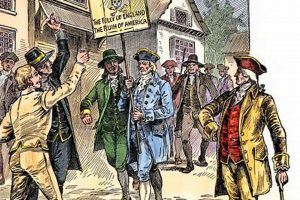
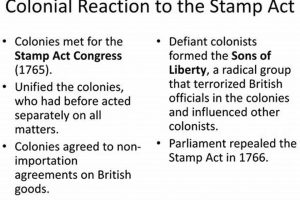
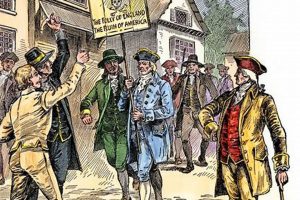
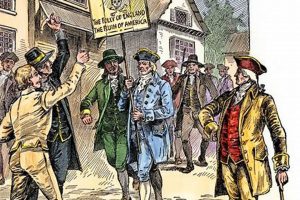
The 1766 cessation of a controversial British tax levied on legal documents, newspapers, pamphlets, and other paper goods in the American colonies marked a significant turning point in colonial history. This tax, imposed the previous year, required colonists to purchase and affix embossed revenue stamps to these items, generating funds for the British crown. Colonial opposition to the tax was widespread and fervent, taking the form of boycotts, protests, and the formation of groups like the Sons of Liberty.
This legislative reversal represented a victory for colonial resistance against perceived unjust taxation without representation. It demonstrated the power of collective action and contributed significantly to the growing tension between Great Britain and its American colonies, ultimately paving the way for the events that would culminate in the American Revolution. The episode highlighted core issues of self-governance and economic independence that became central themes in the struggle for independence.
Further exploration of this historical event can provide valuable insights into the political, economic, and social dynamics that shaped the relationship between Great Britain and its American colonies. Examining the specific grievances, the various forms of protest, and the legislative debates surrounding this pivotal moment offers a deeper understanding of the forces driving the American Revolution.
Tips for Researching the Repeal of the Stamp Act
Understanding the context and significance of the 1766 repeal requires a multifaceted approach. The following tips offer guidance for navigating the historical complexities surrounding this important event.
Tip 1: Explore primary sources. Examining original documents from the period, such as letters, pamphlets, and newspaper articles, provides direct insight into colonial perspectives and reactions.
Tip 2: Consider the British perspective. Researching parliamentary debates and official correspondence illuminates the British government’s motivations and justifications for both imposing and repealing the tax.
Tip 3: Investigate the economic impact. Analyzing the economic consequences of the tax and its repeal on both sides of the Atlantic provides a deeper understanding of the stakeholders involved.
Tip 4: Study the role of key figures. Researching individuals like Benjamin Franklin, George Grenville, and Lord Rockingham reveals the influence of individual actors on the political landscape.
Tip 5: Analyze the different forms of protest. Exploring the diverse methods of resistance employed by colonists, from boycotts to public demonstrations, reveals the depth and breadth of colonial opposition.
Tip 6: Connect the repeal to broader historical trends. Examining the repeal within the larger context of growing tensions between Great Britain and its American colonies clarifies its role in the eventual outbreak of revolution.
By following these research strategies, one can gain a comprehensive understanding of the repeal and its significance in shaping the course of American history. This knowledge illuminates the complex dynamics of power, resistance, and political change during this pivotal era.
This exploration of the repeal sets the stage for a deeper understanding of the American Revolution and the enduring legacy of this crucial historical event.
1. Colonial Resistance

Colonial resistance played a crucial role in the eventual repeal of the Stamp Act. The colonists’ diverse and determined actions demonstrated their refusal to accept taxation without representation, ultimately forcing the British government to reconsider its policy.
- Boycotts of British Goods
Colonists organized widespread boycotts of British goods, significantly impacting British merchants and manufacturers. These boycotts demonstrated the economic power of colonial consumers and put substantial pressure on Parliament to reconsider the Stamp Act. The economic disruption caused by the boycotts served as a powerful argument for repeal.
- Formation of Protest Groups
Groups like the Sons of Liberty emerged throughout the colonies, organizing protests, disseminating information, and intimidating stamp distributors. These groups provided a framework for coordinated resistance and helped mobilize public opinion against the Stamp Act. Their actions contributed to a sense of colonial unity and defiance.
- Petitions and Pamphlets
Colonists circulated petitions and pamphlets articulating their grievances and arguing against the constitutionality of the Stamp Act. These written protests effectively disseminated colonial arguments against taxation without representation to a wider audience, both in the colonies and in Britain. They played a crucial role in shaping public discourse and influencing political opinion.
- Acts of Violence and Intimidation
While less frequent than other forms of protest, acts of violence and intimidation against stamp distributors and British officials underscored the intensity of colonial resistance. These actions, though controversial, highlighted the colonists’ resolve and contributed to the pressure on the British government to repeal the Act. The potential for escalating unrest further motivated British authorities to reconsider the policy.
These combined forms of colonial resistance, ranging from economic pressure to direct action and intellectual arguments, created a climate of instability that ultimately led to the Stamp Act’s repeal. The repeal marked a significant victory for the colonists and demonstrated the potential of collective action, while simultaneously foreshadowing the escalating tensions that would culminate in the American Revolution.
2. Economic Pressures

Economic pressures played a pivotal role in the British Parliament’s decision to repeal the Stamp Act in 1766. The colonial boycotts of British goods, initiated in protest against the Act, had a significant impact on British merchants and manufacturers. These boycotts disrupted transatlantic trade, leading to declining sales, accumulating inventories, and financial losses for British businesses. Merchants and manufacturers, facing economic hardship, exerted considerable pressure on Parliament to repeal the Act and restore profitable trade relations with the colonies. The potential for long-term economic damage to British commercial interests significantly influenced the political calculus in London.
The economic arguments for repeal gained further traction due to the prevailing mercantilist economic theory. Mercantilism emphasized the importance of colonial trade for enriching the mother country. The Stamp Act, while intended to generate revenue, proved counterproductive by disrupting the established trade patterns and ultimately harming British economic interests. This unintended consequence strengthened the case for repeal among those who prioritized the overall health of the British economy over the immediate revenue potential of the Stamp Act.
The repeal of the Stamp Act underscored the power of economic pressure as a tool for political change. The colonists, through their collective action and economic leverage, successfully forced the British government to reconsider a policy deemed detrimental to their interests. The episode serves as a historical example of how economic factors can shape political decisions and illustrates the complex interplay between economic interests and political power in the eighteenth-century Atlantic world. This understanding offers valuable insights into the dynamics that led to the American Revolution and the enduring influence of economic forces on political outcomes.
3. Parliamentary Debates

Parliamentary debates played a crucial role in the repeal of the Stamp Act in 1766. These debates provided a forum for diverse perspectives on colonial policy and taxation, revealing the complex interplay of political, economic, and ideological factors that shaped the decision-making process. The arguments presented in Parliament reflected the divisions within British political circles regarding the best approach to managing the increasingly restive American colonies. Supporters of the Stamp Act, like Prime Minister George Grenville, argued that it was a necessary measure to raise revenue for the defense of the colonies and to assert parliamentary authority over colonial affairs. They emphasized the principle of virtual representation, contending that colonists were represented in Parliament even though they did not elect their own representatives.
Conversely, opponents of the Stamp Act, including prominent figures like William Pitt the Elder, argued that the tax was unjust and counterproductive. They emphasized the principle of no taxation without representation, asserting that the colonists should not be subjected to taxes imposed by a body in which they had no direct voice. They also pointed to the economic consequences of the colonial boycotts, highlighting the damage to British trade and the potential for further unrest. Benjamin Franklin’s testimony before Parliament, offering insights into colonial perspectives and the potential repercussions of the Act, significantly influenced the debate. His reasoned arguments and detailed economic analysis contributed to swaying opinion towards repeal.
The eventual repeal of the Stamp Act demonstrates the importance of parliamentary debates in shaping policy decisions. These debates provided a platform for airing grievances, challenging assumptions, and exploring alternative courses of action. The repeal underscored the power of reasoned argument, economic evidence, and political pressure in influencing legislative outcomes. Studying these debates offers valuable insight into the complexities of British politics and the dynamics that led to the American Revolution. The debates surrounding the Stamp Act exemplify the challenges of balancing imperial control with colonial autonomy and highlight the enduring tension between principles of representation, taxation, and political power.
4. Political Expediency

Political expediency played a significant role in the repeal of the Stamp Act. While principled arguments against taxation without representation contributed to the decision, practical political considerations within the British government ultimately proved decisive. The escalating crisis in the American colonies, coupled with domestic political pressures, forced Parliament to prioritize stability and economic interests over asserting its authority. Understanding the role of political expediency offers insights into the complexities of decision-making and the pragmatic calculations that often shape historical events.
- Maintaining Stability
The growing unrest in the American colonies, marked by boycotts, protests, and the formation of resistance groups, presented a serious threat to British imperial control. The potential for escalating violence and further disruption prompted British authorities to seek a swift resolution to the crisis. Repealing the Stamp Act offered a way to defuse the situation and restore stability, a key concern for a government preoccupied with maintaining order both at home and abroad. The desire to avoid further escalation influenced the decision to prioritize immediate stability over long-term control.
- Economic Considerations
The colonial boycotts of British goods had a substantial impact on British merchants and manufacturers. Declining sales and accumulating inventories created economic hardship and exerted pressure on Parliament to reconsider the Stamp Act. The potential for long-term economic damage, coupled with the prevailing mercantilist emphasis on the importance of colonial trade, provided a strong economic incentive for repeal. Addressing the economic concerns of influential British merchants became a politically expedient course of action for the government.
- Shifting Political Landscape
The fall of Grenville’s government and the rise of the Rockingham administration created a more favorable political climate for repeal. Rockingham and his supporters were more sympathetic to colonial grievances and more willing to compromise. The change in government, coupled with increasing pressure from within Parliament to address the colonial crisis, created an opportunity for repealing the Stamp Act. The political shift provided the necessary impetus for reconsidering the policy.
- Declaratory Act
The simultaneous passage of the Declaratory Act, asserting Parliament’s right to legislate for the colonies “in all cases whatsoever,” served as a politically expedient compromise. While repealing the Stamp Act, the Declaratory Act allowed the British government to maintain its claim of authority over the colonies. This strategic maneuver aimed to appease both colonial interests and those in Britain who insisted on upholding parliamentary sovereignty. The Declaratory Act represented an attempt to balance political realities with the assertion of principle.
The repeal of the Stamp Act, driven by political expediency, reveals the pragmatic considerations often underlying political decisions. While principled arguments played a role, the desire for stability, economic concerns, and shifting political alliances ultimately shaped the outcome. The episode demonstrates the complexities of navigating political pressures and the often-unintended consequences of policy decisions. While the repeal temporarily eased tensions, the underlying issues of representation and colonial autonomy remained unresolved, contributing to the continued escalation towards revolution. The decision reflects the challenges of governing a vast empire and the enduring tension between maintaining control and responding to colonial resistance.
5. Transatlantic Tensions
The repeal of the Stamp Act in 1766 did not erase the underlying transatlantic tensions that fueled colonial resistance. While the repeal served as a temporary reprieve, it also highlighted fundamental disagreements about governance, representation, and economic control, ultimately contributing to the growing divide between Great Britain and its American colonies. Exploring the nature of these tensions offers crucial insights into the dynamics that led to the American Revolution.
- Taxation Without Representation
The core issue of taxation without representation remained a central point of contention. Colonists argued that being subjected to taxes levied by a Parliament in which they lacked direct representation violated their fundamental rights as Englishmen. While the repeal of the Stamp Act addressed the immediate financial burden, it failed to resolve the underlying principle of representative government. This unresolved issue continued to fuel resentment and distrust towards British authority, laying the groundwork for future conflict. The cry of “No taxation without representation” became a rallying cry for colonial resistance and underscored the growing divide between the colonies and the mother country.
- Parliamentary Sovereignty vs. Colonial Autonomy
The tension between parliamentary sovereignty and colonial autonomy became increasingly apparent. The British government maintained its assertion of ultimate authority over the colonies, as exemplified by the Declaratory Act passed alongside the Stamp Act’s repeal. This assertion clashed with the growing desire for self-governance among the colonies. The colonies had developed their own political institutions and traditions of self-rule, fostering a sense of independence that was incompatible with continued subordination to British authority. The conflict between these two opposing views on governance further strained the relationship and set the stage for future confrontations.
- Economic Grievances
Beyond the Stamp Act, broader economic grievances continued to simmer. Colonial merchants chafed under British mercantilist policies that restricted their trade and economic opportunities. These policies, designed to benefit the mother country, fueled resentment among colonial merchants who sought greater economic freedom. The Stamp Act crisis had demonstrated the potential for economic resistance, and colonial merchants remained wary of further British attempts to control colonial trade. These unresolved economic tensions continued to contribute to the growing rift between the colonies and Great Britain.
- Cultural Divergence
Decades of relative autonomy had fostered a distinct American identity, increasingly divergent from British culture and values. This growing cultural divide contributed to a sense of separateness and a weakening of the ties that bound the colonies to the mother country. The experience of resisting the Stamp Act further solidified this sense of American identity and fostered a spirit of collective resistance. The growing cultural divergence, coupled with political and economic grievances, created a fertile ground for revolutionary sentiment.
The repeal of the Stamp Act, while offering a temporary reprieve from escalating tensions, failed to address the fundamental issues that divided Great Britain and its American colonies. The unresolved issues of representation, autonomy, economic grievances, and cultural divergence continued to fester, ultimately contributing to the outbreak of the American Revolution. Understanding these transatlantic tensions is crucial for comprehending the complex dynamics that led to the colonies’ break from British rule and the birth of a new nation.
6. Growing Colonial Unity

The repeal of the Stamp Act in 1766, while driven by a confluence of factors, significantly contributed to a growing sense of unity among the American colonies. The shared experience of resisting the Act fostered a collective identity and demonstrated the potential for coordinated action against perceived British injustices. This burgeoning unity laid the groundwork for future resistance and played a crucial role in the escalating tensions that culminated in the American Revolution. Examining the specific facets of this growing unity provides essential context for understanding the trajectory towards independence.
- Shared Grievances and Common Cause
The Stamp Act impacted colonists across all thirteen colonies, creating a shared experience of grievance against British policies. This common cause transcended regional differences and economic interests, uniting colonists in their opposition to taxation without representation. From merchants in Boston to planters in Virginia, colonists recognized their shared vulnerability to British overreach. This shared experience fostered a sense of collective identity and laid the foundation for future collaborative action.
- Intercolonial Communication and Coordination
The resistance to the Stamp Act necessitated communication and coordination between colonies. Committees of Correspondence were established, facilitating the exchange of information and strategies for resistance. These networks fostered intercolonial dialogue and cooperation, enabling colonists to share news, coordinate boycotts, and organize protests across geographic boundaries. The Sons of Liberty, with chapters in various colonies, also played a vital role in disseminating information and coordinating resistance efforts. This enhanced communication strengthened the bonds between colonies and facilitated a unified response to British policies.
- Realization of Collective Power
The successful repeal of the Stamp Act demonstrated the power of collective action. Colonists realized that their combined efforts, through boycotts, protests, and petitions, could effectively influence British policy. This realization fostered a sense of agency and empowerment, emboldening colonists to challenge future British measures perceived as unjust. The experience of successfully resisting the Stamp Act provided a powerful example of how collective action could achieve tangible political outcomes.
- Development of a Collective Identity
The shared struggle against the Stamp Act fostered the development of a collective American identity distinct from British identity. The experience of resisting British policies, coupled with increasing intercolonial communication and cooperation, fostered a sense of shared purpose and common destiny. This burgeoning American identity contributed to a growing sense of separateness from Great Britain and laid the groundwork for the eventual embrace of independence. The Stamp Act crisis became a defining moment in the development of American national consciousness.
The growing colonial unity fostered by the Stamp Act crisis proved crucial in the years leading up to the American Revolution. The shared experience of resistance, enhanced communication networks, realization of collective power, and development of a shared identity laid the foundation for future coordinated action against British policies. The repeal of the Stamp Act, while intended to quell unrest, inadvertently contributed to the very forces that would ultimately lead to the colonies’ break from British rule. The episode underscores the unintended consequences of political decisions and the power of collective action in shaping historical outcomes.
Frequently Asked Questions
The repeal of the Stamp Act remains a pivotal moment in American colonial history. This section addresses common questions surrounding the Act’s repeal, offering further clarity on its causes, consequences, and historical significance.
Question 1: Why was the Stamp Act repealed despite the British government’s initial insistence on its necessity?
The Stamp Act’s repeal stemmed from a combination of factors, including widespread colonial resistance through boycotts, which significantly impacted British trade. Parliamentary debates revealed divisions within the British government regarding colonial policy. Ultimately, political expediency, coupled with pressure from British merchants facing economic hardship, led to the repeal.
Question 2: Did the repeal of the Stamp Act resolve the underlying tensions between Great Britain and the American colonies?
While the repeal provided temporary relief, it failed to address the fundamental issue of taxation without representation. The Declaratory Act, passed alongside the repeal, asserted Parliament’s continued right to legislate for the colonies, leaving core grievances unresolved and contributing to ongoing tensions.
Question 3: How did colonial resistance contribute to the Stamp Act’s repeal?
Colonial resistance took various forms, including boycotts of British goods, formation of protest groups like the Sons of Liberty, petitions, pamphlets, and occasional acts of violence. These actions demonstrated the colonists’ resolve and exerted significant pressure on the British government, both economically and politically, ultimately forcing a reconsideration of the Stamp Act.
Question 4: What was the economic impact of the Stamp Act and its subsequent repeal?
The Stamp Act disrupted transatlantic trade and negatively impacted British merchants and manufacturers. The colonial boycotts significantly reduced the demand for British goods, leading to economic hardship. The repeal aimed to restore these trade relationships and alleviate the economic pressures on British businesses.
Question 5: What role did key figures play in the events surrounding the Stamp Act’s repeal?
Individuals like Benjamin Franklin, George Grenville, Lord Rockingham, and William Pitt the Elder played influential roles. Franklin’s testimony before Parliament provided crucial insight into colonial perspectives. Grenville championed the Stamp Act, while Rockingham’s government oversaw its repeal. Pitt advocated for colonial rights and argued against taxation without representation.
Question 6: What is the lasting legacy of the Stamp Act and its repeal?
The Stamp Act crisis and its repeal represent a pivotal turning point in the relationship between Great Britain and the American colonies. The episode demonstrated the power of colonial resistance, highlighted the unresolved issues of representation and autonomy, and contributed significantly to the growing tensions that culminated in the American Revolution. It serves as a crucial lesson on the interplay of political power, economic interests, and the struggle for self-governance.
Understanding the context and complexities of the Stamp Act’s repeal provides valuable insights into the dynamics that shaped the American Revolution. Further exploration of this pivotal event enhances ones understanding of the forces driving the movement towards independence.
This FAQ section provides a foundation for further investigation into the political, economic, and social factors that shaped this pivotal moment in American history. Continuing this exploration will enrich one’s understanding of the American Revolution and its enduring legacy.
Conclusion
The 1766 rescission of the tax on printed materials in the American colonies signifies a critical juncture in the unfolding narrative of transatlantic relations. This exploration has highlighted the confluence of factors that led to the policy reversal: colonial resistance through boycotts and protests, economic pressures on British merchants, shifting political dynamics within the British government, and the unresolved tension between parliamentary sovereignty and colonial autonomy. While celebrated as a victory for colonial resistance, the underlying issues of representation and self-governance remained unresolved, foreshadowing the escalating conflict that would culminate in revolution.
The examination of this historical episode offers valuable insights into the complex interplay of political power, economic interests, and the struggle for self-determination. The legacy of this legislative reversal resonates far beyond its immediate impact, serving as a potent reminder of the enduring power of collective action, the importance of political representation, and the long-term consequences of unresolved grievances. Continued study of this era allows for a deeper understanding of the forces that shaped the American Revolution and the enduring principles upon which the nation was founded.