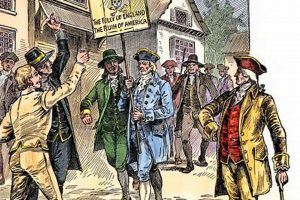
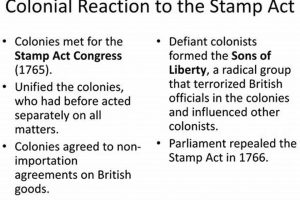
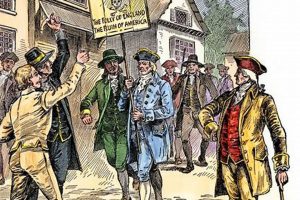
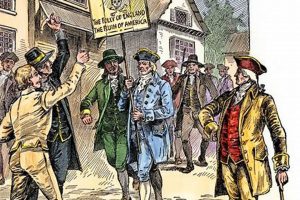
The 1765 gathering of colonial delegates, known as the Stamp Act Congress, marked a pivotal moment in American history. This assembly, comprised of representatives from nine colonies, convened in New York City to formulate a unified response to the recently imposed Stamp Act by the British Parliament. The act, which required a tax stamp on all printed materials, including newspapers, legal documents, and playing cards, was seen by the colonists as a direct threat to their rights and liberties, particularly the right to be taxed only by their own elected representatives.
The Congress’s significance lies primarily in its demonstration of intercolonial unity and resistance. For the first time, representatives from different colonies met to coordinate a collective response to British policy. The resulting “Declaration of Rights and Grievances” asserted the colonists’ rights as Englishmen, including the right to trial by jury and the principle of “no taxation without representation.” This declaration, sent to King George III and Parliament, became a cornerstone of colonial arguments against British policies and helped solidify colonial opposition, laying crucial groundwork for the eventual revolution. The Congress also fostered the development of committees of correspondence, which facilitated communication and coordination among the colonies, further strengthening their collective identity and resolve.
The legacy of this event resonates throughout the narrative of American independence. Its emphasis on colonial rights, intercolonial cooperation, and organized resistance established principles that would shape the course of events leading to the American Revolution. Understanding this historical context is essential for comprehending the subsequent escalation of tensions between Great Britain and its American colonies.
Understanding the Significance of the Stamp Act Congress
The Stamp Act Congress holds a crucial place in American history. Grasping its importance requires exploring the context surrounding the event and its lasting implications. The following tips offer guidance on navigating this historical period.
Tip 1: Research the political climate of the 1760s. Explore the relationship between Great Britain and its American colonies before the Stamp Act. Understanding the existing tensions and evolving colonial identity provides critical background.
Tip 2: Examine the Stamp Act itself. Analyze the specific provisions of the act and the rationale behind its implementation from both the British and colonial perspectives. This analysis reveals the act’s impact on colonial life and commerce.
Tip 3: Study the Declaration of Rights and Grievances. This document encapsulates the colonists’ central arguments against the Stamp Act and articulates their understanding of their rights as Englishmen. Close examination reveals the philosophical underpinnings of colonial resistance.
Tip 4: Consider the role of intercolonial communication. The Stamp Act Congress facilitated dialogue and collaboration between colonies. Researching the committees of correspondence reveals the development of a unified colonial identity and resistance strategy.
Tip 5: Explore the consequences of the Stamp Act Congress. The Congress significantly influenced the escalating tensions between Great Britain and its American colonies. Understanding its aftermath provides crucial context for the eventual outbreak of the American Revolution.
Tip 6: Connect the Stamp Act Congress to broader themes. Explore the concepts of representation, taxation, and political liberty within the broader context of the Enlightenment and the evolution of democratic ideals. This exploration provides a richer understanding of the period’s significance.
By understanding these points, one gains a deeper appreciation for the Stamp Act Congress and its enduring relevance to the narrative of American independence.
Further exploration of these themes will provide a comprehensive understanding of the events that shaped the course of American history.
1. First Unified Colonial Response

The Stamp Act Congress represents a landmark achievement: the first unified colonial response to British policy. Prior to 1765, colonial responses to perceived injustices were largely localized and fragmented. The Stamp Act, however, galvanized opposition across multiple colonies, prompting the unprecedented convening of representatives in a collective display of resistance. This unified front significantly altered the dynamics of the colonial relationship with Great Britain, marking a critical turning point on the path toward revolution.
- Collective Grievance:
The Stamp Act impacted all colonies, fostering a shared sense of grievance. This widespread discontent created fertile ground for collective action, overcoming regional differences and fostering a sense of pan-colonial identity. The shared experience of being subjected to an unjust external force became a unifying factor.
- Formalized Communication & Coordination:
The Congress established formal channels of communication and coordination between colonies. Delegates from nine colonies convened, debated, and ultimately drafted a unified declaration of rights and grievances. This formal structure facilitated collaborative action that amplified colonial voices and enabled a more powerful collective response.
- Demonstration of Colonial Solidarity:
The very act of convening the Congress sent a powerful message to Great Britain: the colonies were capable of acting in concert. This demonstration of solidarity underscored the potential strength of a united colonial front, challenging British assumptions about colonial disunity and laying the groundwork for future coordinated resistance.
- Precedent for Future Action:
The Stamp Act Congress served as a crucial precedent for future intercolonial cooperation. The mechanisms established for communication, debate, and collective action would be instrumental in the years leading up to the American Revolution. It established a framework for future congresses and committees, further solidifying colonial unity.
The unified response embodied by the Stamp Act Congress profoundly shifted the relationship between the colonies and Great Britain. By demonstrating their capacity for collective action, the colonies signaled a new era of resistance, setting the stage for the escalating tensions that would ultimately culminate in the American Revolution. The Congress not only addressed the immediate concerns of the Stamp Act but also laid the foundation for the coordinated efforts that would define the struggle for independence.
2. Assertion of Colonial Rights

The Stamp Act Congress served as a critical platform for the assertion of colonial rights, marking a significant escalation in the growing tension between Great Britain and its American colonies. The Congress provided a forum for colonists to articulate their grievances and formally declare their understanding of their rights as Englishmen, directly challenging British authority and setting the stage for future revolutionary action. This assertion of rights was not merely a reaction to the Stamp Act itself, but represented a broader philosophical and political disagreement about the nature of the relationship between the colonies and the mother country.
- No Taxation Without Representation:
This core principle, articulated forcefully by the Congress, became a rallying cry for colonial resistance. It argued that colonists, like their counterparts in Britain, could not be subjected to taxation without the consent of their elected representatives. The Stamp Act, imposed by the British Parliament where colonists had no representation, directly violated this principle. This argument resonated deeply within the colonies and provided a powerful justification for resistance.
- Rights of Englishmen:
The Congress asserted that colonists possessed the same fundamental rights as Englishmen residing in Great Britain. These rights, including the right to trial by jury and protection from arbitrary taxation, were considered inherent and inalienable. By emphasizing these shared rights, the colonists challenged the legitimacy of British policies that treated them as second-class citizens. This assertion of equal rights laid the groundwork for future arguments for self-governance and independence.
- Right to Petition and Assembly:
The Stamp Act Congress itself demonstrated the colonists’ right to assemble and petition the government for redress of grievances. The very act of convening the Congress, drafting resolutions, and sending petitions to the King and Parliament affirmed these fundamental rights. By exercising these rights, the colonists challenged British attempts to suppress dissent and control colonial affairs.
- Influence of Enlightenment Ideals:
The assertion of colonial rights reflected the influence of Enlightenment ideals, particularly the concepts of natural rights, popular sovereignty, and limited government. Thinkers like John Locke profoundly influenced colonial political thought, providing a philosophical framework for challenging the legitimacy of arbitrary rule. The Congress’s declarations echoed these Enlightenment principles, further solidifying the intellectual and philosophical basis for resistance.
The assertion of colonial rights at the Stamp Act Congress marked a turning point in the relationship between Great Britain and its American colonies. By formally articulating their grievances and declaring their understanding of their rights, the colonists challenged the very foundation of British authority in North America. This bold stance set in motion a chain of events that ultimately led to the American Revolution. The Congress’s declarations provided a framework for future resistance, shaping the arguments and actions that would define the struggle for independence.
3. "No Taxation Without Representation"
The slogan “No taxation without representation” became a cornerstone of colonial resistance and is inextricably linked to the significance of the Stamp Act Congress. The Stamp Act, passed by the British Parliament in 1765, imposed a tax on all printed materials in the colonies. Crucially, the colonies lacked direct representation in Parliament, meaning they had no voice in the decision-making process that levied this tax. The Stamp Act Congress, convened in response to this perceived injustice, provided a platform for colonists to articulate their grievances and formally declare their opposition to taxation without representation. This principle, rooted in the belief that individuals should not be subjected to taxes imposed by a body in which they have no voice, became a powerful rallying cry and a central tenet of the growing movement for colonial independence.
The Congress’s adoption of “No taxation without representation” as a core principle had several significant consequences. Firstly, it provided a clear and concise articulation of colonial grievances, framing the conflict not merely as a dispute over a specific tax, but as a fundamental disagreement about the nature of political representation and the relationship between the colonies and Great Britain. Secondly, it fostered a sense of unity and shared purpose among the colonies, providing a common cause around which they could rally. The shared experience of being taxed without representation transcended regional differences and fostered a sense of collective identity. For instance, merchants in Boston, printers in Philadelphia, and lawyers in Charleston all found common ground in their opposition to the Stamp Act and the principle it violated. This unified front strengthened the colonial position and increased the pressure on British authorities.
The principle of “No taxation without representation” transcended the immediate context of the Stamp Act and had lasting implications for the development of American political thought. It laid the groundwork for future arguments against British policies and ultimately contributed to the colonists’ justification for declaring independence. The emphasis on representation and consent of the governed became central tenets of American democracy, enshrined in the Declaration of Independence and the U.S. Constitution. Understanding the historical context of “No taxation without representation” within the framework of the Stamp Act Congress is crucial for appreciating the origins of American revolutionary thought and the development of democratic principles in the United States. The challenges posed by balancing the interests of a central authority with the rights of individuals and the importance of representation continue to be relevant in contemporary political discourse.
4. Precursor to Future Cooperation

The Stamp Act Congress served as a crucial precursor to future intercolonial cooperation, laying the groundwork for the unified resistance that would characterize the American Revolution. Prior to 1765, colonial responses to British policies were largely localized and fragmented. The Stamp Act, however, with its broad impact across the colonies, catalyzed a collective response. The Congress provided a forum for representatives from different colonies to meet, deliberate, and formulate a unified strategy. This experience of working together, sharing grievances, and developing common goals fostered a sense of collective identity and purpose, establishing a framework for future collaborative action.
The practical significance of this newfound cooperation cannot be overstated. The Congress established committees of correspondence, which facilitated communication and information sharing between the colonies. This network proved invaluable in the years leading up to the Revolution, enabling colonists to coordinate responses to British policies, disseminate revolutionary ideas, and mobilize support for independence. For example, the rapid dissemination of information about the Boston Tea Party through these networks fueled outrage across the colonies and contributed to the growing momentum for revolution. The First Continental Congress, convened in 1774, directly benefited from the precedent set by the Stamp Act Congress, demonstrating the enduring legacy of this early cooperative effort.
The Stamp Act Congress, therefore, represents a pivotal moment in the development of American colonial unity. It demonstrated the potential for collective action, established vital communication networks, and fostered a sense of shared purpose. These developments proved essential in the subsequent struggle for independence, demonstrating that the Congress’s significance extended far beyond its immediate response to the Stamp Act. The ability to overcome regional differences and work together for a common cause, forged in the crucible of the Stamp Act crisis, became a defining characteristic of the American Revolution and a cornerstone of the nation’s eventual success. This legacy of cooperation continues to shape American political and social landscapes, highlighting the enduring importance of collective action in addressing shared challenges.
5. Foundation for Committees of Correspondence

The Stamp Act Congress of 1765 holds significant historical importance, partly due to its role as a foundation for the committees of correspondence. While the Congress itself addressed the immediate concerns of the Stamp Act, the establishment of these committees represents a crucial, albeit indirect, outcome with far-reaching consequences. These committees facilitated communication and coordination among the colonies, proving instrumental in the escalating resistance against British policies leading up to the American Revolution. The Congress demonstrated the potential for intercolonial cooperation, and the committees provided the necessary structure to transform that potential into a powerful force for change. This connection highlights the Congress’s enduring legacy beyond its immediate response to the Stamp Act.
Committees of correspondence emerged organically in the wake of the Stamp Act Congress. Initially formed within individual colonies, they served as a means of disseminating information about British policies and coordinating responses. The Sons of Liberty, a prominent activist group, played a crucial role in establishing and utilizing these networks. Intercolonial committees soon followed, significantly enhancing communication and fostering a greater sense of unity among the colonies. For instance, Samuel Adams, a key figure in the Massachusetts committee, played a pivotal role in connecting with other colonies, sharing information, and strategizing resistance efforts. These communication channels proved vital in mobilizing public opinion against British policies and coordinating actions like boycotts, protests, and eventually, the formation of provincial congresses. Without the groundwork laid by the Stamp Act Congress, the rapid and effective dissemination of revolutionary ideas and the coordination of resistance across geographically dispersed colonies would have been significantly more challenging.
In summary, the establishment of committees of correspondence stands as a testament to the enduring significance of the Stamp Act Congress. While the Congress itself addressed the immediate grievances surrounding the Stamp Act, the subsequent development of these communication networks proved crucial in the escalating tensions with Great Britain. The committees transformed the potential for intercolonial cooperation, demonstrated at the Congress, into a powerful instrument of resistance. This understanding underscores the importance of the Stamp Act Congress not just as a response to a specific tax, but as a catalyst for the broader movement toward American independence. The Congress laid the foundation for the organized resistance that would define the American Revolution, illustrating the profound impact of seemingly localized events on the larger course of history.
6. Direct Challenge to British Authority
The Stamp Act Congress represents a significant turning point in colonial relations with Great Britain, marking a direct challenge to British authority previously unseen in its unified and organized form. While earlier instances of colonial dissent existed, the Congress signified a departure from localized grievances to a collective assertion of colonial rights and autonomy. This direct challenge, rooted in the principle of “no taxation without representation,” laid the groundwork for the escalating tensions that would culminate in the American Revolution. Examining the specific facets of this challenge provides a deeper understanding of the Congress’s historical significance.
- Declaration of Rights and Grievances:
The Congress’s formal declaration, outlining colonial rights and grievances against the Stamp Act, directly challenged Parliament’s authority to tax the colonies without their consent. This document, sent to King George III and Parliament, explicitly stated the colonists’ belief in their rights as Englishmen and their refusal to accept taxation without representation. This act of defiance, unprecedented in its scope and formality, signaled a shift in colonial attitudes towards British rule, moving from quiet dissent to open resistance.
- Unified Colonial Action:
The very act of convening the Congress demonstrated a unified colonial front against British policy. Representatives from nine different colonies, overcoming regional differences and historical tensions, came together to formulate a collective response. This unprecedented display of unity sent a powerful message to British authorities, demonstrating the potential for coordinated resistance and challenging the assumption of colonial fragmentation. The collective action demonstrated by the Congress directly contradicted British perceptions of colonial weakness and disunity.
- Enforcement of Boycotts:
Beyond the formal declarations, the Congress endorsed and encouraged colonial boycotts of British goods. These boycotts, enforced through local committees and popular pressure, directly challenged British economic interests in the colonies. The widespread adherence to these boycotts demonstrated the colonists’ resolve and their ability to exert economic pressure on Great Britain, challenging the effectiveness of British mercantilist policies and demonstrating a tangible form of resistance beyond mere rhetoric.
- Establishment of Committees of Correspondence:
The foundation for committees of correspondence, laid by the Stamp Act Congress, further solidified the challenge to British authority. These committees facilitated communication and coordination among the colonies, creating a shadow network of information and organization outside of official British channels. This independent communication network effectively bypassed British authority and allowed for the rapid dissemination of revolutionary ideas and the coordination of resistance efforts, creating a parallel power structure that challenged British control.
The Stamp Act Congress’s direct challenge to British authority marked a critical turning point in the relationship between Great Britain and its American colonies. The Congress’s actions, from the formal declaration of rights to the endorsement of boycotts and the establishment of communication networks, signaled a new era of colonial resistance. This unified and organized defiance laid the groundwork for the escalating tensions that would ultimately lead to the American Revolution, demonstrating the profound and lasting impact of the Congress’s challenge to British rule.
7. Catalyst for Escalating Tensions
The Stamp Act Congress, while intended to address the immediate issue of the Stamp Act, inadvertently served as a catalyst for escalating tensions between Great Britain and its American colonies. The Congress’s actions, though initially aimed at seeking redress through established channels, ultimately contributed to a hardening of positions on both sides and set in motion a chain of events that propelled the colonies toward revolution. Understanding this catalytic role is crucial for grasping the full significance of the Congress in the broader context of American history.
- Hardening of Colonial Resolve:
The Stamp Act Congress solidified colonial resistance by providing a platform for shared grievances and unified action. The experience of collective action and the articulation of shared principles, such as “no taxation without representation,” strengthened colonial resolve against British policies. This hardening of resolve made future compromise more difficult and contributed to the escalation of the conflict. The success of the Congress in achieving the repeal of the Stamp Act, largely through boycotts and popular pressure, further emboldened colonial resistance and demonstrated the potential power of collective action.
- British Misinterpretation of Colonial Grievances:
The British government largely misconstrued the nature and depth of colonial discontent expressed at the Congress. They viewed the colonial protests as primarily driven by economic self-interest rather than genuine concerns about political representation and fundamental rights. This misinterpretation led to a dismissive and inflexible response from British authorities, further exacerbating tensions and fueling colonial resentment. The British government’s failure to address the underlying political concerns laid the groundwork for future conflicts.
- Increased Polarization and Radicalization:
The Stamp Act Congress, and the British response to it, contributed to increased polarization within the colonies. While some colonists favored a more conciliatory approach, the perceived intransigence of the British government fueled the growth of more radical factions advocating for greater autonomy and even independence. Figures like Samuel Adams and Patrick Henry gained prominence during this period, advocating for more assertive resistance against British policies. This polarization made it increasingly difficult to find common ground and contributed to the escalating cycle of action and reaction.
- Emboldened Colonial Resistance:
The perceived success of the Stamp Act Congress in securing the repeal of the Stamp Act, achieved largely through boycotts and popular pressure, emboldened colonial resistance. This success demonstrated the potential power of collective action and encouraged colonists to adopt more assertive tactics in future disputes with Great Britain. The experience of the Congress provided a blueprint for future resistance efforts, including the formation of the First Continental Congress, and fostered a sense of confidence in the ability of the colonies to challenge British authority effectively.
The Stamp Act Congress’s role as a catalyst for escalating tensions underscores its significance in the trajectory toward revolution. While not intended to ignite a war, the Congress’s actions, coupled with the British government’s response, created a climate of distrust and animosity that made peaceful resolution increasingly difficult. The Congress thus represents a pivotal moment in American history, marking a shift from localized grievances to organized resistance and setting the stage for the tumultuous events that would follow.
Frequently Asked Questions
The following addresses common inquiries regarding the historical significance of the Stamp Act Congress.
Question 1: Why was the Stamp Act Congress significant?
The Stamp Act Congress marked the first significant unified colonial response to British policy. It established a precedent for intercolonial cooperation, articulated colonial grievances, and laid the groundwork for future resistance efforts. The Congress’s actions demonstrated the potential for collective action and contributed to the escalating tensions that ultimately led to the American Revolution.
Question 2: What were the key outcomes of the Stamp Act Congress?
Key outcomes include the Declaration of Rights and Grievances, which asserted colonial rights and protested taxation without representation; the adoption of the principle of “no taxation without representation” as a core tenet of colonial resistance; and the establishment of committees of correspondence, which facilitated communication and coordination among the colonies.
Question 3: How did the Stamp Act Congress contribute to the American Revolution?
The Congress fostered a sense of colonial unity and solidified resistance against British policies. Its actions, coupled with the British government’s response, escalated tensions and contributed to the growing movement for independence. The Congress provided a blueprint for future resistance and laid the foundation for the coordinated efforts that would define the revolution.
Question 4: What was the British reaction to the Stamp Act Congress?
The British government largely underestimated the significance of the Congress and misconstrued the depth of colonial discontent. They viewed colonial protests as driven primarily by economic concerns rather than fundamental issues of political representation and rights. This misinterpretation contributed to a hardening of positions on both sides and further fueled colonial resentment.
Question 5: How did the Stamp Act Congress influence American political thought?
The Congress’s emphasis on principles like “no taxation without representation,” the rights of Englishmen, and the importance of political representation significantly influenced American political thought. These concepts became central tenets of American revolutionary ideology and laid the groundwork for the development of democratic principles in the newly formed nation.
Question 6: What is the lasting legacy of the Stamp Act Congress?
The Stamp Act Congress demonstrated the power of collective action, established a framework for intercolonial cooperation, and articulated core principles of American political thought. Its legacy lies in its contribution to the American Revolution, the development of American democracy, and the enduring importance of civic engagement and resistance against perceived injustice.
Understanding the context and significance of the Stamp Act Congress is crucial for comprehending the origins of the American Revolution and the development of American political thought. Further exploration of these topics offers a deeper understanding of this pivotal period in history.
The Enduring Significance of the Stamp Act Congress
The Stamp Act Congress stands as a pivotal moment in the journey toward American independence. This analysis has explored the multifaceted significance of this event, highlighting its role as a catalyst for colonial unity, a platform for asserting fundamental rights, and a precursor to the organized resistance that defined the American Revolution. The Congress’s legacy extends beyond the immediate crisis of the Stamp Act, shaping the course of American history and contributing to the development of core democratic principles. From the articulation of “no taxation without representation” to the establishment of vital communication networks, the Congress’s actions laid the groundwork for the struggle for independence and profoundly influenced the development of American political thought.
The Stamp Act Congress serves as a powerful reminder of the transformative potential of collective action and the enduring importance of defending fundamental rights. Its legacy continues to resonate, offering valuable lessons about civic engagement, the pursuit of liberty, and the ongoing struggle for a more just and equitable society. Further exploration of this period encourages a deeper understanding of the historical forces that shaped the nation and the enduring relevance of these events in contemporary political discourse.