The British Parliament’s passage of the Stamp Act in 1765 marked a significant turning point in the relationship between Great Britain and its American colonies. This legislation imposed a tax on all printed materials in the colonies, including newspapers, legal documents, pamphlets, and playing cards. These materials were required to bear an embossed revenue stamp as proof of payment.
This act represented a novel approach to colonial taxation. Previously, taxes had primarily focused on regulating trade. The Stamp Act, however, aimed directly at raising revenue for the British crown to offset the costs incurred during the French and Indian War (Seven Years’ War). The British government argued that the colonies benefited from the protection provided by the British military and should therefore contribute to its upkeep. However, the colonists largely viewed the act as an unjust and unconstitutional measure, as they lacked direct representation in Parliament. The cry of “No taxation without representation” became a rallying cry, fueling resistance and ultimately contributing to the escalating tensions that led to the American Revolution.
This pivotal moment in history raises key questions about the nature of representation, the limits of imperial power, and the origins of American independence. Further exploration will delve into the colonial response to the Stamp Act, the role of key figures in the resistance movement, and the act’s eventual repeal.
Understanding the Stamp Act of 1765
The Stamp Act of 1765 holds significant historical importance. Gaining a deeper understanding of its intricacies offers valuable insights into the escalating tensions between Great Britain and its American colonies. The following tips provide a framework for navigating this complex historical event.
Tip 1: Consider the Financial Context. The British government faced substantial debt following the French and Indian War. The Stamp Act was intended to generate revenue to offset these war costs. Examining the financial motivations behind the act helps illuminate its purpose.
Tip 2: Explore the Concept of Virtual Representation. The British government maintained that the colonists were virtually represented in Parliament, even without elected representatives from the colonies. Understanding this concept is crucial to grasping the core arguments surrounding the act’s legitimacy.
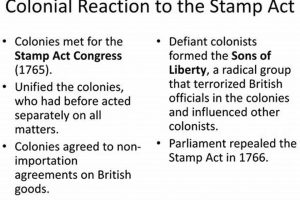
Tip 3: Analyze Colonial Reactions. The Stamp Act sparked widespread outrage and resistance in the American colonies. Exploring the various forms of protest, from boycotts to the formation of groups like the Sons of Liberty, provides crucial context.
Tip 4: Research the Role of Key Figures. Individuals like Samuel Adams, Patrick Henry, and James Otis played pivotal roles in organizing and leading the resistance against the Stamp Act. Researching their contributions offers valuable insights into the dynamics of the era.
Tip 5: Investigate the Act’s Repeal. The Stamp Act was eventually repealed in 1766 due to mounting pressure from colonial resistance and British merchants affected by colonial boycotts. Understanding the factors leading to the repeal is essential.
Tip 6: Connect the Stamp Act to Broader Historical Trends. The Stamp Act was not an isolated incident but part of a larger pattern of escalating tensions between Great Britain and its American colonies. Placing it within the context of events leading up to the American Revolution is crucial for a comprehensive understanding.
By exploring these different facets of the Stamp Act, one can gain a deeper appreciation for its significance as a catalyst for the American Revolution.
Further examination of these topics will provide a richer understanding of this pivotal period in history and its lasting impact.
1. Fund Colonial Defense

The British government’s decision to enact the Stamp Act in 1765 stemmed partly from the considerable expense of defending the American colonies. The recently concluded French and Indian War, while securing British dominance in North America, had incurred significant debt. Maintaining a standing army in the colonies for continued protection against Native American uprisings and potential French resurgence required substantial ongoing funding. The Stamp Act, therefore, represented an attempt to shift some of the financial burden of colonial defense onto the colonists themselves. This rationale, while seemingly logical from the British perspective, overlooked a crucial element: the colonists’ lack of direct representation in Parliament. This perceived injustice ignited widespread resentment and fueled the flames of revolution.
The cost of maintaining several regiments in North America following the French and Indian War placed a significant strain on the British treasury. Stationing troops, providing supplies, and constructing fortifications all contributed to the escalating expenses. The British government argued that the colonists, as beneficiaries of this military presence, should contribute financially. Examples of expenses included fortifying key locations like Fort Pitt (modern-day Pittsburgh), supplying troops with provisions and equipment, and managing logistical challenges across vast distances. The Stamp Act, in theory, offered a means to generate revenue specifically designated for these defense-related costs. However, the colonists viewed the act not as a contribution to their own defense, but rather as an exploitative measure imposed without their consent.
The connection between funding colonial defense and the Stamp Act reveals a fundamental disconnect between the British government and the American colonies. While the British viewed the act as a pragmatic solution to a financial problem, the colonists saw it as a violation of their rights. This divergence in perspective underscores the growing tensions that ultimately led to the American Revolution. The Stamp Act’s failure to achieve its intended financial goals demonstrates the importance of considering colonial sentiment and the principles of representative government when implementing new policies. The ensuing colonial resistance and the eventual repeal of the Stamp Act highlight the limitations of imposing taxes without the consent of the governed.
2. Offset War Debts
The British government faced a substantial financial burden following the Seven Years’ War, also known as the French and Indian War in North America. This conflict, spanning from 1756 to 1763, involved extensive military campaigns across Europe, North America, and other regions. The costs associated with deploying troops, supplying provisions, and maintaining naval operations accumulated significantly, leading to a substantial national debt. Offsetting this war debt became a primary concern for the British Parliament. The Stamp Act of 1765 emerged as one measure intended to address this financial strain. By imposing a tax on printed materials within the American colonies, Parliament aimed to generate revenue to contribute towards alleviating the accumulated war debt. This direct taxation of the colonies represented a departure from previous practices, which primarily focused on regulating trade through duties and tariffs.
The decision to impose the Stamp Act was influenced by several factors beyond simply offsetting war debts. While the financial burden of the war provided a strong impetus, the British government also sought to assert greater control over the American colonies. The war had demonstrated the colonies’ increasing economic and political importance, and Parliament aimed to consolidate imperial authority and ensure the colonies contributed more directly to the empire’s financial stability. The Stamp Act, therefore, served a dual purpose: raising revenue and reinforcing British control. The act’s implementation, however, encountered significant resistance from the colonists, who viewed it as an infringement upon their rights and a form of taxation without representation. This resistance ultimately led to the act’s repeal in 1766, demonstrating the limitations of attempting to impose financial burdens without considering the colonists’ perspectives and concerns.
The Stamp Act’s connection to offsetting war debts underscores the complex relationship between finance, politics, and imperial control in the eighteenth century. The British government’s attempt to address its financial woes through direct taxation of the colonies inadvertently sparked a chain of events that contributed to the growing divide between Britain and its American colonies. The act’s failure to achieve its intended financial goals highlights the importance of understanding the political and social context within which such measures are implemented. The Stamp Act serves as a historical example of the unintended consequences that can arise when financial pressures intersect with evolving political landscapes.
3. Assert Parliamentary Authority
The Stamp Act of 1765 served not only as a revenue-generating measure but also as a crucial instrument for asserting parliamentary authority over the American colonies. Following the French and Indian War, the British government sought to consolidate its control and establish a clearer hierarchy within the empire. The act represented a deliberate attempt to demonstrate Parliament’s power to legislate for the colonies, even in matters of internal taxation, a domain previously largely untouched by direct British intervention. This assertion of authority aimed to curtail the growing autonomy of the colonial assemblies and reinforce the principle of parliamentary supremacy.
- Direct Taxation:
Previous forms of colonial taxation, such as the Sugar Act, primarily focused on regulating trade. The Stamp Act, however, imposed a direct internal tax on the colonies. This unprecedented move signaled Parliament’s intent to exert greater control over colonial finances and internal affairs, directly challenging the authority of colonial legislatures, which historically held sway over internal taxation.
- Legislative Supremacy:
The Stamp Act underscored Parliament’s claim of legislative supremacy over the colonies. By enacting legislation directly affecting the colonies’ internal affairs, Parliament aimed to solidify its position as the ultimate governing body within the British Empire. This directly challenged the colonists’ growing sense of self-governance and their belief in the autonomy of their local assemblies.
- Enforcement Mechanisms:
The act established mechanisms for enforcement, including the use of Admiralty Courts, which operated without juries. This bypassed colonial legal systems and demonstrated Parliament’s resolve to enforce its legislation directly. This not only circumvented established colonial legal procedures but also served as a stark reminder of Parliament’s overriding authority.
- Symbolic Importance:
Beyond its financial implications, the Stamp Act held symbolic importance. It represented a clear statement of Parliament’s intent to exert greater control over the colonies and curtail their growing independence. The act’s very existence, regardless of the revenue generated, symbolized Parliament’s claim to ultimate authority, fueling colonial resentment and resistance.
The assertion of parliamentary authority inherent in the Stamp Act proved to be a miscalculation. Instead of reinforcing British control, it galvanized colonial resistance. The colonists’ outcry against the act centered on the principle of “no taxation without representation,” highlighting their belief that Parliament lacked the legitimacy to impose internal taxes without their consent. This resistance ultimately led to the act’s repeal, but the underlying tension regarding parliamentary authority remained a central issue in the escalating conflict that culminated in the American Revolution. The Stamp Act, therefore, serves as a pivotal example of how an attempt to assert control can inadvertently fuel the very forces it seeks to suppress.
4. Control Colonial Printing
The Stamp Act of 1765, while ostensibly designed to raise revenue, also served as a mechanism for controlling colonial printing. By requiring a tax stamp on all printed materials, including newspapers, pamphlets, legal documents, and even playing cards, Parliament exerted influence over the dissemination of information and ideas within the colonies. This control held significant implications, given the vital role of printed materials in fostering public discourse and mobilizing political action. The act’s impact on colonial printing extended beyond mere taxation; it represented an attempt to regulate the flow of information and potentially stifle dissent against British policies. Examples include the requirement for newspapers to bear the tax stamp, effectively increasing the cost of publication and potentially limiting readership, especially amongst those critical of British rule.
The ability to control the press held significant political ramifications in the eighteenth century. Printed materials served as primary vehicles for disseminating news, political opinions, and revolutionary ideas. By imposing a tax on printed matter, the British government aimed to limit the circulation of potentially subversive materials and maintain a tighter grip on public discourse within the colonies. The act’s impact can be observed in the increased costs associated with publishing newspapers and pamphlets, potentially hindering the dissemination of anti-British sentiment. Furthermore, the act required printers to obtain stamps from designated officials, creating an additional layer of bureaucratic control and potentially enabling selective enforcement against publishers deemed critical of British rule. This added layer of control could be used to suppress dissenting voices and manipulate the flow of information to favor the British government’s narrative.
The connection between the Stamp Act and control over colonial printing highlights the importance of a free press in a democratic society. The attempt to regulate and control the dissemination of information through taxation reveals the British government’s concern over the power of the printed word. This episode underscores the vital role of a free and independent press in facilitating open dialogue, holding power accountable, and fostering a well-informed citizenry. The colonial reaction to the Stamp Act, including boycotts of British goods and organized protests, demonstrates the importance that colonists placed on freedom of expression and the free exchange of ideas. The act’s eventual repeal underscored the limitations of attempting to control information flow and ultimately contributed to the growing movement for colonial independence.
5. Generate Revenue
The British Parliament’s enactment of the Stamp Act in 1765 stemmed significantly from the need to generate revenue. Following the costly French and Indian War, the British treasury faced substantial debt. The act, which imposed a tax on all printed materials in the American colonies, aimed to directly contribute to alleviating this financial burden. Understanding the revenue-generating aspect of the Stamp Act is crucial for comprehending its broader historical context and the ensuing colonial resistance. This exploration delves into the specific facets of this financial motivation.
- Direct Taxation of the Colonies
The Stamp Act represented a novel approach to colonial taxation. Unlike previous measures, such as the Sugar Act, which primarily focused on regulating trade, the Stamp Act imposed a direct tax on the colonies’ internal economic activity. This marked a significant shift in British policy, aiming to extract revenue directly from colonial sources rather than relying solely on trade duties. The direct nature of the tax, levied on items essential to colonial life, contributed significantly to colonial resentment and resistance.
- Funding Colonial Administration and Defense
The revenue generated by the Stamp Act was intended, in part, to fund the administration and defense of the American colonies. Maintaining a standing army, constructing fortifications, and administering colonial governance required significant financial resources. The British government argued that the colonies, as beneficiaries of this protection and administration, should contribute to its cost. However, the lack of colonial representation in Parliament fueled arguments against this form of taxation, leading to widespread protests and boycotts.
- Financial Burden of the Seven Years’ War
The Seven Years’ War, culminating in British victory and expanded territorial control in North America, came at a steep price. The extensive military campaigns and naval operations incurred substantial debt for the British government. The Stamp Act emerged as a direct response to this financial strain, aiming to alleviate the debt burden through direct taxation of the increasingly prosperous American colonies. This attempt to extract revenue from the colonies, however, ignited tensions that ultimately contributed to the American Revolution.
- Precedent for Future Taxation
Beyond its immediate financial goals, the Stamp Act served as a potential precedent for future taxation of the colonies. Its successful implementation could have paved the way for further direct taxes, solidifying Parliament’s authority to levy taxes on the colonies without their consent. This potential for future, unchecked taxation heightened colonial anxieties and contributed to the growing resistance movement, solidifying opposition to British rule.
The Stamp Act’s revenue-generating objective proved to be a critical miscalculation. While intended to address Britain’s financial concerns, it inadvertently fueled colonial resistance and resentment. The act’s focus on generating revenue without addressing colonial concerns regarding representation and autonomy ultimately exacerbated tensions and contributed significantly to the escalating conflict that led to the American Revolution. The failure of the Stamp Act underscores the importance of considering political and social contexts alongside purely financial considerations when implementing new policies.
6. Consolidate Imperial Power

The Stamp Act of 1765, while presented as a measure to generate revenue, served a larger purpose within the British Empire: consolidating imperial power. Following the French and Indian War, Great Britain sought to strengthen its control over the American colonies and establish a more centralized system of governance. The Stamp Act represented a key component of this strategy, aiming to assert Parliamentary authority and curtail colonial autonomy. Examining the act through this lens reveals its significance beyond mere taxation and illuminates its contribution to the escalating tensions that culminated in the American Revolution.
- Centralized Control of Finances:
By imposing a direct tax on the colonies, Parliament aimed to establish greater control over colonial finances. This represented a departure from previous practices, which relied primarily on trade duties regulated by colonial assemblies. The Stamp Act shifted financial authority towards London, diminishing the power of colonial legislatures and asserting Parliament’s dominance in fiscal matters. This centralization aimed to streamline revenue collection and ensure a more consistent flow of funds to the British treasury.
- Reduction of Colonial Autonomy:
The Stamp Act directly challenged the long-standing tradition of colonial self-governance. Colonial assemblies had historically exercised significant control over internal affairs, including taxation. The act’s imposition bypassed these established practices, demonstrating Parliament’s intent to curtail colonial autonomy and assert its legislative supremacy. This infringement on colonial self-governance fueled resentment and strengthened the colonists’ resolve to resist external control.
- Enforcement of Imperial Law:
The Stamp Act included provisions for enforcement that further consolidated imperial power. The use of Admiralty Courts, which operated without juries, bypassed colonial legal systems and asserted British authority. This demonstrated a willingness to circumvent colonial legal procedures and enforce imperial law directly, strengthening the perception of British overreach and fueling colonial anxieties regarding their legal rights and protections.
- Symbolic Assertion of Power:
Beyond its practical implications, the Stamp Act served as a symbolic assertion of imperial power. The act itself, regardless of the revenue generated, represented Parliament’s claim to ultimate authority over the colonies. This symbolic demonstration of control, combined with the practical implications of the tax, galvanized colonial resistance and solidified opposition to British policies perceived as infringing upon colonial liberties. The act became a rallying point for colonists seeking to defend their rights and autonomy.
The Stamp Act’s contribution to consolidating imperial power proved to be a miscalculation. While intended to strengthen British control, it inadvertently fueled colonial resistance and laid the groundwork for the American Revolution. The act’s emphasis on centralized control, reduction of colonial autonomy, and direct enforcement of imperial law ultimately backfired, exacerbating tensions and pushing the colonies closer to declaring independence. The Stamp Act serves as a historical example of how attempts to consolidate power through heavy-handed measures can inadvertently undermine the very authority they seek to reinforce.
Frequently Asked Questions about the Stamp Act
The Stamp Act of 1765 remains a pivotal event in the history of the American Revolution. This section addresses common questions surrounding the act’s purpose, implementation, and consequences.
Question 1: What specific items were subject to the Stamp Act?
The Stamp Act mandated the use of embossed revenue stamps on various printed materials, including legal documents (contracts, wills, licenses), newspapers, pamphlets, almanacs, playing cards, and dice. This broad application ensured the act touched nearly every facet of colonial life, maximizing its revenue potential while simultaneously fueling widespread resentment.
Question 2: How did the Stamp Act differ from previous British taxes on the colonies?
Unlike earlier taxes, primarily focused on regulating trade (e.g., the Sugar Act), the Stamp Act represented a direct internal tax levied on the colonies. This unprecedented approach aimed to generate revenue specifically for the British treasury rather than regulating commerce, marking a significant shift in British colonial policy and directly challenging colonial autonomy over internal taxation.
Question 3: Why did the colonists react so strongly to the Stamp Act?
Colonial resistance stemmed from the perceived violation of fundamental rights. The cry of “No taxation without representation” encapsulated the core grievance: the colonists lacked direct representation in the British Parliament, the body imposing the tax. This perceived injustice fueled protests, boycotts, and the formation of resistance groups, ultimately contributing to the growing movement for independence.
Question 4: How did the British government justify the Stamp Act?
The British government argued that the colonies benefited from British military protection, particularly during the French and Indian War, and should therefore contribute to the costs of maintaining a standing army in North America. They also asserted that the colonists were “virtually represented” in Parliament, a concept that failed to resonate with the colonists who demanded direct representation.
Question 5: What role did the Stamp Act play in the lead-up to the American Revolution?
The Stamp Act served as a catalyst for the American Revolution. It galvanized colonial resistance, fostered a sense of unity among the colonies, and heightened tensions with Great Britain. The act’s eventual repeal, while addressing the immediate grievance, failed to resolve the underlying issues of representation and autonomy, ultimately contributing to the escalating conflict that led to war.
Question 6: What was the ultimate fate of the Stamp Act?
Facing mounting pressure from colonial resistance and British merchants affected by colonial boycotts, Parliament repealed the Stamp Act in 1766. However, the Declaratory Act, passed alongside the repeal, asserted Parliament’s continued right to legislate for the colonies “in all cases whatsoever,” failing to address the core colonial grievance and leaving the door open for future conflict.
Understanding the complexities surrounding the Stamp Act provides valuable insights into the political, economic, and social dynamics that shaped the American Revolution. This pivotal event serves as a crucial reminder of the importance of representation, individual liberties, and the delicate balance between centralized authority and local autonomy.
Further exploration will examine the specific consequences of the Stamp Act and its lasting impact on the relationship between Great Britain and the American colonies.
The Stamp Act of 1765
Parliament’s enactment of the Stamp Act in 1765 stemmed from a confluence of factors: the need to generate revenue for a depleted treasury following the Seven Years’ War, the desire to consolidate imperial control over the American colonies, and the assertion of parliamentary authority over colonial affairs. While intended to address pressing financial concerns and solidify British rule, the act inadvertently ignited a firestorm of colonial resistance. The tax on printed materials, perceived as a violation of fundamental rights and a blatant disregard for colonial representation, galvanized opposition and fostered a sense of unity among the colonies. The Stamp Act’s focus on revenue generation without addressing underlying colonial grievances regarding representation and autonomy ultimately backfired, exacerbating tensions and accelerating the movement towards independence. The act’s legacy extends beyond its financial and political implications; it serves as a powerful illustration of the unintended consequences of imperial overreach and the vital role of individual liberties in shaping historical trajectories.
The Stamp Act’s repeal in 1766, though a victory for colonial resistance, failed to resolve the fundamental issues that fueled the discontent. The underlying tensions regarding representation, autonomy, and the limits of imperial power persisted, ultimately culminating in the American Revolution. Examining the Stamp Act offers crucial insights into the complexities of colonial governance, the dynamics of revolution, and the enduring importance of balancing governmental authority with individual liberties. This pivotal event serves as a stark reminder that history’s trajectory is often shaped not by intention, but by the unforeseen consequences of actions taken, underscoring the need for careful consideration of political and social contexts alongside fiscal and imperial objectives. The echoes of “No taxation without representation” continue to resonate, reminding us of the enduring power of individual voices and the ongoing struggle for self-determination.