



An average off-center stamp can be a fascinating collectible, but its position within the margins often has a direct effect on grade and value. In stamp grading, “average” generally describes a design that is noticeably off center, with perforations or margins close to, and sometimes cutting into, part of the printed image. The precise standard depends on the grading organization, the stamp’s issue, and whether the stamp is perforated or imperforate. Understanding those distinctions helps you avoid overpaying for a common example—or overlooking a genuinely scarce stamp simply because it is not perfectly centered.
What Does Average Off-Center Stamp Grading Mean?
An Average grade describes centering that falls below the level expected for Fine or Very Fine examples. On a perforated stamp, the design is displaced toward one or more edges, leaving visibly uneven spacing between the printed design and the perforation tips. On an imperforate stamp, one or more margins may be extremely narrow or cut into the design.
Centering is not the same as overall condition. A stamp can have sound paper, original gum, and an attractive cancellation while still receiving an Average centering grade. Conversely, a well-centered stamp can have a thin spot, tear, crease, or other defect that reduces its desirability.
Grading services use their own terminology and numerical scales. Some may describe a stamp as Average, while others assign a number or a combined grade. Always read the grading service’s published standards and the wording on the certificate rather than assuming every label means exactly the same thing.
How Stamp Centering Is Evaluated
Graders compare the position of the printed design with the stamp’s outer boundaries. For most perforated stamps, those boundaries are the perforation tips. The key question is whether the design has balanced clearance on all four sides, not whether the stamp itself looks rectangular.
- Left-to-right centering: Compare the space between the design and perforations on both vertical sides.
- Top-to-bottom centering: Compare the corresponding spaces above and below the design.
- Design intrusion: Check whether perforations touch or cut into the printed frame or other design elements.
- Overall appearance: Consider whether the displacement is slight, obvious, or severe.
- Issue characteristics: Recognize that some classic stamps were produced with naturally tight spacing or irregular perforations.
When a stamp is off center in both directions, the result is often more noticeable than a similar shift in only one direction. A design pushed toward the upper-left corner, for example, may have very narrow margins on two adjacent sides.
Perforated Versus Imperforate Stamps
Perforated stamps are assessed by the relationship between the printed design and the holes or remaining perforation teeth. Imperforate stamps have no perforations, so their visible paper margins become especially important. A four-margin imperforate example generally has paper showing beyond the design on every side; a stamp cut into the design on one or more sides is usually less desirable.
Do not confuse a narrow margin with a fault automatically. A narrow margin affects centering and appearance, but whether it constitutes a separate defect depends on the stamp and the applicable grading standard.
Average Compared With Other Centering Grades
The following comparison is a practical guide, not a substitute for a particular expertizing organization’s definitions. Grade boundaries can vary, especially for older issues.
| Grade description | Typical appearance | General collector response |
| Superb | Exceptionally balanced margins and eye appeal | Often commands a substantial premium when the stamp is also sound |
| Extremely Fine | Well centered with only minor imbalance | Highly desirable for quality-focused collections |
| Very Fine | Attractive centering with some unevenness | A common benchmark for catalog valuations |
| Fine | Noticeably uneven margins, generally with the design clear of perforations | Acceptable to many collectors, particularly for difficult issues |
| Average | Clearly off center; perforations may touch or cut into the design | Typically discounted, although scarcity can outweigh centering |
Descriptions such as “Fine–Very Fine” indicate an intermediate assessment, but they are not universally interchangeable with a numerical score. A seller’s shorthand is also not an independent grade unless supported by a recognized certificate.
Does an Average Off-Center Grade Reduce Stamp Value?
Usually, yes. A common stamp with Average centering often sells for less than an otherwise comparable Fine or Very Fine example. The discount may be modest or substantial depending on the issue, demand, availability, and the extent of the displacement. There is no reliable universal percentage.
Compare stamps that match in all significant respects: catalog number, shade or variety, mint or used status, gum condition, faults, and certification. A low auction price for a defective stamp is not a useful benchmark for a sound Average example.
When Scarcity Matters More Than Centering
Centering is only one part of the value equation. A scarce classic stamp, a difficult postal cancellation, or an unusual stamp on its original cover may attract strong interest despite imperfect alignment. Some issues were routinely poorly centered because the printed subjects were close together or production methods made precise perforation difficult.
In such cases, experienced collectors judge the stamp against realistic examples of the same issue, not against a modern commemorative with generous, even margins. Exceptional centering may still earn a premium, but an Average example can remain important and collectible.
Condition Factors That Must Be Assessed Separately
A centering grade does not guarantee that a stamp is free from damage. Before buying or submitting a stamp for grading, examine these additional characteristics:
- Paper: Look for thin spots, tears, holes, creases, stains, and repairs. Some flaws are easier to see from the back.
- Perforations: Check for short, missing, pulled, or altered teeth. Irregular teeth may be normal for some issues, but damage still affects value.
- Gum: On mint stamps, distinguish original gum from disturbed gum, hinge marks, no gum, or possible regumming.
- Cancellation: On used stamps, consider whether the postmark is genuine, readable, heavy, or obscuring an important part of the design.
- Color and surface: Fading, soiling, toning, and abrasion can weaken eye appeal even when centering is acceptable.
- Authenticity: For valuable stamps, verify the issue, perforation gauge, watermark, and any overprint or surcharge before relying on a catalog identification.
Expert certificates may disclose faults separately from the grade. Read the full certificate, including qualifications and notes, rather than focusing only on the headline description.
How to Assess an Off-Center Stamp at Home
A careful preliminary inspection can help you decide whether a stamp is worth purchasing or sending to an expert. It cannot replace professional authentication, particularly for valuable or frequently altered issues.
- Identify the stamp accurately. Consult a current specialized catalog and check the relevant denomination, design, color, perforations, and watermark.
- Handle it safely. Use clean stamp tongs over a clear work surface. Avoid touching the gum or applying pressure to the perforations.
- Inspect all four sides. Under good lighting, compare the distance from the design to each outer edge. A magnifier helps reveal perforations touching the frame.
- Examine the back. Look for hinge remnants, gum disturbance, thin areas, stains, and repairs. Do not peel off hinges or attempt cleaning.
- Compare appropriate examples. Review sold auction lots and certified stamps of the same issue, not just optimistic asking prices.
- Record uncertainty. If identification or condition is unclear, describe it conservatively and consider an expert opinion.
For online listings, request sharp front and back images. A scan should show the entire stamp without cropping the perforations; otherwise, it may conceal the very details needed to judge centering.
Professional Stamp Grading and Expert Certificates
Professional grading provides an independent opinion about a stamp’s centering and, depending on the service, its overall condition. Expertizing also addresses authenticity and identification. These are related services, but they are not necessarily identical: a certificate may authenticate a stamp without assigning a numerical grade.
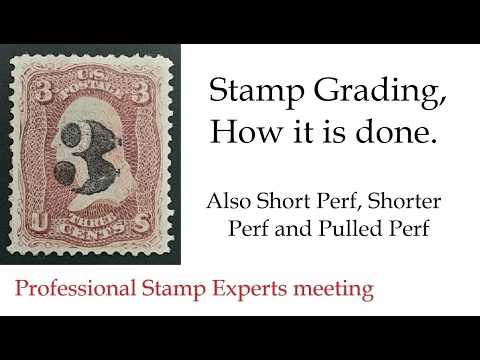
Organizations used by collectors include the Philatelic Foundation and Professional Stamp Experts in the United States. Other national and specialist bodies offer opinions for particular countries or collecting areas. Before submitting, check current fees, accepted material, turnaround times, grading criteria, and what happens if a stamp is found to be altered or misidentified.
When Is Certification Worth the Cost?
Certification is most useful when authenticity is uncertain, a valuable variety is frequently confused with a common one, or the potential price difference justifies the expense. For an inexpensive, obviously common stamp with Average centering, grading and shipping costs may exceed the stamp’s market value.

A certificate is an expert opinion, not a guarantee of future resale price. Also verify that the certificate corresponds to the stamp offered: compare the image, identification, condition notes, and any certificate number with the issuing organization’s records when available.
Buying and Selling Average-Centered Stamps Wisely
Buy the stamp, not merely the label. An Average example with clean color, sound paper, and a light cancellation may be more appealing than another with similar centering but multiple faults. Decide whether your priority is completing an album, studying postal history, or assembling a high-grade collection; each approach supports a different buying decision.
Sellers should disclose off-centering and any known faults plainly. Use accurate photographs and avoid phrases such as “perfect except for centering” when gum, perforations, or paper have not been carefully examined. If the stamp is on cover, preserve the entire envelope: the postmark, route, date, and postal markings may contribute more historical interest than the individual stamp alone.
Conclusion
Average off-center stamp grading describes a noticeable alignment issue, not a verdict that a stamp is worthless or damaged. Assess centering alongside authenticity, paper condition, gum, cancellation, scarcity, and the production realities of the issue. With careful comparisons and professional advice when justified, an Average stamp can be a sensible purchase, an accessible album space-filler, or an important piece of philatelic history.
Frequently Asked Questions
What does Average centering mean on a postage stamp?
It generally means the design is noticeably displaced within the stamp’s margins. On a perforated example, the perforations may approach, touch, or cut into the design. Exact definitions vary by grading service and issue.
Can an average off-center stamp still be valuable?
Yes. Rarity, a desirable cancellation, an important variety, or use on an original cover can support significant value. For common stamps, however, comparable better-centered examples usually attract stronger prices.
Is an off-center stamp automatically a printing error?
No. Ordinary misalignment during printing or perforating is common and is generally treated as a centering issue. A recognized error or major variety requires more specific evidence and should be checked against a specialist catalog or expert opinion.

How can I tell whether perforations cut into a stamp design?
Examine each side under magnification and follow the outer printed frame or design elements. If the perforation tips interrupt the printed area rather than remaining outside it, the design is cut into. Use a clear image or the actual stamp; cropped photographs can be misleading.
Should I get an average-centered stamp professionally graded?
Consider it when the stamp may be valuable, difficult to identify, or vulnerable to alteration or forgery. Compare the likely benefit with the full cost of grading, expertizing, insurance, and shipping before submitting.
