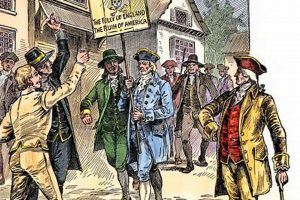
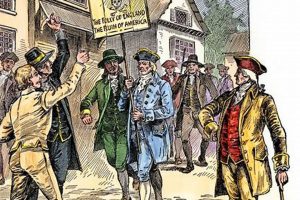
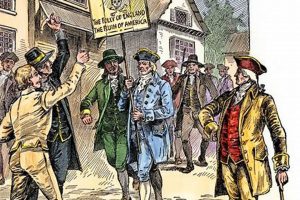
The 1765 legislation requiring all printed materials in the American colonies to carry a tax stamp purchased from authorities, and the subsequent meeting of colonial representatives in New York City to coordinate resistance to the tax, represent pivotal moments in the growing tension between Great Britain and its American colonies. This tax, intended to raise revenue for British military expenses in North America, sparked widespread protests due to its perceived violation of colonial rights and representation. Colonists argued they were being taxed without consent by a Parliament in which they had no representation. The required stamps on newspapers, pamphlets, legal documents, and even playing cards became a symbol of British oppression.
The assembly of delegates from nine colonies marked the first significant collective action against British policies. This gathering, held in October 1765, produced a Declaration of Rights and Grievances, asserting colonial loyalty to the Crown but also claiming the right to self-taxation. Petitions were sent to the King and Parliament, highlighting the economic hardship and constitutional issues raised by the new tax. This unified display of colonial defiance played a vital role in shaping American identity and paving the way for future coordinated action leading up to the American Revolution. The events laid the groundwork for intercolonial communication and cooperation, significantly strengthening the bonds between the colonies.
Understanding these historical events provides essential context for exploring broader topics related to the causes of the American Revolution, the development of colonial political thought, and the origins of American governance. Further exploration of individual colonial responses, the economic consequences of the tax, and the British government’s reaction can deepen understanding of this critical period in American history.
Understanding the Stamp Act Crisis
These tips offer guidance for researching and interpreting the historical significance of the 1765 tax levied on printed materials in the American colonies and the subsequent assembly of colonial representatives.
Tip 1: Primary Sources: Explore original documents from the period. Letters, diaries, newspapers, and pamphlets offer direct insights into colonial reactions and perspectives.
Tip 2: British Perspective: Consider the British government’s rationale for implementing the tax. Research the financial pressures and political context influencing their decision-making.
Tip 3: Colonial Resistance: Investigate various forms of colonial resistance beyond the formal Congress. Analyze the role of boycotts, protests, and popular demonstrations in challenging British authority.
Tip 4: Impact on Specific Colonies: Recognize the diverse responses across the thirteen colonies. Research how geographic, economic, and social factors shaped each colony’s reaction to the tax.
Tip 5: Long-Term Consequences: Consider the lasting impact of these events. Explore how the crisis contributed to growing colonial unity and the eventual movement toward independence.
Tip 6: Historiography: Examine different historical interpretations of the Stamp Act crisis. Be aware that perspectives on the events have evolved over time.
Tip 7: Connect to Broader Themes: Relate the Stamp Act crisis to larger historical themes, such as the development of representative government, the growth of colonial identity, and the evolution of the relationship between Great Britain and its American colonies.
By exploring these aspects, one gains a more nuanced understanding of the significance of this pivotal period in American history. Research provides a foundation for comprehending the complex interplay of economic, political, and social factors that shaped the course of events leading to the American Revolution.
The insights gained from exploring the suggested research areas allow for a more informed analysis of the Stamp Act crisis and its enduring legacy.
1. Taxation without representation

The phrase “Taxation without representation” encapsulates the core grievance driving colonial resistance to the Stamp Act. The Act, passed by the British Parliament in 1765, imposed a tax on all printed materials in the American colonies. Colonists argued that they were being taxed by a body in which they had no elected representatives, violating fundamental principles of British constitutionalism. This perceived injustice ignited widespread protests and fueled the formation of the Stamp Act Congress. The Congress, comprised of delegates from nine colonies, served as a platform to formally articulate colonial opposition to the tax and assert the principle of self-taxation. The cry of “Taxation without representation” became a rallying cry, uniting colonists from diverse backgrounds and laying the groundwork for future coordinated action. The Virginia Resolves, passed by the Virginia House of Burgesses, forcefully articulated this grievance and inspired similar resolutions in other colonies.
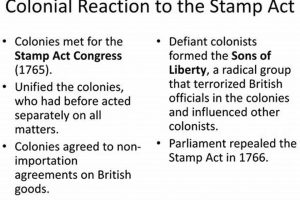
The Stamp Act Congress demonstrated the practical significance of “Taxation without representation” as a mobilizing force. The Congress drafted petitions to the King and Parliament, outlining colonial objections to the tax and asserting their rights as British subjects. The collective action of the colonies, driven by the shared grievance of taxation without representation, exerted significant pressure on the British government. This pressure, combined with colonial boycotts of British goods, ultimately led to the repeal of the Stamp Act in 1766. The repeal demonstrated the potential effectiveness of unified colonial action based on shared principles. However, the underlying issue of parliamentary authority over the colonies remained unresolved, foreshadowing future conflict. The Declaratory Act, passed alongside the repeal, asserted Parliament’s right to legislate for the colonies “in all cases whatsoever,” setting the stage for further tensions.
The Stamp Act crisis and the principle of “Taxation without representation” served as a crucial turning point in the relationship between Great Britain and the American colonies. The crisis highlighted the growing divergence in political ideologies and laid the foundation for future movements toward independence. While the immediate crisis was resolved with the repeal of the Act, the underlying tension regarding colonial representation and self-governance persisted, contributing significantly to the outbreak of the American Revolution a decade later. The legacy of “Taxation without representation” continues to resonate in discussions of political representation and self-determination.
2. Colonial Resistance

Colonial resistance played a pivotal role in the Stamp Act crisis, demonstrating the colonists’ growing dissatisfaction with British policies and their willingness to take collective action. The Stamp Act, passed in 1765, sparked widespread opposition in the American colonies due to its perceived violation of colonial rights and the principle of “no taxation without representation.” The Stamp Act Congress, convened in response to the Act, became a focal point for organized resistance. Understanding the various forms of colonial resistance provides crucial insight into the events leading up to the American Revolution.
- Boycotts of British Goods
Colonists organized widespread boycotts of British goods, targeting merchants who complied with the Stamp Act. These boycotts, enforced by groups like the Sons of Liberty, exerted significant economic pressure on British businesses and demonstrated the colonists’ collective power to disrupt trade. The boycotts played a crucial role in persuading British merchants to lobby Parliament for the Act’s repeal. For example, merchants in Boston and New York signed non-importation agreements, pledging to refuse shipments of British goods until the Act was repealed.
- Protests and Demonstrations
Public protests and demonstrations erupted throughout the colonies, expressing popular anger against the Stamp Act and British authority. These protests often involved burning effigies of tax collectors and engaging in acts of defiance, creating a climate of unrest and demonstrating the intensity of colonial opposition. The burning of stamped paper in Boston and the hanging of an effigy of stamp distributor Andrew Oliver illustrate the public nature of colonial resistance.
- Formation of the Stamp Act Congress
The convening of the Stamp Act Congress in October 1765 marked a significant step in colonial resistance. Delegates from nine colonies met to coordinate their response to the Stamp Act, demonstrating a growing sense of intercolonial unity. The Congress drafted petitions to the King and Parliament, asserting colonial rights and formally requesting the repeal of the Act. This collective action provided a platform for colonists to articulate their grievances and present a united front against British policies.
- Legal Challenges
Colonists also challenged the legality of the Stamp Act through legal channels. Lawyers argued that the Act violated colonial charters and fundamental rights as British subjects. These legal challenges, though ultimately unsuccessful in preventing the Act’s implementation, contributed to the broader debate about the extent of parliamentary authority over the colonies. For instance, prominent lawyers like James Otis argued that the Act was unconstitutional and violated the colonists’ rights to self-taxation.
These diverse forms of colonial resistance, ranging from economic boycotts to legal challenges and public protests, collectively demonstrated the colonists’ determination to oppose the Stamp Act. The Stamp Act Congress, formed in the midst of this resistance, provided a vital platform for coordinating colonial action and presenting a unified front to the British government. These events laid the groundwork for future resistance movements and contributed significantly to the growing tensions that ultimately led to the American Revolution. The legacy of colonial resistance during the Stamp Act crisis resonates in American political thought, highlighting the importance of civic engagement and the defense of individual liberties.
3. Intercolonial Unity

The Stamp Act Congress of 1765 stands as a pivotal moment in the development of intercolonial unity. Prior to the Stamp Act, cooperation between the American colonies remained limited, with regional interests and identities often overshadowing common goals. The controversial tax levied by the British Parliament, however, created a shared grievance that transcended colonial boundaries, fostering a sense of collective purpose and laying the groundwork for future coordinated action. Examining the facets of this burgeoning intercolonial unity provides crucial context for understanding the American Revolution’s origins.
- Shared Grievance and Collective Action
The Stamp Act, impacting all colonies equally, created a shared experience of injustice. This common ground facilitated collective action, as colonists recognized the power of unified resistance. The boycotts against British goods, organized across colonial lines, demonstrated the potential for coordinated efforts to exert pressure on the British government. The Stamp Act Congress itself exemplified this unity, bringing together delegates from nine colonies to formulate a shared response. This collective action laid the foundation for future intercolonial collaborations.
- Communication and Information Sharing
The Stamp Act crisis necessitated enhanced communication between the colonies. Committees of correspondence were established to share information and coordinate resistance strategies. These networks facilitated the dissemination of news, pamphlets, and legal arguments, fostering a sense of shared purpose and enabling colonies to learn from each other’s experiences. The exchange of ideas and strategies strengthened the collective response and contributed to the growth of a cohesive colonial identity. For instance, the committees shared information about successful boycott strategies, ensuring consistency and maximizing their impact.
- Development of a Collective Identity
The shared experience of resisting the Stamp Act fostered a sense of collective identity among colonists. By working together towards a common goal, colonists began to see themselves less as residents of individual colonies and more as members of a larger, unified community with shared interests and grievances. This evolving sense of shared identity played a crucial role in shaping the political landscape leading up to the Revolution. The shared identity transcended regional differences, creating a sense of pan-colonial solidarity.
- Precedent for Future Cooperation
The Stamp Act Congress served as an important precedent for future intercolonial cooperation. The Congress demonstrated the feasibility of organizing collective action across colonial boundaries and provided a model for future collaborative efforts. This experience proved invaluable in the years leading up to the Revolution, as colonists increasingly relied on intercolonial communication and coordination to resist British policies. The First Continental Congress, convened in 1774, built upon the foundation laid by the Stamp Act Congress.
The Stamp Act and the subsequent Congress served as a catalyst for intercolonial unity. The shared experience of resisting unjust taxation fostered communication, collective action, and a burgeoning sense of shared identity. These developments laid the groundwork for the future collaborations and coordinated resistance that characterized the American Revolution. The legacy of intercolonial unity forged during the Stamp Act crisis significantly shaped the course of American history, highlighting the power of collective action in challenging oppressive policies and advocating for self-governance.
4. Petitions and Grievances
Petitions and grievances played a central role in the Stamp Act crisis, providing a formal mechanism for colonists to articulate their objections to British policies and assert their rights. The Stamp Act Congress, convened in October 1765, served as a crucial platform for drafting and disseminating these petitions. Understanding the content and significance of these documents offers valuable insights into the political thought underpinning colonial resistance and the growing tensions between Great Britain and its American colonies. The petitions, addressed to King George III and the British Parliament, meticulously outlined colonial grievances, emphasizing the perceived injustice of taxation without representation and the economic hardships imposed by the Stamp Act. They asserted colonists’ rights as British subjects and appealed to the principles of British constitutionalism. For example, the petition to the King declared loyalty to the Crown but insisted on the right of colonists to be taxed only by their own elected representatives.
The petitions and grievances articulated by the Stamp Act Congress represent more than mere expressions of discontent; they signify a deliberate and organized effort to engage in political discourse and seek redress through established channels. The Congress adopted a measured tone, avoiding inflammatory rhetoric and emphasizing reasoned arguments based on legal precedent and constitutional principles. This approach aimed to demonstrate the colonists’ commitment to resolving the crisis through peaceful means while firmly asserting their rights. The careful wording and legal arguments presented in the petitions underscore the colonists’ understanding of British law and their strategic approach to challenging the Stamp Act’s legitimacy. The petition to Parliament, for instance, highlighted the economic burdens imposed by the Act and argued that it violated established principles of trade and commerce.
The practical significance of the petitions and grievances drafted by the Stamp Act Congress can be understood in several ways. Firstly, they served as a unifying force, articulating shared grievances and demonstrating the potential for collective action across colonial boundaries. Secondly, they provided a framework for future resistance movements, establishing the precedent of appealing to British authorities while simultaneously asserting colonial rights. Finally, the petitions and grievances provide historians with invaluable insights into the political and ideological context of the American Revolution. While the Stamp Act was eventually repealed, the underlying tensions regarding colonial representation and self-governance persisted, culminating in the outbreak of war a decade later. The legacy of the petitions and grievances resonates in contemporary political discourse, highlighting the importance of civic engagement and the ongoing struggle for political representation and self-determination.
5. Economic Consequences

The Stamp Act’s economic consequences significantly contributed to the growing tensions between Great Britain and its American colonies. Intended to raise revenue for British military expenses in North America, the Act instead triggered widespread economic disruption, fueling colonial resistance and ultimately contributing to the Act’s repeal. Exploring these economic repercussions provides crucial context for understanding the events leading up to the American Revolution. The Act’s impact extended beyond mere financial hardship, influencing colonial trade, political discourse, and the development of intercolonial unity.
- Boycotts of British Goods
Colonial merchants and consumers organized widespread boycotts of British goods in protest against the Stamp Act. These boycotts, enforced by groups like the Sons of Liberty, disrupted transatlantic trade and exerted significant economic pressure on British merchants and manufacturers. The boycotts demonstrated the colonists’ collective economic power and their willingness to endure hardship to defend their principles. The impact on British businesses contributed to growing pressure on Parliament to repeal the Act. For instance, imports from Britain to the colonies declined sharply, illustrating the boycotts’ effectiveness.
- Impact on Colonial Businesses
The Stamp Act placed a financial burden on colonial businesses, particularly printers, publishers, and merchants who relied on printed materials. The cost of purchasing stamps added to the expense of conducting business, reducing profits and creating economic hardship. This financial strain fueled resentment towards the British government and contributed to the growing sense of injustice among colonial business owners. Printers, for example, faced increased costs for newspapers and legal documents, impacting their profitability and contributing to their active participation in resistance efforts.
- Disruption of Trade and Commerce
The Stamp Act disrupted established trade patterns between Great Britain and the colonies. The boycotts and the refusal of some colonial officials to enforce the Act created uncertainty and instability in commercial transactions. This disruption further strained economic relations and fueled tensions between colonial merchants and British authorities. The uncertainty surrounding the enforcement of the Act hampered trade and contributed to economic instability in the colonies.
- Contribution to Intercolonial Unity
The shared experience of economic hardship resulting from the Stamp Act fostered a sense of unity among the colonies. The coordinated boycotts and the Stamp Act Congress, convened in part to address the economic grievances, demonstrated the potential for collective action and laid the groundwork for future intercolonial cooperation. The economic consequences of the Act inadvertently contributed to the growing sense of shared identity among colonists. The Stamp Act Congress provided a platform for representatives from different colonies to discuss shared economic concerns and coordinate resistance strategies.
The economic consequences of the Stamp Act played a crucial role in shaping the political landscape leading up to the American Revolution. The Act’s negative impact on colonial businesses, the disruption of trade, and the subsequent boycotts fueled colonial resistance and contributed to the growing tensions between Great Britain and its American colonies. While the Act itself was relatively short-lived, its economic repercussions had lasting effects, fostering intercolonial unity and solidifying colonial opposition to British policies. The economic hardship experienced during this period contributed significantly to the colonists’ resolve to resist British authority and ultimately pursue independence.
6. Repeal of the Act

The repeal of the Stamp Act in 1766 represents a pivotal moment in the escalating tensions between Great Britain and its American colonies. Directly linked to the collective resistance spearheaded by the Stamp Act Congress, the repeal demonstrates the impact of colonial unity and organized opposition. Examining the facets of the repeal reveals its significance not only as a victory for colonial resistance but also as a critical step toward the eventual American Revolution. The repeal demonstrates the potential effectiveness of unified colonial action, while simultaneously highlighting the unresolved issues of parliamentary authority and colonial self-governance that continued to fuel tensions.
- Economic Pressure and British Mercantile Interests
Colonial boycotts of British goods, a key strategy advocated by the Stamp Act Congress, significantly impacted British mercantile interests. Merchants and manufacturers, facing declining profits, exerted pressure on Parliament to repeal the Act. This economic pressure played a crucial role in swaying parliamentary opinion and demonstrates the effectiveness of colonial economic resistance as a political tool. The repeal underscores the interconnectedness of economic interests and political decision-making in the eighteenth-century Atlantic world.
- Parliamentary Debates and Shifting Political Landscape
The Stamp Act’s repeal was preceded by intense debates within the British Parliament. Arguments focused on the Act’s economic impact, the legitimacy of colonial grievances, and the broader question of parliamentary authority over the colonies. The repeal signifies a momentary shift in the British political landscape, reflecting the influence of colonial resistance and the arguments presented by sympathetic members of Parliament. For instance, prominent figures like William Pitt the Elder championed the colonial cause and argued for the repeal.
- Colonial Celebration and the Seeds of Future Conflict
News of the repeal was met with widespread celebration in the American colonies. The victory, however, proved short-lived. The Declaratory Act, passed alongside the repeal, asserted Parliament’s right to legislate for the colonies “in all cases whatsoever.” This assertion of parliamentary supremacy undermined the colonial victory and sowed the seeds of future conflict by leaving the fundamental issue of colonial self-governance unresolved. The celebrations, while significant, masked the underlying tensions that continued to simmer beneath the surface.
- Legacy of Resistance and the Path to Revolution
The repeal of the Stamp Act, while achieved through concerted colonial resistance, paradoxically contributed to the growing movement toward independence. The experience of successfully challenging British policy emboldened colonial leaders and solidified intercolonial bonds. The repeal, combined with the continued assertion of parliamentary authority, set the stage for future confrontations and ultimately propelled the colonies toward revolution. The Stamp Act crisis and its resolution served as a crucial turning point in the relationship between Great Britain and the American colonies.
The repeal of the Stamp Act, though a significant victory for the colonies, ultimately represents a temporary reprieve in the broader conflict with Great Britain. The Stamp Act Congress, by fostering colonial unity and providing a platform for organized resistance, played a crucial role in achieving the repeal. However, the underlying issues of representation and self-governance, exacerbated by the Declaratory Act, remained unresolved. The repeal, therefore, while marking a successful instance of colonial resistance, paradoxically contributed to the escalating tensions that culminated in the American Revolution. The legacy of the Stamp Act and its repeal resonates in American history as a pivotal moment in the struggle for self-determination and representative government.
7. Precursor to Revolution

The Stamp Act and the subsequent Stamp Act Congress serve as a crucial precursor to the American Revolution, marking a significant escalation in the tensions between Great Britain and its American colonies. While not immediately leading to war, these events laid the groundwork for the revolutionary movement by fostering colonial unity, solidifying resistance to British policies, and crystallizing the ideological arguments for self-governance. The Stamp Act, intended to raise revenue for British military expenses in North America, inadvertently ignited a firestorm of protest due to its perceived violation of colonial rights and the principle of “no taxation without representation.” The Stamp Act Congress, convened in response to the Act, provided a platform for colonists to articulate their grievances, coordinate resistance strategies, and assert their rights as British subjects. This collective action, unprecedented in colonial history, demonstrated the potential for intercolonial unity and laid the foundation for future coordinated resistance.
The Stamp Act crisis fostered a sense of shared identity among colonists, transcending regional differences and solidifying opposition to British policies. The boycotts of British goods, organized in response to the Act, demonstrated the colonists’ willingness to endure economic hardship to defend their principles. Moreover, the Stamp Act Congress provided a platform for the development and dissemination of revolutionary ideas. The petitions and grievances drafted by the Congress articulated the colonists’ arguments against taxation without representation, drawing upon Enlightenment ideals and principles of British constitutionalism. These arguments, widely circulated throughout the colonies, fueled public discourse and contributed to the growing intellectual movement for independence. For instance, the Virginia Resolves, drafted by Patrick Henry and passed by the Virginia House of Burgesses, forcefully articulated the colonists’ right to self-taxation and inspired similar resolutions in other colonies. The widespread dissemination of these ideas, facilitated by the networks established during the Stamp Act crisis, radicalized colonial public opinion and laid the groundwork for the revolutionary movement.
Understanding the Stamp Act and the Stamp Act Congress as a precursor to the Revolution provides crucial insights into the complex interplay of factors that led to American independence. The crisis demonstrated the potential for colonial unity, solidified resistance to British policies, and provided a platform for the dissemination of revolutionary ideas. While the Stamp Act itself was eventually repealed, the underlying tensions regarding representation and self-governance remained unresolved. The experience of resisting the Stamp Act, however, emboldened colonial leaders, fostered a sense of shared identity, and laid the organizational and ideological foundation for the American Revolution. The legacy of the Stamp Act crisis resonates in American history as a pivotal moment in the struggle for self-determination and representative government, highlighting the transformative power of collective action and the enduring significance of the principles upon which the nation was founded. The challenges faced during this period underscore the complex and often protracted nature of political change and the importance of understanding historical context when analyzing contemporary issues of governance and representation.
Frequently Asked Questions
This section addresses common inquiries regarding the 1765 Stamp Act and the subsequent Stamp Act Congress, aiming to provide clear and concise answers.
Question 1: What specific items were taxed under the Stamp Act?
The Stamp Act mandated the purchase of tax stamps for a wide range of printed materials, including legal documents, newspapers, pamphlets, almanacs, playing cards, and even dice.
Question 2: Why did the British government implement the Stamp Act?
The primary motivation behind the Stamp Act was to raise revenue to cover the costs of British military presence in North America following the French and Indian War. The British government believed the colonies should contribute to their own defense.
Question 3: How did the Stamp Act Congress contribute to colonial resistance?
The Stamp Act Congress facilitated coordinated resistance by bringing together representatives from different colonies. It provided a platform for sharing grievances, formulating a unified response, and drafting petitions to the King and Parliament. The Congress played a vital role in organizing boycotts and disseminating information throughout the colonies.
Question 4: Was the Stamp Act Congress successful in achieving its goals?
The Stamp Act Congress played a significant role in the eventual repeal of the Stamp Act. The unified colonial resistance, including the boycotts organized through the Congress, exerted considerable pressure on the British government and merchants. While the Congress did not directly achieve representation in Parliament, its actions demonstrated the power of collective action.
Question 5: What is the significance of the Declaratory Act?
Passed alongside the repeal of the Stamp Act, the Declaratory Act asserted Parliament’s right to legislate for the colonies “in all cases whatsoever.” This act, while seemingly conciliatory in repealing the Stamp Act, simultaneously reaffirmed British authority over the colonies and laid the groundwork for future conflict.
Question 6: How did the Stamp Act crisis contribute to the American Revolution?
The Stamp Act crisis served as a crucial turning point in the relationship between Great Britain and the American colonies. The experience of unified resistance, the articulation of grievances based on principles of self-governance, and the unresolved issue of parliamentary authority fueled growing tensions and contributed significantly to the outbreak of the American Revolution a decade later.
Understanding these key aspects of the Stamp Act crisis provides valuable context for exploring the broader historical narrative of the American Revolution. The interplay of economic pressures, political ideologies, and colonial resistance shaped the events of this era and laid the foundation for the birth of a new nation.
Further exploration of primary source documents, scholarly analyses, and individual colonial experiences can enrich one’s understanding of this pivotal period in American history.
The Legacy of 1765
The examination of the 1765 tax levied on printed materials and the subsequent assembly of colonial representatives reveals a pivotal moment in the relationship between Great Britain and its American colonies. The tax, intended to bolster British finances, ignited widespread colonial resistance rooted in the principle of “no taxation without representation.” The coordinated response, culminating in the assembly of delegates, demonstrated a burgeoning sense of colonial unity and laid the groundwork for future collective action. The petitions and grievances articulated during this period underscore the colonists’ commitment to defending their rights as British subjects while simultaneously challenging the legitimacy of parliamentary authority over colonial affairs. The economic consequences of the tax, including widespread boycotts of British goods, further exacerbated tensions and contributed to the growing divide between the colonies and the mother country.
The events of 1765, though culminating in the repeal of the tax, left an enduring legacy. The experience of unified resistance, the articulation of core principles of self-governance, and the unresolved question of parliamentary authority shaped the political landscape and propelled the colonies toward revolution. Continued exploration of this period remains essential for understanding the origins of American independence and the enduring significance of the principles upon which the nation was founded. The echoes of 1765 resonate in contemporary discussions of political representation, economic justice, and the ongoing pursuit of self-determination.