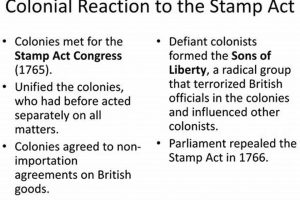
The Stamp Act of 1765, requiring colonists to pay a tax on printed materials, ignited widespread resistance in the American colonies. Colonists formed groups like the Sons of Liberty, boycotted British goods, and engaged in protests and demonstrations, arguing that taxation without representation was tyrannical. This colonial defiance significantly hampered British trade and led to the act’s repeal in 1766.
The act’s consequences proved pivotal in the escalating tensions between Great Britain and its American colonies. The organized resistance and burgeoning sense of colonial unity it fostered laid crucial groundwork for the American Revolution a decade later. The arguments developed against the Stamp Act, particularly regarding representation and self-governance, became central tenets of the revolutionary ideology.
Further exploration of this period can delve into specific colonial responses, the role of key figures like Samuel Adams and Patrick Henry, the economic repercussions of the boycotts, and the British government’s perspective on colonial unrest. This examination provides a deeper understanding of the events that shaped the American Revolution.
Tips for Understanding the Stamp Act’s Impact
Examining the consequences of the Stamp Act requires careful consideration of various factors. These tips offer guidance for a comprehensive understanding.
Tip 1: Consider the economic ramifications. The boycotts organized in response to the Stamp Act significantly disrupted transatlantic trade, impacting both colonial merchants and British businesses. Analyze the extent of these disruptions and their influence on British policy.
Tip 2: Explore the development of colonial unity. The Stamp Act fostered a sense of shared grievance among the colonies. Research the formation of groups like the Sons of Liberty and how intercolonial communication strengthened resistance efforts.
Tip 3: Analyze the philosophical arguments. The colonists’ arguments against taxation without representation drew upon Enlightenment ideals and contributed to a developing sense of American identity. Explore the intellectual underpinnings of these arguments.
Tip 4: Research the British perspective. Understand the British government’s rationale for implementing the Stamp Act and its response to colonial resistance. This offers valuable insight into the escalating tensions.
Tip 5: Investigate the repeal of the Stamp Act. The repeal demonstrates the impact of colonial resistance, but it also highlights ongoing disagreements about parliamentary authority over the colonies. Examine the factors contributing to the repeal and its long-term implications.
Tip 6: Connect the Stamp Act to the American Revolution. The Stamp Act crisis foreshadowed the American Revolution. Consider how the arguments, strategies, and alliances formed during this period directly contributed to later events.
Understanding the Stamp Act’s impact requires acknowledging its multifaceted nature. These tips provide a starting point for further exploration of this critical period in American history.
By examining the economic, political, and ideological consequences of the Stamp Act, a clearer picture emerges of the forces that ultimately led to American independence.
1. Colonial Resistance

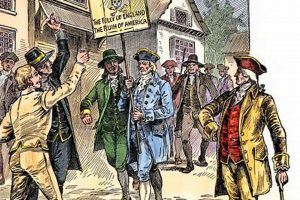
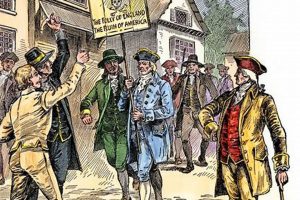
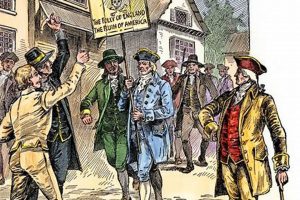
Colonial resistance stands as a central component in understanding the Stamp Act’s repercussions. The Act, perceived as an unjust measure of taxation without representation, ignited a firestorm of opposition across the American colonies. This resistance took numerous forms, from organized boycotts of British goods, significantly impacting mercantile trade, to public demonstrations and acts of defiance against tax collectors. The formation of groups like the Sons of Liberty provided a structure for this resistance, facilitating communication and coordination between colonies. For example, the burning of effigies representing tax collectors and the intimidation tactics employed against British officials demonstrated the colonists’ resolve. This widespread and multifaceted resistance proved crucial in pressuring the British government towards eventual repeal.
The importance of colonial resistance lies not solely in its immediate effect on the Stamp Act’s fate. It also fostered a growing sense of shared identity and purpose among the disparate colonies. The collective action undertaken in response to the Act laid the foundation for future cooperation and solidified a sense of shared grievance against British policies. This nascent sense of unity, forged in the crucible of resistance, proved invaluable during the American Revolution. The Stamp Act Congress, convened in 1765, exemplifies this growing intercolonial collaboration, representing a significant step towards unified action. This collective resistance, therefore, transcends a mere reaction to a single act and represents a crucial developmental stage in the journey toward American independence.
In summary, colonial resistance served as a catalyst in shaping the outcome of the Stamp Act. It not only forced the repeal of the Act but also significantly contributed to the growing sense of colonial unity and the development of revolutionary sentiment. Understanding the nature and impact of this resistance is crucial for comprehending the broader context of the American Revolution and the forces that ultimately led to the birth of a new nation. The Stamp Act, and the resistance it provoked, serves as a case study in the power of collective action and the profound impact of perceived injustice.
2. Boycotts
Boycotts played a crucial role in the colonial response to the Stamp Act of 1765. Refusal to purchase British goods became a powerful tool of resistance, directly impacting the economic interests of British merchants and manufacturers. This organized economic pressure significantly contributed to the eventual repeal of the Act and shaped the relationship between Great Britain and its American colonies.
- Economic Impact
The boycotts created noticeable economic hardship for British businesses reliant on colonial trade. Imports from Britain declined sharply, forcing merchants and manufacturers to petition Parliament for relief. This economic pressure proved highly effective in demonstrating the colonies’ collective power and influencing political decisions in London. For example, the Society of Promoting Arts, Manufactures and Commerce in London noted a significant drop in exports, impacting industries such as textiles and manufactured goods. This direct economic consequence underscored the colonies’ leverage and the potential effectiveness of organized boycotts.
- Non-Importation Agreements
Formal agreements among colonists to abstain from importing British goods provided structure and organization to the boycotts. These agreements, often overseen by groups like the Sons of Liberty, helped ensure widespread participation and enforce compliance within communities. These non-importation agreements became a powerful tool in maintaining the boycotts effectiveness. For instance, the resolutions adopted by the Stamp Act Congress advocated for a unified boycott across multiple colonies, signaling a concerted effort to pressure Britain.
- Social and Political Impact
The boycotts extended beyond their purely economic impact, fostering a sense of unity and shared purpose among colonists. Public demonstrations of support for the boycotts, including public burnings of British goods, transformed economic resistance into a powerful expression of political dissent. The social pressure to participate in boycotts further solidified colonial unity against the Stamp Act. Women played a significant role in these boycotts, organizing spinning bees to produce homespun cloth as an alternative to British textiles. This collective participation highlighted the widespread social and political engagement in resisting the Act.
- The Repeal of the Stamp Act
While multiple factors contributed to the British government’s decision to repeal the Stamp Act in 1766, the economic pressure exerted by colonial boycotts played a significant role. The boycotts demonstrated the potential economic consequences of enforcing unpopular policies and contributed to a shift in British policy towards the colonies. The repeal itself marked a victory for colonial resistance, though it also led to the passage of the Declaratory Act, which reaffirmed Parliament’s authority to legislate for the colonies. This highlighted the ongoing tension between colonial desires for autonomy and British assertions of parliamentary supremacy.
The boycotts initiated in response to the Stamp Act proved to be a turning point in the relationship between Great Britain and the American colonies. Beyond their immediate economic impact, they fostered colonial unity, emboldened resistance movements, and established a precedent for collective action that would profoundly shape the events leading up to the American Revolution.
3. Protests and Demonstrations

Protests and demonstrations constituted a significant component of colonial resistance to the Stamp Act of 1765. These public displays of discontent took various forms, ranging from organized marches and rallies to acts of symbolic defiance, such as burning effigies of British officials. The intensity and widespread nature of these protests underscore their significance in shaping the Act’s outcome. These actions served as a visible manifestation of colonial grievances, demonstrating widespread opposition to taxation without representation and directly challenging British authority. For example, the burning of stamped paper in Boston and the ransacking of Lieutenant Governor Thomas Hutchinson’s house demonstrated the escalating nature of popular resistance. These public acts of defiance served not only as a form of pressure on British authorities but also fostered a sense of collective identity and purpose among colonists.
The practical significance of these protests and demonstrations lies in their contribution to the eventual repeal of the Stamp Act. The visible and vocal nature of colonial resistance directly influenced public opinion both in the colonies and in Great Britain itself. Merchants and manufacturers in Britain, facing economic hardship due to colonial boycotts associated with the protests, exerted pressure on Parliament to reconsider the Act. Moreover, the protests illustrated the depth of colonial opposition and suggested the potential for further unrest. These factors, combined with the broader political and economic considerations within Britain, ultimately led to the Act’s repeal in 1766. This repeal marked a significant victory for colonial resistance and established a precedent for collective action against perceived unjust policies. The protests, however, also contributed to a hardening of attitudes on both sides of the Atlantic, setting the stage for future conflict.
In summary, protests and demonstrations played a crucial role in achieving the repeal of the Stamp Act. They provided a visible and effective means of expressing colonial discontent, pressuring British authorities, and fostering a sense of unity among the colonies. While the repeal itself represented a temporary de-escalation of tensions, the legacy of resistance established during this period proved instrumental in shaping the course of events leading up to the American Revolution. The Stamp Act protests served as a crucial learning experience for colonists in organizing and mobilizing against perceived injustices, demonstrating the power of collective action and paving the way for future struggles for autonomy and independence.
4. Increased Colonial Unity

The Stamp Act of 1765, while intended to raise revenue for the British Crown, inadvertently fostered a sense of unity among the American colonies. This burgeoning collective identity, born from shared grievances and coordinated resistance, proved to be a significant consequence of the Act and a critical precursor to the American Revolution. Exploring the facets of this increased unity provides valuable insight into the Act’s long-term impact.
- Shared Grievances
The Stamp Act impacted colonists across various social and economic strata, creating a common ground for complaint. From merchants burdened by new taxes to printers and lawyers whose livelihoods were directly affected, the Act’s universality fostered a sense of shared injustice. This widespread discontent transcended regional and class divisions, providing a unifying experience across the colonies. The shared experience of being subjected to what they perceived as unjust taxation created common ground for previously disparate colonial groups.
- Intercolonial Communication and Cooperation
The need to coordinate resistance efforts against the Stamp Act facilitated increased communication and cooperation between the colonies. Committees of Correspondence were established to share information and strategize, creating networks of communication that extended from Massachusetts to Georgia. The Stamp Act Congress, held in New York in 1765, brought together representatives from nine colonies, marking a significant step toward formal intercolonial collaboration. This unprecedented level of communication fostered a sense of shared purpose and laid the groundwork for future unified action.
- Development of a Collective Identity
Through shared grievances and coordinated action, colonists began to develop a sense of collective identity distinct from their British counterparts. The slogan “No Taxation Without Representation” encapsulated this burgeoning American identity, emphasizing the colonists’ belief in their right to self-governance. This shared identity, forged in the crucible of resistance, transcended regional differences and contributed to a growing sense of shared destiny, further solidifying the concept of a unified American populace.
- Foundation for Future Resistance
The increased colonial unity fostered by the Stamp Act proved essential in laying the groundwork for future resistance movements. The networks of communication, organizational structures, and shared sense of purpose developed during this period provided a foundation for the organized resistance that would characterize the years leading up to the American Revolution. The experience gained through resisting the Stamp Act equipped colonists with the tools and strategies necessary for future challenges to British authority. For example, the Sons of Liberty, formed in response to the Act, played a critical role in subsequent protests and actions leading up to the Revolution, demonstrating the lasting legacy of this period.
The increased colonial unity resulting from the Stamp Act transcended a mere reaction to a single piece of legislation. It represented a crucial turning point in the relationship between Great Britain and the American colonies, contributing significantly to the development of a distinct American identity and paving the way for the organized resistance that ultimately led to the American Revolution. The Act, intended to strengthen British control, paradoxically contributed to the very forces that would ultimately break it.
5. Repeal of the Act (1766)

The repeal of the Stamp Act in 1766 stands as a direct consequence of the widespread resistance it engendered within the American colonies. This resistance, manifested through boycotts, protests, and increasingly unified colonial action, exerted significant pressure on the British government and mercantile interests. The economic impact of colonial boycotts, coupled with the potential for escalating unrest, ultimately persuaded Parliament to reconsider the Act’s efficacy. This repeal demonstrates a clear cause-and-effect relationship between colonial action and British policy, marking a significant victory for colonial resistance and highlighting the power of collective action. For instance, the decline in British imports due to the colonial boycotts directly impacted British merchants, who in turn petitioned Parliament for the Act’s repeal. This illustrates the practical impact of colonial resistance and its role in influencing British policy.
Understanding the repeal’s significance requires acknowledging its multifaceted nature. While representing a colonial victory, the repeal also underscored the underlying tension between British assertions of parliamentary authority and colonial desires for greater autonomy. The concurrent passage of the Declaratory Act, affirming Parliament’s right to legislate for the colonies “in all cases whatsoever,” exemplifies this persistent tension. This demonstrates the complex interplay between colonial resistance, British policy, and the evolving political landscape. Furthermore, the repeal served as a crucial precedent for future colonial resistance. The success of the organized opposition to the Stamp Act emboldened colonists and provided a framework for future challenges to British policies, contributing to the growing momentum towards revolution. The experience gained through this successful resistance effort proved invaluable in subsequent struggles against British authority.
In conclusion, the repeal of the Stamp Act represents a pivotal moment in the relationship between Great Britain and its American colonies. It highlights the effectiveness of colonial resistance, the complex dynamics of transatlantic politics, and the growing divide between British assertions of authority and colonial aspirations for self-governance. The repeal itself, while resolving the immediate crisis, did not address the underlying tensions, ultimately contributing to the escalating conflict that culminated in the American Revolution. Examining the repeal provides crucial insight into the causes and consequences of the Stamp Act crisis and its profound implications for the future of the American colonies.
6. Foundation for Revolution
The Stamp Act, while repealed, proved to be a pivotal catalyst for the American Revolution. The Act’s repercussions extended far beyond its immediate economic and political consequences, laying the groundwork for the ideological and organizational foundations of the rebellion. Examining this foundational role provides crucial insight into the Act’s enduring historical significance.
The resistance to the Stamp Act fostered a sense of shared American identity distinct from British identity. Colonists, forced to confront shared grievances and coordinate resistance efforts across geographical boundaries, began to conceive of themselves as a unified entity with common interests and aspirations. The slogan “No Taxation Without Representation” encapsulated this burgeoning American identity, articulating core principles of self-governance that would underpin the revolutionary movement. The Stamp Act Congress, formed in 1765, exemplifies this growing intercolonial collaboration and the development of a shared political consciousness. This emergent sense of collective identity proved essential in mobilizing support for future resistance efforts.
Furthermore, the Stamp Act provided a testing ground for various forms of resistance that would later be employed during the Revolution. Boycotts, non-importation agreements, and popular protests, honed during the Stamp Act crisis, became key components of the revolutionary struggle. The Sons of Liberty, initially formed to resist the Stamp Act, played a significant role in subsequent protests, including the Boston Tea Party, demonstrating the organizational continuity between the Stamp Act resistance and the later revolutionary movement. The Act, therefore, served as a crucial training ground for revolutionary leaders and activists, fostering organizational skills and strategies that proved invaluable in the fight for independence.
The ideological arguments developed during the Stamp Act crisis, particularly concerning representation and the limits of parliamentary authority, directly informed the intellectual framework of the Revolution. The colonists’ arguments against taxation without representation resonated with broader Enlightenment ideals circulating within the colonies and provided a philosophical justification for the eventual break with Great Britain. Pamphlets and speeches from this period, such as those by James Otis and John Dickinson, articulate these arguments and highlight their influence on revolutionary thought. These intellectual debates shaped the political discourse of the era and contributed to the growing ideological divide between the colonies and Great Britain.
In conclusion, the Stamp Act’s significance extends far beyond its immediate impact. By fostering a shared American identity, developing effective methods of resistance, and shaping the intellectual framework of revolution, the Stamp Act served as a crucial foundation for the American Revolution. Understanding this connection provides a critical perspective on the Act’s enduring historical importance and its pivotal role in the birth of the United States. While seemingly a singular event, the Stamp Act crisis resonated throughout the subsequent decade, ultimately shaping the course of American history.
Frequently Asked Questions
This section addresses common inquiries regarding the consequences of the 1765 Stamp Act.
Question 1: Why did the Stamp Act generate such strong resistance in the colonies?
The Stamp Act mandated a tax on all printed materials, impacting a wide range of colonists. However, the core issue lay in the principle of “taxation without representation.” Colonists argued that they lacked representation in the British Parliament and therefore could not be justly taxed by that body. This perceived violation of fundamental rights fueled widespread resistance.
Question 2: How did colonial women contribute to the resistance against the Stamp Act?
Colonial women played a significant role in resisting the Stamp Act, particularly through participation in boycotts of British goods. They organized spinning bees to produce homespun cloth, reducing reliance on British textiles. This active participation demonstrated widespread opposition to the Act and challenged traditional gender roles within colonial society.
Question 3: Was the Stamp Act the sole cause of the American Revolution?
The Stamp Act was not the sole cause of the American Revolution, but it served as a significant catalyst. The Act exacerbated existing tensions between the colonies and Great Britain, highlighted fundamental disagreements about representation and governance, and fostered a sense of colonial unity that laid the groundwork for future resistance. It marked a critical turning point in the relationship.
Question 4: What was the Declaratory Act, and how did it relate to the repeal of the Stamp Act?
Passed concurrently with the repeal of the Stamp Act, the Declaratory Act asserted Parliament’s authority to legislate for the colonies “in all cases whatsoever.” While repealing the Stamp Act addressed the immediate colonial grievances, the Declaratory Act reaffirmed British control, leaving the underlying issue of parliamentary authority unresolved and setting the stage for future conflict.
Question 5: How did the Stamp Act contribute to the development of American identity?
The shared experience of resisting the Stamp Act fostered a sense of collective identity among colonists. The Act’s impact transcended regional and class differences, uniting colonists in a common cause. This shared experience, coupled with the development of arguments for self-governance and representation, contributed significantly to the development of a distinct American identity separate from British identity.
Question 6: Beyond the repeal, what were the long-term impacts of the Stamp Act?
The Stamp Act’s long-term impact extended far beyond its repeal. It served as a catalyst for increased colonial unity, established effective methods of resistance such as boycotts and non-importation agreements, and contributed to the development of the intellectual and ideological arguments that would underpin the American Revolution. The crisis foreshadowed the future conflict and significantly shaped the course of American history.
Understanding the complexities surrounding the Stamp Act and its repeal provides crucial insights into the origins of the American Revolution. Further exploration of these events and their interconnectedness is essential for a comprehensive grasp of this pivotal period.
Continue reading to explore related topics and delve deeper into the events that shaped the American Revolution.
The Stamp Act
Examination of the Stamp Act reveals its profound impact on the American colonies. The Act’s consequences extended beyond its immediate economic and political ramifications, serving as a catalyst for the American Revolution. Widespread colonial resistance, manifested through boycotts, protests, and the formation of intercolonial communication networks, forced the British government to repeal the Act in 1766. However, the experience fostered a sense of shared American identity, distinct from British identity, and established effective methods of resistance that would prove crucial in the subsequent struggle for independence. Moreover, the arguments developed against the Stamp Act concerning representation and parliamentary authority laid the intellectual groundwork for the Revolution. The repeal itself, while a colonial victory, did not resolve the underlying tensions between British assertions of authority and colonial desires for self-governance, foreshadowing the inevitable conflict.
The Stamp Act serves as a case study in the power of collective action and the unintended consequences of political decisions. Further exploration of this period remains crucial for understanding the origins of the American Revolution and the forces that shaped the nation’s founding. The legacy of the Stamp Act resonates within the broader narrative of American history, reminding us of the enduring struggle for liberty and self-determination.