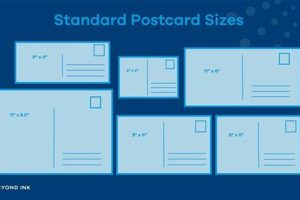
Standard postcard dimensions vary by country. In the United States, the maximum size accepted by the United States Postal Service is 6 inches long by 4.25 inches high. Smaller sizes are also permissible, provided they are rectangular and meet minimum size requirements. International standards, defined by the Universal Postal Union, differ slightly. Adhering to these dimensional guidelines ensures efficient processing and delivery.
Correct dimensions are crucial for mail handling equipment and automation. Oversized or unusually shaped pieces may be rejected or incur additional postage fees. Historically, standardized sizes facilitated efficient sorting and delivery as mail volumes grew. Today, this standardization continues to be essential for cost-effective processing in a global postal system. Consistent dimensions also offer senders a predictable canvas for design and messaging.
This article further explores the nuances of postcard sizing, including variations for international mailing, the impact of size on design choices, and optimal aspect ratios for visual communication. A comprehensive understanding of these factors empowers users to create effective and deliverable postcards.
Tips for Effective Postcard Sizing
Optimizing postcard dimensions maximizes deliverability and visual impact. Careful consideration of size ensures compatibility with postal regulations and enhances design effectiveness.
Tip 1: Verify postal regulations. Consult the relevant postal service for current size requirements. Domestic and international standards may differ.
Tip 2: Consider aspect ratio. A visually appealing aspect ratio complements the design and imagery. Common ratios include 4:3 and 3:2.
Tip 3: Plan for bleed. If the design extends to the edge of the card, incorporate bleed by extending the artwork slightly beyond the final trim size. This prevents unwanted white borders.
Tip 4: Maximize usable space. Balance the desired size with the available space for messaging and visuals. Avoid overcrowding.
Tip 5: Test print before mass production. A test print allows verification of dimensions, color accuracy, and overall design before committing to a large print run.
Tip 6: Choose appropriate paper stock. Thicker paper stock enhances perceived quality and durability but may affect postage costs.
Adhering to these tips ensures postcards meet postal requirements, enhances their visual appeal, and maximizes the effectiveness of communication.
By understanding these guidelines, one can create postcards that are both visually appealing and efficiently delivered.
1. Standard Dimensions

Standard dimensions are fundamental to understanding postcard sizes. They ensure efficient processing within postal systems and provide a framework for effective visual communication. Variations from these standards can result in increased postage costs, processing delays, or rejection by postal services.
- Maximum Size:
Maximum size limitations prevent oversized pieces from disrupting mail processing equipment. Exceeding these limits often incurs surcharges. In the United States, the maximum size is 6 x 4.25 inches. Larger postcards may require additional postage or be deemed non-mailable.
- Minimum Size:
Minimum size requirements ensure postcards are easily handled and processed by automated systems. Postcards that are too small risk getting lost or damaged during sorting. The United States Postal Service stipulates a minimum size of 3.5 x 5 inches. Smaller dimensions may be rejected.
- International Standards:
International standards, defined by the Universal Postal Union, provide a framework for global mail exchange. Variations exist between countries, emphasizing the importance of researching specific requirements for international mailings. Ignoring these variations can lead to delays or returns.
- Aspect Ratio:
Aspect ratio refers to the proportional relationship between width and height. Common aspect ratios for postcards include 4:3 and 3:2 (or 2:3). Maintaining a consistent aspect ratio ensures visual harmony and contributes to a balanced design. Choosing an appropriate aspect ratio enhances the visual impact of the postcard.
Adhering to standard dimensions ensures postcards are processed efficiently and delivered successfully. These standards, encompassing maximum and minimum sizes, international variations, and aspect ratio considerations, are crucial factors influencing postcard design and ensuring compatibility with postal regulations. Failure to comply with these parameters can compromise deliverability and overall effectiveness.
2. Maximum Size

Maximum size restrictions for postcards are a critical factor in determining what size is a postcard because they dictate the upper limits of acceptable dimensions for successful mailing. Exceeding these limits can result in additional postage fees, processing delays, or outright rejection by postal services. Understanding these limitations is essential for cost-effective and efficient postcard distribution.
- Postal Regulations:
Postal regulations define the maximum acceptable dimensions for postcards to ensure compatibility with mail processing equipment and efficient sorting. These regulations vary by country. For example, the United States Postal Service (USPS) sets a maximum size of 6 inches long by 4.25 inches high. International standards, defined by the Universal Postal Union, may differ. Non-compliance can lead to returned mail or surcharges.
- Machinability:
Mail processing equipment relies on standardized sizes for automated sorting and handling. Oversized postcards disrupt this process, potentially causing jams or requiring manual intervention. This underscores the importance of adhering to maximum size limits. Efficient processing relies on consistent dimensions to optimize automated systems.
- Cost Implications:
Exceeding maximum size limitations often results in higher postage costs. Postal services typically charge extra for non-standard sizes due to the additional handling required. This can significantly impact mailing budgets, particularly for large-scale campaigns. Awareness of maximum size restrictions helps control costs.
- Design Considerations:
While creative design is encouraged, maximum size limitations provide a practical boundary. Designers must work within these constraints to ensure deliverability. Pushing boundaries too far risks exceeding size limits and incurring extra costs. Understanding these limitations is crucial in the design phase.
Therefore, the maximum permissible size plays a crucial role in defining acceptable postcard dimensions. Adhering to these limitations ensures smooth processing, predictable costs, and successful delivery, directly addressing the core question of what size is a postcard from a practical and logistical perspective. Ignoring these constraints can have significant negative consequences, highlighting the importance of considering maximum size as a primary factor in postcard design and production.
3. Minimum Size

Minimum size requirements are integral to defining acceptable postcard dimensions. These limitations ensure postcards are handled efficiently by automated mail processing systems and remain readily identifiable throughout the delivery process. Insufficient size increases the risk of postcards becoming lost or damaged during sorting and transit. Understanding minimum size parameters is thus a critical component of understanding what size a postcard should be. A postcard falling below the minimum size threshold may be rejected by postal services or fail to reach its intended recipient, rendering the communication effort ineffective.
Postal regulations stipulate minimum dimensions to maintain operational efficiency. For instance, the United States Postal Service mandates a minimum size of 3.5 inches by 5 inches. Smaller items risk being misdirected or lost within the complex machinery of mail sorting facilities. Consider a postcard significantly smaller than the minimum; it could easily slip between conveyor belts or become jammed in sorting mechanisms. Conversely, postcards meeting minimum size requirements facilitate smooth processing and enhance successful delivery rates. This illustrates the direct, practical significance of understanding minimum size in the context of postcard dimensions.
In conclusion, minimum size requirements are not arbitrary restrictions but essential parameters impacting deliverability and cost-effectiveness. Failure to comply with these standards increases the risk of mailpiece rejection, processing delays, and ultimate delivery failure. Therefore, a thorough understanding of minimum size is not merely a technical detail but a fundamental aspect of understanding what size a postcard is, directly impacting the success of any postcard-based communication strategy.
4. International Variations

International variations in postcard size regulations significantly impact the answer to “what size is a postcard.” While domestic standards offer a clear framework, international mailing necessitates understanding country-specific requirements. Ignoring these variations can lead to increased postage costs, processing delays, or outright rejection of the postcard by the destination country’s postal service. Therefore, navigating international postcard sizing requires careful consideration of these varying standards.
- Universal Postal Union (UPU) Guidelines:
The UPU provides a framework for international mail exchange, offering recommendations for postcard dimensions. However, member countries retain the authority to define their own specific requirements within certain limitations. While the UPU fosters standardization, it does not enforce uniform sizing globally, necessitating awareness of individual country regulations.
- Country-Specific Regulations:
Each country’s postal service establishes its own acceptable size parameters. For example, Canada Post may have different requirements than Australia Post or Royal Mail in the United Kingdom. Researching these specific regulations is crucial for successful international postcard delivery. A postcard acceptable in one country might be considered non-standard in another, leading to potential issues.
- Impact on Design and Content:
Varying size regulations impact design choices and content layout. A design optimized for a standard US postcard may require adjustments for international destinations. This reinforces the importance of considering the target country’s size restrictions during the design phase. Adjustments may include altering image placement, font sizes, or overall layout to accommodate different dimensions.
- Pre-Printing Considerations:
For large international mailings, understanding size variations is crucial before printing. Printing postcards that conform only to domestic standards can lead to significant losses if those cards are rejected by the destination country. Pre-printing research and planning are essential for cost-effective international postcard campaigns. Confirming size compatibility with the target country’s postal service avoids costly reprints or wasted materials.
Therefore, “what size is a postcard” becomes a more complex question when considering international variations. Careful consideration of the UPU guidelines, country-specific regulations, and their impact on design and pre-printing decisions is crucial for successful international postcard delivery. Failing to address these variations can lead to logistical challenges and financial implications, highlighting the importance of understanding international standards in effective postcard communication.
5. Aspect Ratio

Aspect ratio, the proportional relationship between a postcard’s width and height, plays a crucial role in its visual appeal and design effectiveness. Understanding aspect ratio is integral to determining suitable postcard dimensions and optimizing the presentation of visual content. An inappropriate aspect ratio can distort images, create awkward layouts, and diminish the overall impact of the postcard’s message. Therefore, aspect ratio is a key consideration in answering the question, “what size is a postcard,” particularly concerning its visual presentation.
- Common Ratios:
Commonly used aspect ratios for postcards include 4:3 (e.g., 6×4.5 inches) and 3:2 (or 2:3, e.g., 6×4 inches). These ratios offer balanced proportions suitable for a variety of image and text layouts. Choosing a common aspect ratio often simplifies design choices and ensures compatibility with standard frame sizes, should recipients choose to display the postcard.
- Impact on Visual Composition:
Aspect ratio significantly influences how visual elements are arranged and perceived. A wide aspect ratio (e.g., 16:9) emphasizes horizontal elements and creates a sense of spaciousness, while a narrow aspect ratio (e.g., 4:5) accentuates vertical elements and can evoke a sense of height or intimacy. Selecting an aspect ratio aligned with the intended visual message enhances the postcard’s overall impact.
- Relationship to Standard Sizes:
Standard postcard sizes often adhere to common aspect ratios. For instance, the maximum postcard size accepted by the USPS (6×4.25 inches) approximates a 2:3 aspect ratio. This alignment simplifies design and printing processes while ensuring compliance with postal regulations. Choosing a size with a standard aspect ratio streamlines production and avoids compatibility issues.
- Digital Design Considerations:
In digital design, aspect ratio considerations extend to screen displays and online sharing. Choosing an aspect ratio compatible with common screen resolutions ensures the postcard’s visuals translate effectively across different devices. This is particularly relevant for postcards designed for online distribution or social media sharing. Maintaining consistent visual presentation across platforms reinforces brand identity and message clarity.
In conclusion, aspect ratio is intrinsically linked to postcard size and significantly impacts the effectiveness of visual communication. Selecting an appropriate aspect ratio ensures images and text are displayed harmoniously, contributing to a visually appealing and impactful postcard. Understanding the interplay between aspect ratio and standard sizes is thus crucial for anyone seeking to create effective and visually engaging postcards. This knowledge directly contributes to answering the question, “what size is a postcard,” from a design and aesthetic perspective.
Frequently Asked Questions about Postcard Sizes
This section addresses common inquiries regarding postcard dimensions, providing clear and concise answers to facilitate informed decision-making.
Question 1: What is the standard postcard size in the United States?
The maximum acceptable size for a postcard in the US is 6 inches by 4.25 inches. Smaller sizes are permissible, provided they meet the minimum requirement of 3.5 inches by 5 inches.
Question 2: Do international postcard sizes differ?
Yes, international postcard size regulations vary. While the Universal Postal Union provides guidelines, each country establishes its own specific requirements. Consulting the destination country’s postal service regulations is essential.
Question 3: What happens if a postcard exceeds the maximum size?
Oversized postcards may be subject to additional postage fees, experience processing delays, or be rejected entirely by the postal service.
Question 4: Why is aspect ratio important for postcard design?
Aspect ratio, the proportional relationship between width and height, impacts visual composition and image presentation. Choosing an appropriate aspect ratio enhances the postcard’s aesthetic appeal and effectiveness.
Question 5: How does postcard size affect postage costs?
Size and weight determine postage costs. Exceeding maximum size limits often leads to higher postage fees. Thicker card stock also contributes to increased weight and, consequently, higher postage.
Question 6: Where can one find the most up-to-date information on postcard size regulations?
Consulting the official website of the relevant postal service (e.g., USPS for the United States, Royal Mail for the UK) provides the most accurate and current information on postcard size regulations.
Understanding these frequently asked questions helps ensure postcard designs meet postal requirements and optimize communication effectiveness. Accurate sizing is crucial for both deliverability and visual impact.
The next section delves into specific examples of postcard sizes used globally, providing further practical guidance.
Conclusion
This exploration of postcard dimensions has highlighted the critical interplay between size, deliverability, and visual impact. Adhering to postal regulations regarding maximum and minimum sizes is fundamental for successful delivery. International variations necessitate careful consideration of country-specific requirements. Aspect ratio significantly influences visual composition and overall aesthetic appeal. Understanding these factors empowers informed design choices and ensures effective communication.
Effective postcard design transcends mere aesthetics; it requires a thorough understanding of practical limitations and technical specifications. Careful consideration of size parameters optimizes both the message’s visual impact and its successful arrival. By integrating these considerations into the design process, one ensures that the intended message reaches its destination effectively and efficiently.