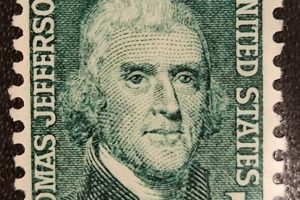
Several factors contribute to the desirability of a four-cent Lincoln stamp. Condition is paramount; an unused stamp with vibrant color, sharp corners, and intact gum holds significantly more value than a worn, faded, or damaged example. Rarity, driven by low printing numbers or distinctive plate variations, also plays a key role. A stamp with a documented error in its production can become highly sought after by collectors. The stamps centering within the perforated margin, often referred to as centering, is another crucial aspect affecting value. For example, a stamp with the design significantly off-center is generally less desirable.
Understanding these attributes provides collectors with a foundation for evaluating a stamp’s potential worth. The four-cent Lincoln stamp, issued during various periods throughout the 20th century, offers a rich collecting area with numerous variations and potential discoveries. Studying historical production data and specialized philatelic resources helps collectors pinpoint scarce varieties and appreciate the historical context surrounding these stamps. Their value reflects not only their scarcity but also their connection to a specific era of American postal history.
This exploration will delve into the details of each factor influencing a four-cent Lincoln stamp’s desirability. Specific examples, grading standards, and market trends will be examined to provide a comprehensive overview for both novice and experienced collectors.
Tips for Assessing Four-Cent Lincoln Stamp Value
Collectors seeking to understand the potential value of four-cent Lincoln stamps should consider several key factors. The following tips offer guidance for evaluating these stamps.
Tip 1: Prioritize Condition: A stamp’s condition significantly impacts its value. Mint stamps, especially those with original gum and minimal handling, command higher prices. Damage, such as tears, creases, or fading, drastically reduces value.
Tip 2: Research Rarity: Rarity is determined by factors like limited print runs or unique plate variations. Specialized catalogs and philatelic resources can help identify scarce varieties.
Tip 3: Examine Centering: The placement of the stamp’s design within the perforated border affects its desirability. Well-centered stamps are generally preferred and more valuable.
Tip 4: Identify Errors and Varieties: Printing errors or variations, such as inverted centerings or missing colors, can significantly increase a stamp’s value. These errors are often documented in philatelic literature.
Tip 5: Consult Expert Opinions: For high-value stamps, seeking professional grading and authentication from reputable organizations is recommended. This provides an objective assessment of a stamp’s condition and authenticity.
Tip 6: Understand Market Trends: Stamp values fluctuate based on market demand. Staying informed about current market trends can help collectors make informed decisions.
Tip 7: Consider Professional Grading: Certified stamps from reputable grading services, such as Professional Stamp Experts (PSE) or Numismatic Guaranty Corporation (NGC), often command higher prices due to the independent verification of authenticity and condition.
By carefully considering these factors, collectors can gain a deeper understanding of the nuances driving value in four-cent Lincoln stamps. These insights enable more informed collecting decisions and a greater appreciation for the historical significance embedded within these small pieces of postal history.
This information provides a solid foundation for navigating the world of four-cent Lincoln stamps. Further research and engagement within the collecting community will enhance understanding and appreciation of these historical artifacts.
1. Condition

Condition is a primary determinant of a four-cent Lincoln stamp’s value. The degree of preservation directly impacts desirability and price. A stamp in pristine, mint condition, exhibiting vibrant color, sharp corners, and full original gum, commands a premium. Conversely, a stamp with flaws, such as tears, creases, fading, thin spots, or disturbed gum, experiences a significant reduction in value. For example, a 1954 4-cent Lincoln stamp in perfect mint condition might be worth several dollars, whereas a similar stamp with a noticeable crease or tear could be worth only a few cents. The extent of damage directly correlates with the decrease in value.
Several grading systems exist to assess stamp condition objectively. These systems employ standardized terminology and numerical scales to describe a stamp’s state of preservation. Understanding these grading standards allows collectors to communicate effectively about condition and interpret price guides accurately. Utilizing a magnifying glass or specialized philatelic tools aids in identifying subtle flaws that might otherwise be overlooked. Factors like centering, the placement of the design within the perforated margin, also contribute to overall condition and influence value. A stamp with a significantly off-center design will typically be valued lower than a perfectly centered example, even if both are otherwise in excellent condition.
Recognizing the impact of condition on value allows collectors to make informed decisions. Prioritizing well-preserved examples, even for common stamps, builds a higher quality collection. While damaged stamps might be more affordable, their potential for appreciation is limited. Careful handling and proper storage techniques are essential for preserving stamp condition and maximizing long-term value.
2. Rarity

Rarity significantly influences a four-cent Lincoln stamp’s value. Scarcity, often driven by limited print runs, specific plate variations, or unique errors, directly correlates with desirability and price. Stamps produced in smaller quantities, or those exhibiting unusual characteristics, become more sought after by collectors. For example, the 1909 VDB 4-cent Lincoln stamp, with its initials of the designer, Victor David Brenner, appearing on the reverse, was discontinued after a short print run, contributing to its current rarity and high value. Conversely, stamps printed in large quantities during their initial release often remain relatively common and less valuable.
Specialized catalogs and philatelic resources document production figures and identify scarce varieties. These resources provide collectors with essential information for determining a stamp’s relative rarity. Understanding the factors contributing to scarcity, such as specific printing processes or historical events impacting production, enhances a collector’s ability to assess value accurately. Beyond print runs, plate variations, such as double transfers or re-entries, further contribute to rarity. These unintentional anomalies during the printing process create unique characteristics sought after by discerning collectors. Identifying these variations often requires specialized knowledge and careful examination.
Rarity, as a key driver of value, highlights the importance of research and careful evaluation. Collectors benefit from understanding production figures, identifying unique varieties, and utilizing reputable resources for accurate information. Recognizing the interplay between rarity and value allows for strategic collecting decisions, focusing on acquiring scarce and potentially valuable stamps. This knowledge fosters a deeper appreciation for the historical and production-related nuances impacting the philatelic market.
3. Centering

Centering plays a crucial role in determining a four-cent Lincoln stamp’s value. This refers to the precise placement of the stamp’s design within its perforated border. A perfectly centered stamp features equal margins on all four sides, showcasing the design in its intended entirety. Conversely, off-center stamps exhibit uneven margins, potentially clipping portions of the design or displaying excessive blank space. The degree of off-centering directly impacts a stamp’s desirability and value. A slightly off-center stamp might experience a minor reduction in value, while a severely off-center example, potentially cutting into the central design elements, can be significantly devalued. For instance, a 1930 4-cent Lincoln stamp with the design perfectly centered might be worth several dollars, whereas an example with the design significantly shifted to one side might be worth only a fraction of that amount. This difference underscores the importance collectors place on precise centering.
Collectors often utilize specialized tools and measurements to assess centering accurately. These tools allow for precise determination of margin widths and identification of even minor deviations from perfect centering. Understanding the nuances of centering and its impact on value requires careful observation and attention to detail. While some off-centering is common, especially in older stamps, the extent of the misalignment is the critical factor in determining its effect on value. The market generally favors well-centered stamps, as they represent the intended presentation of the design and demonstrate careful production. This preference is reflected in price guides and auction results, where superior centering often commands a premium. Centering also contributes to the overall aesthetic appeal of a stamp, making well-centered examples more visually pleasing and desirable for collectors.
In summary, centering represents a crucial factor affecting four-cent Lincoln stamp values. Its impact underscores the importance of careful examination and the utilization of accurate assessment tools. The emphasis on centering reflects the collecting community’s appreciation for precise production and the complete presentation of a stamp’s design. This understanding empowers collectors to make informed decisions and appreciate the nuances contributing to a stamp’s overall value and desirability.
4. Errors
Errors in stamp production significantly contribute to a four-cent Lincoln stamp’s value. These unintended deviations from the standard design, arising during the printing process, create unique and scarce varieties highly sought after by collectors. The nature and magnitude of the error directly influence a stamp’s desirability and price. Errors can range from minor imperfections, such as color shifts or misplaced perforations, to major anomalies, like inverted centers or missing design elements. For instance, the renowned 1918 24-cent inverted Jenny, while not a four-cent Lincoln stamp, exemplifies the dramatic impact an inverted center error can have on value, transforming a relatively common stamp into a philatelic rarity. Similarly, a four-cent Lincoln stamp with a missing color or a doubled image due to a printing error can become considerably more valuable than its correctly printed counterpart.
Several factors contribute to the value of error stamps. Rarity, driven by the infrequent occurrence of specific errors, plays a crucial role. The more unusual the error, the greater its potential value. Collectors prioritize well-documented errors, often referencing specialized catalogs and philatelic literature that detail known varieties and their relative scarcity. Condition also remains a critical factor, even for error stamps. A pristine, undamaged error stamp commands a higher premium than a similar error stamp with flaws. The combination of rarity and condition significantly amplifies a stamp’s value. Furthermore, the historical context surrounding specific errors adds to their appeal. Understanding the printing processes and historical circumstances leading to particular errors enhances a collector’s appreciation and contributes to the stamp’s overall significance.
The presence of errors provides a compelling dimension to stamp collecting. These unintentional deviations offer glimpses into the printing process and create opportunities for collectors to acquire unique and historically significant pieces. Careful examination, research, and authentication are essential when evaluating error stamps. Recognizing the interplay between rarity, condition, and historical context allows collectors to appreciate the distinct value proposition presented by error stamps within the broader philatelic landscape.
5. Demand

Collector demand significantly influences the value of four-cent Lincoln stamps. While rarity, condition, and noteworthy features contribute to desirability, robust collector interest ultimately drives market prices. Understanding the dynamics of demand provides crucial context for evaluating these stamps.
- Current Market Trends
Current market trends reflect the prevailing demand for specific four-cent Lincoln stamp varieties. Trends are influenced by factors such as new discoveries, renewed interest in particular historical periods, or shifting collector demographics. For example, a surge in popularity for stamps from a specific era can elevate prices across that period, even for relatively common four-cent Lincoln stamps. Tracking auction results and monitoring dealer inventories offer insights into evolving market trends.
- Collector Specialization
Many collectors focus on specific subsets within four-cent Lincoln stamps. Some specialize in particular print runs, plate variations, or error types. This focused demand can significantly impact the value of niche varieties. A scarce plate block error, for example, might command a substantial premium within a specialized collecting community dedicated to plate varieties. General collector interest in four-cent Lincoln stamps provides a baseline for value, while specialized demand can create significant price variations for specific items.
- Economic Conditions
Broader economic conditions can influence demand for collectible assets, including stamps. During periods of economic prosperity, collectors may have more disposable income, leading to increased demand and potentially higher prices. Conversely, economic downturns can dampen demand and exert downward pressure on values. While inherent numismatic factors primarily determine a stamp’s value, economic conditions provide a backdrop against which market dynamics play out.
- Long-Term Appreciation
The long-term appreciation potential of four-cent Lincoln stamps is linked to sustained collector demand. Stamps consistently sought after by collectors are more likely to maintain or increase their value over time. Factors contributing to long-term demand include historical significance, enduring design appeal, and ongoing research revealing new varieties or insights. While short-term market fluctuations can occur, long-term appreciation prospects are tied to the sustained interest of the collecting community.
The interplay between these demand-related factors and inherent numismatic attributes ultimately determines a four-cent Lincoln stamp’s value. Recognizing the dynamics of collector demand provides a more comprehensive understanding of market behavior and allows for more informed collecting decisions. While rarity and condition establish a foundation for value, the level of collector interest ultimately determines the price a stamp commands in the marketplace.
6. Authentication
Authentication plays a crucial role in establishing the legitimacy and value of a four-cent Lincoln stamp. Verification of a stamp’s genuineness provides a foundation for accurate valuation and assures collectors of its provenance. Without authentication, uncertainty surrounding a stamp’s authenticity can significantly detract from its market value and deter potential buyers. The process of authentication involves careful examination by experts, often utilizing specialized tools and techniques to identify genuine stamps and distinguish them from forgeries or alterations.
- Expert Examination
Expert examination forms the cornerstone of stamp authentication. Experienced philatelists possess the knowledge and skills to assess a stamp’s physical characteristics, including printing methods, paper type, ink composition, and perforations. Microscopic analysis and comparison with known genuine examples aid in identifying subtle indicators of authenticity or potential forgeries. Reputable philatelic organizations and grading services employ expert examiners who provide objective assessments and issue certificates of authenticity.
- Provenance Research
Researching a stamp’s provenance, or chain of ownership, provides valuable context for authentication. A documented history of ownership, including prior sales records or inclusion in reputable collections, strengthens a stamp’s credibility. Provenance research often involves examining auction catalogs, dealer records, and collection inventories. A well-documented provenance enhances a stamp’s desirability and can contribute to its overall value.
- Specialized Tools and Techniques
Specialized tools and techniques assist in the authentication process. Ultraviolet light reveals hidden security features or repairs not visible under normal light. Watermark detectors identify watermarks embedded within the stamp paper, providing further evidence of authenticity. Spectrometers analyze ink composition, helping to distinguish genuine stamps from forgeries using different ink formulations. These tools, combined with expert knowledge, provide a comprehensive approach to stamp authentication.
- Third-Party Grading and Certification
Submitting stamps to reputable third-party grading services, such as Professional Stamp Experts (PSE) or Numismatic Guaranty Corporation (NGC), provides an independent and objective assessment of authenticity and condition. These services encapsulate authenticated stamps in protective holders, accompanied by detailed descriptions and assigned grades. Third-party certification enhances confidence in a stamp’s genuineness and facilitates its marketability. Certified stamps often command higher prices due to the added assurance of authenticity and documented condition.
Authentication serves as a critical prerequisite for establishing the true value of a four-cent Lincoln stamp. By verifying a stamp’s genuineness, expert examination, provenance research, specialized tools, and third-party certification mitigate the risks associated with forgeries and alterations. This process ensures that collectors can confidently acquire and value genuine four-cent Lincoln stamps, preserving the integrity of the philatelic market and fostering continued appreciation for these historical artifacts.
Frequently Asked Questions
This section addresses common inquiries regarding factors influencing four-cent Lincoln stamp value. The responses provide concise, informative explanations.
Question 1: Do all four-cent Lincoln stamps hold significant value?
No. While some four-cent Lincoln stamps are quite valuable, many remain relatively common and affordable. Value is determined by factors such as condition, rarity, and the presence of errors.
Question 2: How does condition affect value?
Condition is paramount. A pristine, undamaged stamp with vibrant color and intact gum commands a higher price than a damaged or faded example. Even minor imperfections can significantly impact value.
Question 3: Where can one find reliable information about stamp values?
Reputable stamp catalogs, price guides, and online resources specializing in philately provide valuable information. Consulting with experienced stamp dealers or appraisers also offers expert insights.
Question 4: Are stamps with printing errors always more valuable?
While errors generally increase value, the magnitude and type of error influence the extent of the price premium. Minor errors might have a minimal impact, whereas significant errors can dramatically increase value.
Question 5: How is a four-cent Lincoln stamp’s rarity determined?
Rarity is typically based on production numbers and the existence of specific plate variations or unique characteristics. Specialized catalogs and philatelic literature document these factors.
Question 6: What is the importance of professional authentication?
Professional authentication verifies a stamp’s genuineness and provides an objective assessment of its condition. This process protects collectors from forgeries and ensures accurate valuation.
Understanding these factors allows for more informed collecting decisions and a greater appreciation of the nuances driving four-cent Lincoln stamp values. Further research and engagement with philatelic resources will enhance one’s knowledge and expertise.
For further exploration, consider researching specific varieties, consulting with experts, or joining philatelic societies. Continued learning within this field enriches the collecting experience.
The Value of Four-Cent Lincoln Stamps
Several interconnected factors contribute to a four-cent Lincoln stamp’s desirability and market value. Condition, encompassing preservation and centering, plays a crucial role. Rarity, influenced by production numbers and unique variations, significantly impacts value. Errors arising during the printing process create scarce and sought-after varieties. Collector demand, driven by market trends and specialized interests, ultimately determines realized prices. Authentication, through expert examination and specialized techniques, verifies genuineness and protects against forgeries. Understanding these factors provides a framework for assessing these stamps and appreciating the nuances of philately.
The enduring appeal of four-cent Lincoln stamps lies in their historical significance and the diverse collecting opportunities they present. Continued research, careful examination, and engagement with the philatelic community enhance understanding and appreciation of these small but historically rich artifacts. By considering these factors, collectors navigate the market effectively and build collections reflecting both historical significance and potential investment value.