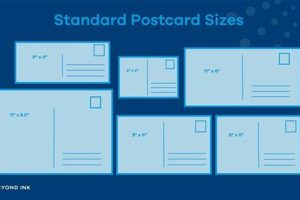
The United States Postal Service establishes specific dimensions for mailpieces to ensure efficient processing and delivery. Postcards must adhere to a minimum size of 3.5 inches high by 5 inches long and a maximum size of 4.25 inches high by 6 inches long. Exceeding these limits may result in additional postage or return to sender.
Adhering to these postal regulations offers several advantages. Standardized dimensions facilitate automated sorting and handling, contributing to faster and more reliable delivery. Furthermore, maintaining the correct dimensions avoids unnecessary surcharges and ensures the piece is delivered without delay. Historically, standardized mail sizes have evolved alongside advancements in postal technology, reflecting the ongoing pursuit of efficiency and affordability.
Understanding these dimensional requirements is fundamental to successful direct mail campaigns, efficient communication, and cost-effective mailing practices. The following sections will explore design considerations, paper stock options, and addressing guidelines for postcards.
Tips for Effective Postcard Design and Mailing
Creating impactful postcards and ensuring their successful delivery requires careful attention to design and adherence to postal regulations. The following tips provide guidance for maximizing effectiveness.
Tip 1: Maximize the Allowable Dimensions: While staying within the maximum dimensions of 4.25 inches high by 6 inches long allows for more design space and visual impact.
Tip 2: Choose Appropriate Paper Stock: Select a sturdy paper stock that can withstand handling and sorting processes. Consider a thicker stock for postcards containing important information or offers.
Tip 3: Design for Readability: Employ clear fonts, concise messaging, and effective use of white space to ensure the message is easily understood at a glance.
Tip 4: Accurate Addressing is Crucial: Ensure the recipient’s address is legible and correctly formatted to prevent delivery delays or returns. Use a clear font and avoid decorative elements near the address area.
Tip 5: Include a Clear Call to Action: Direct recipients towards the desired action, whether it’s visiting a website, making a purchase, or attending an event.
Tip 6: Consider Pre-Sorting for Discounts: For larger mailings, pre-sorting postcards by ZIP code can qualify for postal discounts, reducing overall mailing costs.
Tip 7: Integrate with Other Marketing Efforts: Coordinate postcard campaigns with other marketing initiatives to reinforce messaging and maximize reach.
By following these guidelines, mailers can create effective postcard campaigns that achieve their communication and marketing objectives while remaining compliant with postal regulations. Careful planning and execution are essential for successful postcard marketing.
In conclusion, adhering to postal size regulations and implementing effective design strategies are crucial for successful postcard campaigns. By considering these factors, businesses and individuals can maximize the impact of their mailings and achieve their communication goals.
1. Minimum Dimensions

Minimum dimensions for USPS postcards play a vital role in mail processing and delivery. These dimensions, set at 3.5 inches in height and 5 inches in length, ensure postcards are compatible with automated sorting equipment. Pieces falling below these minimums risk becoming jammed in machinery or misdirected, leading to processing delays and potential delivery failures. For instance, a postcard measuring 3 inches by 4 inches would be considered non-mailable as a postcard and likely require additional postage as a letter. Adhering to the minimum size guarantees efficient processing and timely delivery.
Maintaining these minimum dimensions also contributes to cost-effectiveness. Mail pieces significantly smaller than the standard size can incur extra fees due to the increased handling required. Furthermore, the minimum size provides sufficient space for addressing, postage, and essential messaging, optimizing communication effectiveness within the allocated space. Consider a business sending out promotional postcards: A postcard that meets the minimum size can effectively convey a concise message and contact information, whereas an undersized card might compromise readability and impact.
In summary, adhering to the USPS minimum postcard dimensions is crucial for efficient processing, cost-effective mailing, and successful delivery. Understanding these requirements enables effective communication through this widely utilized mail format. Failure to comply can result in processing delays, additional postage expenses, and reduced impact, highlighting the practical significance of these seemingly simple dimensional limitations within the broader postal system.
2. Maximum Dimensions

Maximum dimensions for USPS postcards are critical for automated processing and efficient mail delivery. Exceeding these limits, set at 4.25 inches in height and 6 inches in length, can result in processing difficulties, additional postage costs, and potential delivery delays. Understanding these constraints is crucial for successful postcard campaigns.
- Mail Processing Efficiency
Automated mail sorting equipment relies on standardized sizes. Postcards exceeding the maximum dimensions disrupt this process, requiring manual handling, which increases processing time and cost. For example, a 4.5″ x 7″ postcard, while seemingly only slightly larger, would likely be rejected by automated sorting machines and require manual processing.
- Postage Costs
Oversized postcards are often subject to additional postage fees, similar to large envelopes or small packages. These surcharges reflect the increased handling and processing required for non-standard mailpieces. Staying within the maximum dimensions helps control mailing expenses and ensures predictable budgeting.
- Delivery Speed
Manual processing due to oversized dimensions can lead to delivery delays. Postcards exceeding the maximum limits may be routed differently within the postal system, potentially adding time to the delivery schedule. Adhering to the size requirements contributes to timely delivery and efficient logistics.
- Design Considerations
While maximizing the allowable space can enhance visual impact, exceeding the maximum dimensions negates these benefits due to the resulting processing issues and surcharges. Effective postcard design balances visual appeal with practicality, recognizing the importance of staying within the prescribed size limits.
In conclusion, adhering to the maximum size limitations for USPS postcards is essential for cost-effective mailing and efficient delivery. These dimensions are integral to automated processing, impacting postage costs and delivery speed. Effective postcard campaigns balance creative design with practical considerations, recognizing the importance of these size constraints within the postal system. Ignoring these limits can lead to unnecessary expenses and delays, highlighting the significance of seemingly minor dimensional details within the broader context of postal operations.
3. Length Requirements

Postcard length directly impacts automated processing within the United States Postal Service. The required length, between a minimum of 5 inches and a maximum of 6 inches, ensures compatibility with high-speed sorting equipment. Mail pieces exceeding this range disrupt automated operations, necessitating manual handling, which increases processing time and cost. Consider a postcard measuring 7 inches in length: this non-standard size would require manual sorting, potentially delaying delivery and incurring additional postage fees. Conversely, a postcard shorter than 5 inches might be lost or misdirected during automated processing due to its insufficient size.
The length requirement contributes significantly to the efficiency of mail delivery. Standardized dimensions facilitate smooth passage through sorting machinery, optimizing delivery routes and minimizing handling time. This standardization ultimately benefits both the postal service and mail recipients. For businesses utilizing postcard marketing, adherence to length requirements ensures timely delivery of promotional materials, maximizing campaign effectiveness. Imagine a time-sensitive marketing campaign: postcards exceeding the maximum length could arrive late, diminishing the campaign’s impact and potentially leading to lost revenue.
In summary, postcard length represents a critical factor in efficient mail processing and delivery. Adherence to USPS length requirements ensures compatibility with automated systems, minimizes processing time and costs, and maximizes the effectiveness of mailed communications. Understanding this seemingly simple requirement offers significant practical advantages for both individual mailers and large-scale mailing operations. Non-compliance can lead to delays, increased expenses, and diminished impact, underscoring the importance of this seemingly minor detail within the larger context of postal logistics.
4. Height Requirements

Postcard height represents a critical dimension within United States Postal Service regulations, directly impacting mail processing and delivery efficiency. Adherence to the specified height range, between a minimum of 3.5 inches and a maximum of 4.25 inches, ensures compatibility with automated sorting equipment and facilitates smooth processing throughout the postal system. Deviations from these requirements can lead to processing delays, additional postage costs, and potential delivery issues. Understanding the importance of height requirements is essential for effective and cost-efficient mail communication.
- Automated Processing Compatibility
Automated sorting equipment relies on standardized mailpiece dimensions for efficient operation. Postcards exceeding the maximum height or falling below the minimum height disrupt this process, requiring manual handling, which increases processing time and associated costs. A postcard measuring 5 inches in height, for instance, would likely be rejected by automated sorting machinery, necessitating manual intervention.
- Postage Cost Optimization
Non-standard postcard sizes, including those exceeding height limitations, often incur additional postage fees. These surcharges reflect the increased handling and processing required for mailpieces outside the standard dimensions. Maintaining the correct height helps control mailing expenses and ensures predictable budgeting.
- Impact on Delivery Speed
Manual handling due to non-compliant height can introduce delays in the delivery process. Oversized or undersized postcards may be routed differently within the postal system, potentially adding time to the delivery schedule. Adhering to the specified height range contributes to timely and efficient delivery.
- Design and Readability Considerations
While maximizing allowable dimensions can enhance visual impact, exceeding height restrictions negates these benefits due to processing complications and potential surcharges. Effective postcard design considers both aesthetics and practicality, recognizing the importance of staying within the prescribed height limits to ensure efficient processing and delivery. A postcard with excessive height might be visually striking but ultimately impractical within the postal system.
In conclusion, height requirements for USPS postcards are integral to the efficiency of the postal system. These seemingly minor dimensional limitations play a significant role in automated processing, postage costs, and delivery timelines. Effective mail communication requires adherence to these standards, balancing design considerations with the practical realities of mail processing and delivery infrastructure. Disregarding height requirements can lead to unnecessary expenses, processing delays, and diminished impact, highlighting the importance of seemingly small details within the larger context of postal operations.
5. Non-standard Surcharges

Non-standard surcharges represent a significant cost consideration when mailing postcards through the United States Postal Service. These surcharges apply to mailpieces that deviate from the standard size and shape requirements, impacting postage expenses and overall mailing budgets. Understanding the relationship between non-standard surcharges and USPS postcard size is crucial for cost-effective mailing practices.
- Dimensional Non-Compliance
Postcards exceeding the maximum dimensions (4.25″ x 6″) or falling below the minimum dimensions (3.5″ x 5″) are subject to non-standard surcharges. These surcharges reflect the increased handling and processing required for mailpieces outside the standard size range. For example, a postcard measuring 4″ x 7″ would likely incur a non-standard surcharge due to its excessive length. This additional cost can significantly impact mailing budgets, particularly for large-volume mailings.
- Shape Irregularities
Postcards featuring unusual shapes, such as die-cuts or rounded corners, can also trigger non-standard surcharges. These irregular shapes often require specialized handling and may not be compatible with automated processing equipment. A postcard with a custom die-cut shape, while visually appealing, might incur additional fees due to its non-standard form. Balancing creative design with cost considerations is crucial in postcard marketing.
- Thickness and Rigidity
Excessively thick or rigid postcards can also be subject to non-standard surcharges. These characteristics can impede automated processing and may require special handling. For instance, a postcard printed on unusually thick card stock might incur additional fees due to its rigidity. Selecting appropriate paper stock is essential for balancing durability and cost-effectiveness.
- Cost Calculation and Budgeting
Accurately calculating postage costs requires careful consideration of potential non-standard surcharges. Failing to account for these surcharges can lead to unexpected expenses and budget overruns. Utilizing online postage calculators or consulting with postal service representatives can help determine accurate postage costs for non-standard postcards. Precise cost estimation is crucial for effective budget management in direct mail campaigns.
In summary, non-standard surcharges represent a critical cost factor in postcard mailing. Adhering to USPS size and shape requirements minimizes the risk of these surcharges, contributing to cost-effective mailing practices. Careful planning, including consideration of dimensions, shape, thickness, and rigidity, is essential for managing postage expenses and maximizing the return on investment in postcard marketing campaigns. Understanding these factors allows for informed decision-making regarding design and material choices, balancing creative aspirations with budgetary constraints.
6. Automated Processing Impact
Automated processing significantly impacts mail delivery speed and efficiency within the United States Postal Service. Postcard size plays a crucial role in this process. Mailpieces adhering to the standardized dimensions (3.5″ x 5″ minimum, 4.25″ x 6″ maximum) facilitate seamless movement through automated sorting equipment. Conversely, non-standard sizes disrupt this automated flow, requiring manual handling, which increases processing time and costs. Consider a bulk mailing of postcards: those conforming to size regulations are rapidly sorted by automated machinery, while oversized or undersized pieces necessitate manual intervention, potentially delaying the entire mailing.
The connection between postcard size and automated processing affects several aspects of mail delivery. Standardized sizes enable efficient sorting, optimizing delivery routes and minimizing handling time. This efficiency translates to faster delivery speeds and reduced operational costs for the postal service. Furthermore, automated processing reduces the likelihood of misdirected or lost mail. For businesses relying on direct mail marketing, adhering to postcard size regulations ensures timely delivery of promotional materials, maximizing campaign impact. Imagine a time-sensitive marketing campaign: postcards of non-standard sizes could arrive late, diminishing the campaign’s effectiveness.
In conclusion, postcard size directly impacts the efficiency of automated processing within the postal system. Adherence to USPS size regulations ensures compatibility with automated equipment, optimizing mail flow, reducing processing time and costs, and improving delivery speed. Non-compliance necessitates manual handling, potentially leading to delays, increased expenses, and diminished impact, particularly for time-sensitive mailings. Understanding this connection is crucial for both individual mailers and large-scale mailing operations seeking efficient and cost-effective mail delivery.
Frequently Asked Questions about USPS Postcard Sizes
This section addresses common inquiries regarding United States Postal Service postcard size regulations, providing clear and concise answers to facilitate informed mailing practices.
Question 1: What are the exact size requirements for a USPS postcard?
Postcards must meet specific dimensional criteria: a minimum of 3.5 inches high by 5 inches long and a maximum of 4.25 inches high by 6 inches long.
Question 2: What happens if a postcard exceeds the maximum size limits?
Postcards exceeding the maximum dimensions are considered non-standard and may incur additional postage fees, experience processing delays, or be returned to the sender.
Question 3: Are there benefits to using the maximum permissible postcard size?
Utilizing the maximum permissible size provides increased design space for visual elements and messaging while remaining compliant with postal regulations.
Question 4: Why is adhering to USPS size regulations important?
Compliance with size regulations ensures compatibility with automated processing equipment, facilitating efficient sorting, timely delivery, and cost-effective mailing practices.
Question 5: How can one determine the correct postage for a non-standard sized postcard?
Consulting the USPS website, using online postage calculators, or inquiring at a local post office can provide accurate postage information for non-standard sized postcards.
Question 6: What paper stock thickness is recommended for postcards?
While specific thickness requirements are not mandated, a sturdy paper stock is recommended to withstand handling and sorting processes, ensuring the postcard arrives in good condition. Consult the USPS for specific weight requirements.
Understanding USPS postcard size regulations is crucial for successful and cost-effective mailing. Careful attention to these seemingly minor details can significantly impact delivery efficiency and overall mailing expenses.
For further information and specific mailing scenarios, consult the official USPS website or a local post office.
USPS Postcard Size
Adhering to USPS postcard size regulations is paramount for efficient and cost-effective mailing practices. Standardized dimensions, ranging from a minimum of 3.5″ x 5″ to a maximum of 4.25″ x 6″, ensure compatibility with automated processing equipment, facilitating timely delivery and minimizing postage expenses. Ignoring these seemingly minor dimensional details can lead to processing delays, increased costs due to non-standard surcharges, and potential return-to-sender scenarios, ultimately impacting the success of any mailing campaign.
Careful consideration of postcard dimensions empowers informed decision-making regarding design, paper stock selection, and overall mailing strategy. Understanding these regulations allows mailers to maximize the effectiveness of postcard communication while minimizing unnecessary expenses and delays. Ultimately, compliance with USPS postcard size requirements contributes to a more efficient and reliable postal system for all.