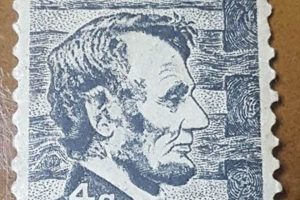
The value of a four-cent Lincoln stamp depends on several factors, including its condition, the year of issue, any potential errors or varieties, and market demand. A stamp in mint condition, with its original gum and no imperfections, will typically command a higher price than a used or damaged stamp. For example, a well-preserved 1909 four-cent Lincoln stamp in mint condition could be worth significantly more than a common 1950s four-cent Lincoln stamp with a cancellation mark.
Determining the value of older postage provides insight into historical printing processes, postal rates, and even artistic trends of the era. These small pieces of history offer collectors a tangible connection to the past. Beyond their historical significance, stamps can represent a valuable investment for collectors. Rare stamps, particularly those in pristine condition, can appreciate in value over time.
Factors affecting stamp values include condition (mint or used), printing variations, and market trends. Resources such as stamp catalogs, online marketplaces, and expert appraisers can provide more detailed information about specific stamp values and assist collectors in making informed decisions.
Tips for Determining Value
Accurately assessing the value of a four-cent Lincoln stamp requires careful consideration of several key factors. The following tips provide guidance for this process.
Tip 1: Assess Condition: Examine the stamp for any signs of wear, such as tears, creases, thin spots, or fading. Mint condition stamps, retaining their original gum and showing no signs of use, are generally more valuable.
Tip 2: Identify the Issue Date: Different four-cent Lincoln stamps were issued over several decades. Pinpointing the year of issue is crucial for accurate valuation, as some years are rarer or more desirable than others. Specialized stamp catalogs can assist with identification.
Tip 3: Check for Printing Errors or Varieties: Errors during the printing process can create rare and valuable stamps. Look for variations in color, missing perforations, or inverted images. These varieties can significantly impact a stamp’s worth.
Tip 4: Consult a Stamp Catalog: Reputable stamp catalogs provide detailed information on different stamp issues, including estimated values based on condition and rarity. These catalogs are essential resources for collectors.
Tip 5: Seek Expert Opinions: For particularly valuable or rare stamps, consulting a professional philatelic appraiser can provide a definitive assessment of its worth. Appraisers possess specialized knowledge and experience in identifying and valuing stamps.
Tip 6: Research Online Marketplaces: Observing completed sales of similar stamps on online marketplaces can offer insights into current market values. However, be aware that prices can fluctuate based on demand and the specific condition of individual stamps.
By carefully considering these factors, collectors can gain a more accurate understanding of the potential value of a four-cent Lincoln stamp.
Understanding these nuances empowers informed decisions regarding potential acquisitions or sales, ensuring transactions align with market realities and collector objectives.
1. Condition

Condition significantly influences a four-cent Lincoln stamp’s value. The grading scale, ranging from superb mint state to heavily damaged, directly correlates with potential market prices. A stamp’s preservation state affects its desirability among collectors. Minor imperfections, such as small tears or hinge marks, can substantially reduce value compared to a pristine example. For instance, a 1954 four-cent Lincoln stamp with a small tear might be valued at a few cents, while a mint-state example of the same issue could command a dollar or more. This disparity highlights the importance of condition in determining worth.
Several factors contribute to a stamp’s condition. Exposure to moisture, sunlight, and improper handling can cause damage over time. Hinge remnants, creases, and fading are common issues affecting older stamps. Careful storage in protective albums or mounts is crucial for preserving condition and maintaining value. Professional grading services provide objective assessments, offering standardized evaluations that facilitate informed buying and selling decisions.
Understanding the impact of condition empowers collectors to make informed acquisitions. Prioritizing well-preserved stamps, even if slightly more expensive initially, can represent a wiser long-term investment. Condition remains a cornerstone of philatelic evaluation, impacting not only monetary worth but also the historical and aesthetic appreciation of these miniature artifacts.
2. Rarity
Rarity significantly influences the value of a four-cent Lincoln stamp. Scarcity, often linked to limited print runs, specific issue dates, or distinctive plate variations, drives demand among collectors. The interplay between available supply and collector interest directly impacts market prices. For example, the 1909 VDB Lincoln cent, with its limited production, commands substantially higher prices than more common Lincoln cents. Similarly, a four-cent Lincoln stamp with a rare printing error, such as an inverted center or missing perforation, can be considerably more valuable than a standard issue.
Several factors contribute to stamp rarity. Unforeseen events during production, such as damaged printing plates or altered designs, can lead to limited quantities of specific varieties. Changes in postal rates or stamp designs can also result in shorter production runs, increasing scarcity. Furthermore, external factors like wartime paper shortages or distribution disruptions can limit the number of surviving stamps from certain periods. Meticulous record-keeping and specialized catalogs help collectors identify and understand the rarity of specific issues, enabling informed decisions about acquisition and potential investment.
Understanding rarity is essential for collectors seeking to assess value accurately. Recognizing the factors influencing scarcity empowers informed decisions regarding potential purchases or sales. Rarity, combined with condition, forms the cornerstone of philatelic valuation, providing a framework for understanding the market forces shaping the worth of these historical artifacts. This knowledge enables collectors to navigate the complexities of the stamp market, appreciating the interplay between historical context, production circumstances, and collector demand.
3. Issue Date
The issue date of a four-cent Lincoln stamp plays a crucial role in determining its value. Different issues, spanning several decades, reflect varying degrees of rarity, design changes, and historical context. Understanding the significance of issue dates provides a foundational element for accurate valuation and informed collecting.
- Early Issues (1909-1920s):
Stamps from this period, particularly the 1909 VDB issue, are often more valuable due to their historical significance and potential rarity. The first depictions of Abraham Lincoln on postage, these issues mark a pivotal moment in philatelic history. Variations within these early issues, such as different perforation types or watermark positions, further influence value.
- Mid-Century Issues (1930s-1950s):
These issues generally represent a larger print run and are often more accessible to collectors. While typically less valuable than early issues, variations such as different printing methods or paper types can still impact their worth. Specific commemorative issues within this period can also command higher prices due to their limited production.
- Later Issues (1960s-1970s):
With the shift towards automated production processes, stamps from these later years tend to be more common. Condition plays a significant role in determining value, as mint examples are generally more desirable than used copies. Specialized varieties or errors within these later issues can still hold significant value for collectors.
- Commemorative Issues:
Throughout the decades, specific four-cent Lincoln stamps were issued to commemorate significant events or anniversaries. These commemorative issues, often featuring unique designs or limited print runs, can be more valuable than standard issues from the same period. Identifying and understanding the historical context surrounding these issues contributes to accurate valuation.
By considering the issue date in conjunction with other factors like condition and potential variations, collectors can gain a more comprehensive understanding of a four-cent Lincoln stamp’s value. Researching specific issue dates and their associated rarity provides essential context for informed collecting and investment decisions. This knowledge empowers collectors to navigate the market effectively, recognizing the historical and numismatic significance embedded within these small pieces of history.
4. Printing Errors

Printing errors significantly influence the value of a four-cent Lincoln stamp. These errors, arising from unintended deviations during the production process, transform ordinary stamps into sought-after collectibles. The resulting scarcity, coupled with collector interest in these unique anomalies, drives market values considerably higher than standard issue counterparts. Errors range from minor imperfections, such as slight color shifts or off-center printing, to major deviations like inverted centers or missing design elements. The magnitude of the error often correlates directly with the stamp’s value. For instance, an inverted Jenny, a famous example of a printing error on a US stamp, is highly prized by collectors.
Several factors contribute to the occurrence of printing errors. Mechanical malfunctions in the printing presses, inconsistencies in ink distribution, or errors in the plate preparation process can all lead to these unique variations. The precise cause and nature of the error are crucial for authenticating and assessing a stamp’s value. Specialized catalogs and expert opinions often play a vital role in identifying and categorizing these errors. Detailed examination under magnification is sometimes necessary to distinguish genuine printing errors from post-production damage. Documented examples of specific errors on four-cent Lincoln stamps include double prints, omissions of certain design elements, and color shifts. These documented instances provide valuable reference points for collectors and appraisers.
Understanding printing errors is essential for collectors seeking rare and potentially valuable stamps. Knowledge of these errors allows for informed decisions regarding acquisition and valuation. The presence of a verifiable printing error transforms a common stamp into a unique piece of philatelic history, often commanding significantly higher prices. This understanding of printing errors contributes to a broader appreciation of the production process and the historical context surrounding these seemingly minor, yet fascinating, variations.
5. Market Demand
Market demand plays a crucial role in determining the value of a four-cent Lincoln stamp. The interplay between collector interest, available supply, and prevailing economic conditions significantly influences price fluctuations. Understanding market dynamics is essential for collectors seeking to assess current values and anticipate potential future trends. Just as with other collectibles, scarcity coupled with high demand drives prices upward, while abundant supply and waning interest can lead to price decreases.
- Collector Interest:
The level of interest among stamp collectors directly impacts demand. Specific issues, such as those commemorating historical events or featuring popular designs, often attract greater interest, driving up their value. Trends in collecting, influenced by factors like historical anniversaries or renewed interest in specific periods, can significantly impact market demand for particular four-cent Lincoln stamp issues. For example, a surge in interest in early 20th-century American history might increase demand for stamps from that era.
- Available Supply:
The scarcity of a particular four-cent Lincoln stamp issue directly influences its market value. Limited print runs, accidental destruction of existing stock, or unexpected increases in collector demand can restrict supply, leading to higher prices. Conversely, newly discovered hoards or decreased collector interest can increase supply, potentially lowering market values. Understanding the factors influencing supply is crucial for assessing a stamp’s potential future value.
- Economic Conditions:
Prevailing economic conditions can influence collector behavior and, consequently, market demand. During periods of economic prosperity, collectors may have more disposable income to invest in collectibles, potentially driving up prices. Conversely, economic downturns can lead to decreased spending on non-essential items like stamps, potentially softening demand and impacting prices. Recognizing these broader economic influences provides valuable context for understanding market fluctuations.
- Auction Results and Market Trends:
Monitoring auction results and tracking market trends provides valuable insights into current demand and price movements. Observing prices realized for specific four-cent Lincoln stamp issues in recent auctions offers a real-time gauge of market activity. Tracking trends over time helps identify emerging areas of collector interest or potential price bubbles. This information empowers collectors to make informed decisions about buying and selling, aligning their strategies with current market dynamics.
By considering these interconnected facets of market demand, collectors can develop a more nuanced understanding of the factors influencing the value of a four-cent Lincoln stamp. This knowledge, combined with careful assessment of condition, rarity, and issue date, provides a comprehensive framework for informed collecting and investment decisions. Recognizing the dynamic nature of market forces allows collectors to anticipate potential shifts in value and make strategic choices that align with their collecting goals and market realities.
6. Expert Appraisal

Expert appraisal plays a critical role in accurately determining the value of a four-cent Lincoln stamp. While various resources offer estimated values, professional appraisal provides definitive assessments, especially crucial for rare or potentially valuable stamps. Appraisal relies on specialized knowledge and experience to navigate the complexities of condition, rarity, and market fluctuations, offering collectors and investors reliable valuations.
- Authentication and Verification:
Expert appraisers possess the knowledge and tools to authenticate stamps, verifying their genuineness and identifying potential forgeries or alterations. Authentication is paramount in establishing value, as counterfeit or altered stamps hold significantly less worth. Microscopic examination, watermark detection, and comparison with documented examples are among the techniques employed.
- Condition Assessment:
Appraisers meticulously evaluate a stamp’s condition, considering factors like centering, perforations, gum condition (if applicable), and any signs of damage or wear. This detailed assessment, often using standardized grading scales, provides an objective measure of the stamp’s preservation state, directly impacting its value. Minor imperfections can significantly influence a stamp’s grade and subsequent market worth.
- Rarity Determination:
Experts possess in-depth knowledge of stamp production, distribution, and historical context. This expertise allows them to assess a stamp’s rarity based on factors such as issue date, printing variations, and known surviving quantities. Accurate rarity determination is crucial, as scarcity directly correlates with value. Specialized catalogs and auction records serve as valuable resources for appraisers in this process.
- Market Analysis:
Appraisers stay abreast of current market trends, auction results, and collector demand. This market awareness allows them to provide valuations that reflect current market realities. Understanding fluctuations in collector interest and economic conditions empowers appraisers to offer accurate assessments of a stamp’s potential market value, considering both immediate and long-term investment perspectives.
Expert appraisal provides an essential service for collectors seeking accurate and reliable valuations for their four-cent Lincoln stamps. By combining authentication, condition assessment, rarity determination, and market analysis, appraisers offer a comprehensive and informed perspective on a stamp’s worth. This professional evaluation is particularly valuable for rare stamps, stamps with potential printing errors, or those in exceptionally good condition, providing collectors with the confidence to make informed decisions regarding acquisition, sale, or insurance coverage.
7. Catalog Values

Catalog values provide a crucial benchmark for understanding the potential worth of a four-cent Lincoln stamp. These resources offer estimated market values based on various factors, including condition, rarity, and historical context. While not definitive indicators of actual selling prices, catalog values offer a valuable starting point for collectors and serve as a guide for understanding market trends and potential investment opportunities. They represent a compilation of historical data and expert analysis, offering a structured framework for assessing stamp values.
- Condition Grades and Corresponding Values:
Stamp catalogs typically employ standardized grading systems to categorize stamp condition, ranging from mint state to heavily damaged. Each grade corresponds to a specific value range, reflecting the impact of condition on market worth. For example, a four-cent Lincoln stamp graded as “very fine” might have a catalog value significantly higher than an identical stamp graded as “good.” These condition-based valuations provide a structured approach to assessing potential market prices.
- Rarity Designations and Price Variations:
Catalogs often include rarity designations for different stamp issues, indicating their relative scarcity within the philatelic market. These designations, ranging from common to extremely rare, directly influence catalog values. A rare four-cent Lincoln stamp variety, such as one with a documented printing error, will typically command a higher catalog value than a common issue from the same period. These rarity-based distinctions provide valuable insights into the potential market demand and investment potential of specific stamps.
- Historical Context and Value Trends:
Catalogs frequently provide historical context for different stamp issues, including details about their production, distribution, and any significant events that might have impacted their rarity or value. This historical context helps collectors understand the factors that contribute to a stamp’s market worth. For example, a four-cent Lincoln stamp issued during a period of wartime paper shortages might have a higher catalog value due to its relative scarcity. Understanding this historical context provides a deeper appreciation for the stamp’s significance and potential investment value.
- Market Fluctuations and Catalog Updates:
Recognizing that market conditions and collector demand can fluctuate, reputable stamp catalogs undergo periodic updates to reflect current market trends. These updates ensure that the catalog values remain relevant and provide collectors with the most accurate information available. Monitoring these updates allows collectors to stay informed about shifts in market values and make informed decisions about buying and selling. Understanding the dynamic nature of the stamp market is crucial for maximizing investment potential.
By utilizing catalog values in conjunction with expert opinions and market analysis, collectors can gain a comprehensive understanding of the potential worth of a four-cent Lincoln stamp. Catalogs offer a structured framework for assessing value, providing a crucial benchmark for navigating the complexities of the philatelic market. While individual selling prices may vary based on specific circumstances, catalog values remain an invaluable resource for collectors seeking to build informed collections and make sound investment decisions.
Frequently Asked Questions
This section addresses common inquiries regarding the valuation of four-cent Lincoln stamps. Clear and concise responses aim to provide practical guidance for collectors and enthusiasts.
Question 1: Where can one find reliable information on four-cent Lincoln stamp values?
Reputable stamp catalogs, online marketplaces specializing in philatelic materials, and professional appraisers offer reliable valuation resources. Cross-referencing information from multiple sources enhances accuracy.
Question 2: Do all four-cent Lincoln stamps hold significant value?
Value varies considerably depending on factors like condition, rarity, and specific issue date. While some rare varieties command substantial prices, more common issues may have minimal monetary worth. Accurate assessment requires careful consideration of these factors.
Question 3: How does stamp condition affect value?
Condition is paramount. Stamps in pristine, mint condition generally command significantly higher prices than used or damaged examples. Even minor imperfections can impact value. Professional grading provides standardized assessments.
Question 4: What are the most valuable four-cent Lincoln stamps?
Rarity drives high values. Stamps with documented printing errors, limited edition commemorative issues, or those from early production years often command premium prices. Expert authentication is crucial for verifying such rarities.
Question 5: How can one determine the authenticity of a potentially valuable stamp?
Consulting a professional philatelic appraiser or a reputable stamp dealer is recommended for authentication. Expert examination can verify genuineness and detect potential forgeries or alterations, protecting against misrepresentation.
Question 6: Is investing in four-cent Lincoln stamps a sound financial strategy?
While certain rare stamps can appreciate in value, stamp collecting should primarily be approached as a hobby rather than a purely financial investment. Market fluctuations, authentication challenges, and the specialized knowledge required pose inherent risks. Thorough research and expert guidance are essential for informed decisions.
Accurate valuation requires careful consideration of multiple factors. Consulting reputable resources and seeking expert advice provides a solid foundation for navigating the complexities of the stamp market.
For further information on specific aspects of stamp collecting, refer to specialized resources or consult with philatelic experts.
How Much is a 4 Cent Lincoln Stamp Worth? – Conclusion
Determining the value of a four-cent Lincoln stamp requires a multifaceted approach. Condition, ranging from pristine mint state to damaged, significantly impacts worth. Rarity, often linked to specific issue dates, limited print runs, or unique printing errors, further influences market prices. Market demand, driven by collector interest and prevailing economic conditions, introduces dynamic price fluctuations. Expert appraisal provides crucial authentication and valuation services, particularly for rare or potentially valuable stamps. Catalog values offer a helpful benchmark, though actual selling prices may vary based on specific circumstances. Careful consideration of these interconnected factors provides a comprehensive framework for understanding the potential worth of these historical artifacts.
The enduring appeal of four-cent Lincoln stamps lies not solely in their potential monetary value, but also in their historical significance. These small pieces of history offer tangible connections to past eras, reflecting changing artistic styles, printing technologies, and postal rates. Whether viewed as financial investments or historical artifacts, four-cent Lincoln stamps represent a rich and rewarding area of study for collectors and enthusiasts. Continued research and engagement within the philatelic community provide avenues for deepening one’s understanding and appreciation of these miniature treasures.