



An Austria-Hungary classic stamps catalog opens a window onto one of Europe’s most intricate postal histories. The Habsburg lands used a succession of Austrian and Hungarian issues across a multilingual empire, leaving collectors with far more to study than portraits and denominations. Paper, perforations, printing methods, cancellations, and changing currencies can turn two seemingly identical stamps into very different catalog entries. Understanding those details is the key to identifying material accurately and building a collection with confidence.
This guide explains how to use an Austria-Hungary stamp catalog, recognize major classic issues, interpret valuations, and avoid common identification mistakes. It also covers the historical distinction between Austrian and Hungarian postal administrations—a distinction that matters when deciding where a stamp belongs.
What Is an Austria-Hungary Classic Stamps Catalog?
An Austria-Hungary classic stamps catalog is a reference that organizes postage stamps and often related postal material issued in the Habsburg territories. Depending on its scope, it may include Austria’s first issue of 1850, Hungarian issues beginning in 1871, stamps used in Austrian post offices abroad, and Bosnia and Herzegovina under Habsburg administration.
Classic-period boundaries vary among collectors and publishers. Some focus on nineteenth-century issues; others extend their collections to the collapse of Austria-Hungary in 1918. A useful catalog generally provides illustrations, issue dates, denominations, varieties, and separate prices for unused and used examples.
- Austria: Imperial issues from 1850 onward, including stamps used in territories administered by Austria.
- Hungary: Separate Hungarian postage stamps issued from 1871, following the Austro-Hungarian Compromise of 1867.
- Bosnia and Herzegovina: Distinctive issues associated with Austro-Hungarian administration, beginning in 1879.
- Related postal history: Newspaper stamps, revenue material, postal stationery, military mail, and overseas post offices may be listed separately.
Not every stamp used within the empire carries the same inscription or appears under a single catalog heading. Begin with the issuing administration, not the modern country where the cover was mailed.
The Historical Framework Collectors Need
The Austrian Empire introduced its first postage stamps in 1850. These early issues circulated across extensive Habsburg territories, including areas that are now part of Austria, Hungary, the Czech Republic, Slovakia, Croatia, Slovenia, Italy, Poland, Romania, and Ukraine. Consequently, a cancellation from a town outside present-day Austria can still be entirely appropriate on an Austrian stamp.
After the 1867 compromise established the Dual Monarchy, Austria and Hungary shared a monarch but developed separate internal administrations. Hungarian stamps appeared in 1871. A letter posted in Budapest after that date normally requires a different identification approach from one mailed in Vienna.
Geography is especially important for postal history. Place names can appear in German, Hungarian, Italian, Czech, or other languages, sometimes in historical spellings. A town cancellation may reveal the route and origin of a cover, but its name alone does not establish which administration issued the stamp.
Major Classic Issues to Look For
Austria’s First Issue of 1850
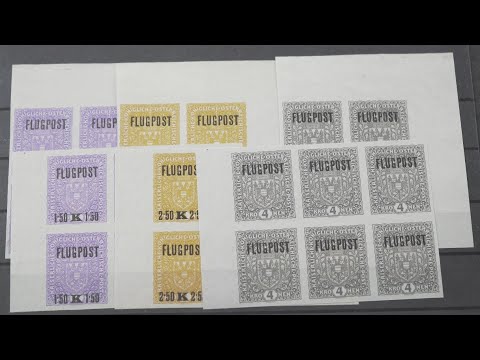
Austria’s first definitive stamps show the imperial coat of arms. Collectors study their denominations, shades, paper, printing characteristics, and cancellations. The set was issued imperforate, so margins are a central condition factor: examples with the design clear on all sides are generally more desirable than copies cut into the printed frame.
Specialized catalogs distinguish characteristics that a general album may combine. Paper type and printing differences can be subtle, so compare more than one feature before assigning a scarce variety. A damaged or heavily canceled stamp should not automatically be identified as the rarer entry simply because one detail appears promising.
Franz Joseph Issues and Later Austrian Designs
Portraits of Emperor Franz Joseph I became prominent in later Austrian issues. Designs, inscriptions, currencies, and perforations changed over time, making a date-based comparison useful. Look closely at the frame, direction of the portrait, denomination, and printing method before checking more specialized features.
Austrian newspaper stamps deserve particular attention. The famous Mercury designs were produced for newspaper postage, and their colors and printings are important to identification. Some are valuable and heavily forged; an apparent rarity warrants expert examination rather than an optimistic catalog lookup.
Hungary’s First Stamps of 1871
The first Hungarian postage stamps feature Franz Joseph and were produced in lithographed and engraved printings. Distinguishing the two is a foundational skill for Hungarian philately. Examine the sharpness and character of the design under magnification, and use a specialized reference with clear illustrations; worn impressions and damaged stamps can complicate the comparison.
Later Hungarian issues include familiar envelope-and-numeral designs, as well as the Turul, the mythological bird associated with Hungarian national imagery. These series offer rewarding opportunities to study paper, watermarks, perforations, shades, and postal use.
Bosnia and Herzegovina Under Habsburg Administration
Bosnia and Herzegovina issues are often collected alongside Austria-Hungary, although their catalog treatment is usually separate. Early stamps feature the coat of arms, while later pictorial issues depict landscapes, architecture, and local scenes. Perforation varieties can be particularly important, so a perforation gauge is essential when comparing catalog entries.

How to Identify an Austria-Hungary Stamp Step by Step
- Examine the design and inscription. Identify the portrait, coat of arms, numeral, bird, or pictorial scene. Note words such as “Magyar” and the currency shown.
- Choose the correct catalog section. Separate Austrian, Hungarian, Bosnian, and other related issues before comparing individual listings.
- Find the basic issue. Match the design, denomination, color, and approximate period using catalog illustrations.
- Check production details. Measure perforations, inspect paper and printing, and test for a watermark when the catalog requires it.
- Assess condition and cancellation. Record faults, gum condition, margin quality, and any readable postmark.
- Confirm the variety. Compare all diagnostic characteristics, not just the one that produces the highest catalog value.

Use stamp tongs, a magnifier, and a clean work surface. A perforation gauge measures the number of perforation holes or teeth over two centimeters, not the total number along one edge. Measure both horizontal and vertical sides because some stamps have compound perforations.
Choosing the Best Catalog for Your Collection
The right reference depends on your interests and language preferences. General worldwide catalogs help establish basic identification, while specialized European catalogs offer deeper coverage of printing types, varieties, and postal history. Catalog numbering systems differ, so always record the publisher alongside the number.
| Reference | Useful for | Consideration |
| Scott Standard Postage Stamp Catalogue | General identification and widely used Scott numbers | Specialized varieties may require another reference |
| Michel catalogs | Detailed Central European listings and varieties | German terminology can take practice |
| ANK Österreich | Specialized Austrian collecting | Check the edition’s coverage and language |
| Hungarian specialized catalogs | Hungarian issues, varieties, and local expertise | Terminology and numbering vary by publisher |
| Auction archives and specialist literature | Market comparisons and deeper research | Descriptions and sale conditions need careful review |
Catalog editions change, and older copies can still be excellent identification tools. For pricing, however, consult recent editions and comparable sales. Specialist handbooks and philatelic societies can fill gaps that even a detailed catalog cannot address.
Understanding Catalog Values and Real Market Prices
A catalog value is a reference point, not a guaranteed selling price. It assumes the condition and category specified by the publisher. Actual prices depend on demand, centering, margins, gum, cancellation, faults, provenance, and whether a scarce item has a respected certificate.
- Unused: Check whether original gum is present and whether it has been hinged, disturbed, or replaced.
- Used: Look for an appropriate cancellation that does not obscure the entire design.
- Imperforate: Compare margin width and determine whether the design has been cut into.
- On cover: Consider the complete postal history, including rate, destination, route, and cover condition.
- Scarce varieties: Verify that identification and authenticity are supported by evidence.
For a realistic comparison, search completed auction results for the same catalog number and a similar grade. Include any buyer’s premium and account for differences in certificates, freshness, and presentation. An attractive common stamp may sell readily, while a poorly conditioned scarce variety can be difficult to place.
Advanced Collecting: Cancellations, Covers, and Varieties
Postal markings add depth beyond the printed stamp. Austrian and Hungarian cancellations can document small towns, railway routes, administrative changes, and the use of historical place names. Clear strikes on a loose stamp are appealing, but a dated cover can provide stronger context for the postal rate and journey.
Resist the temptation to remove a stamp from an old envelope simply to improve an album page. The cover may preserve information that is lost once the stamp is detached, and it can be more significant intact. Record the dispatch and arrival markings, destination, contents date if available, and any manuscript instructions.
Advanced specialists also study plate flaws, retouches, shades, re-entries, and printing states. These features require consistent reference material and comparison with verified examples. Apparent varieties may instead be ink smears, paper damage, cleaning, or ordinary production variation.
Forgeries, Repairs, and Expert Certification
Popular classic stamps have attracted forged designs, counterfeit cancellations, added perforations, regumming, and repairs. Valuable Austrian newspaper stamps and early Hungarian varieties deserve particular caution, but inexpensive-looking material can also be altered to imitate a premium listing.
Warning signs include a cancellation that appears inconsistent with the issue period, perforations that cut awkwardly into the design, an unusually bright surface, or gum that looks too uniform for the stamp’s age. None of these signs proves a forgery on its own. Use them as reasons to investigate, not as a substitute for expertise.
For a consequential purchase, seek an independent certificate from a recognized expert or committee with relevant experience. Read the certificate carefully: it should identify the item and state its findings, including material faults where applicable. An older certificate can be useful, but it is worth checking whether the photograph and description match the stamp exactly.
Practical Tips for Building a Focused Collection
Instead of trying to acquire every listing at once, choose a manageable theme: Austria’s first issue, Hungarian Turul stamps, Bosnian pictorials, or cancellations from a particular region. A focused collection makes it easier to recognize genuine varieties and understand what represents an improvement.
- Buy a current general catalog and add a specialist reference for your chosen area.
- Create an inventory with the catalog publisher, number, issue date, condition, price paid, and source.
- Keep covers intact and store stamps in archival-quality mounts or stock books.
- Compare unfamiliar varieties with reliable reference images before purchasing.
- Join a specialist society or local philatelic club and ask experienced collectors for feedback.
Choose quality over quantity when your budget allows. A well-centered, sound example with a legible cancellation often teaches more—and is easier to enjoy—than a group of poorly identified stamps described as rare.
Conclusion
An Austria-Hungary classic stamps catalog is most powerful when used as a starting point rather than a price list. Understanding the empire’s postal administrations, checking the physical characteristics of each issue, and studying cancellations will lead to more reliable identifications. Whether you collect an 1850 Austrian coat of arms, Hungary’s first lithographed stamps, or Bosnian pictorial covers, careful research turns a collection into a meaningful record of Central European history.
Frequently Asked Questions
How do I identify an Austria-Hungary stamp without a date?
Start with its design, inscription, denomination, and currency. Locate the closest illustration in the Austrian, Hungarian, or Bosnian catalog section, then compare perforations, paper, and printing. A readable cancellation may provide an additional date range.
Are old Austria-Hungary stamps always valuable?
No. Many classic imperial stamps survive in large quantities. Value depends on the specific issue, variety, condition, and demand; a common stamp with damage may have little commercial value despite its age.
What is the difference between Austrian and Hungarian classic stamps?
Early Austrian stamps were used across much of the Habsburg territory. Hungary began issuing its own postage stamps in 1871. Catalogs generally list the two administrations separately, even though both formed part of the Dual Monarchy.
Which catalog is best for Austrian and Hungarian stamp varieties?
A worldwide catalog is useful for basic identification, while Michel and country-specific specialist catalogs provide more detailed variety listings. The best choice depends on the issues you collect, the language you can use, and the depth of information you need.
How can I tell whether a valuable classic stamp is genuine?
Compare it with authoritative references and check its printing, paper, perforations, and cancellation. For an expensive or disputed item, obtain an independent opinion or certificate from a recognized expert in the relevant issues.
