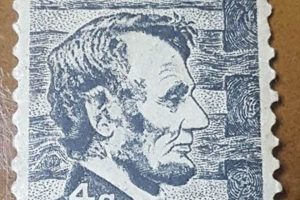
A Lincoln stamp with a face value of four cents, exhibiting a purple hue, can represent several distinct philatelic items. This coloration may indicate a standard issue affected by environmental factors or printing variations, a deliberate color choice for a specific commemorative issue, or even an error in the printing process. One example might be the 1959 4-cent Lincoln Memorial stamp printed on the Giori press, which sometimes shows a shift towards purple due to ink variations.
The market value of such a stamp is not solely determined by its face value or color. Factors such as condition (including centering, gum, and any flaws), rarity, and demand significantly influence price. A seemingly minor variation in shade, perforation, or even paper type can dramatically impact a stamp’s desirability among collectors. Understanding these nuances is crucial for accurate appraisal. Historical context, such as the specific printing period or the events a stamp commemorates, also contributes to its value and interest.
This exploration will further analyze factors affecting the price of four-cent Lincoln stamps with purple hues, including specific examples of known varieties, common pitfalls in identification, and resources available for collectors seeking to assess their holdings.
Tips for Evaluating Four-Cent Lincoln Stamps with Purple Hues
Careful consideration of several factors is crucial for accurately assessing these stamps.
Tip 1: Verify the Legitimacy of the Color. Discoloration due to environmental factors (e.g., light exposure, humidity) differs from intended variations or printing errors. Expert authentication can confirm the origin of the purple hue.
Tip 2: Consult Specialized Catalogs. Reputable philatelic resources like the Scott Specialized Catalogue provide detailed listings and valuations of different stamp varieties, including color variations.
Tip 3: Assess the Stamp’s Condition. Even minor flaws, such as thin spots or creases, can significantly impact value. Centering within the perforations is another critical aspect.
Tip 4: Understand the Importance of Gum. Original gum, particularly if undisturbed, often adds value, while regummed or hinged stamps may be less desirable.
Tip 5: Research Specific Printing Variations. Knowledge of different printings, paper types, and perforation varieties can help identify potentially valuable stamps.
Tip 6: Seek Expert Opinions. Consulting with experienced philatelists or appraisers offers valuable insight and helps avoid misidentification or overvaluation.
Tip 7: Consider Professional Grading. Third-party grading services provide objective assessments of a stamp’s condition and authenticity, increasing its marketability.
Accurate assessment requires diligence and a thorough understanding of the relevant factors. These tips provide a framework for evaluating four-cent Lincoln stamps exhibiting purple coloration and maximizing their potential value within the philatelic market.
By considering these points, collectors can make informed decisions about their holdings.
1. Color Variations

Color variations play a crucial role in determining the value of a four-cent Lincoln stamp. While the intended color of these stamps was typically red-brown, variations can arise due to several factors, including inconsistencies in the printing process, ink quality, and paper characteristics. These deviations, especially those resulting in distinct shades like purple, can significantly impact a stamp’s desirability and market value. For instance, the 1959 4-cent Lincoln Memorial stamp, printed on the Giori press, occasionally exhibits a shift towards purple due to ink variations. This particular variation is sought after by collectors and commands a premium compared to standard examples. Similarly, the 1909 4-cent Lincoln stamp, if found with a deep violet or purple hue instead of the typical carmine, can be quite valuable due to its rarity.
Understanding the cause of the color variation is crucial. A genuine error during the printing process is generally more valuable than discoloration due to environmental factors like light exposure or chemical reactions. Distinguishing between these requires careful examination and, often, expert authentication. For example, a stamp with a uniform purple hue due to a known ink variation during a specific printing run is different from a stamp with uneven fading or discoloration caused by improper storage. The former might be a valuable collectible, while the latter likely suffers a diminished value.
Careful consideration of color variations offers collectors valuable insights for identifying potentially significant stamps. However, distinguishing between valuable color variations and undesirable discoloration requires expertise and access to reliable resources. This knowledge enables collectors to make informed decisions regarding acquisition, appraisal, and potential investment in four-cent Lincoln stamps. The interplay between rarity, condition, and the specific nature of the color variation ultimately determines the stamp’s place within the philatelic market.
2. Condition

Condition significantly impacts the value of a “4 cent Lincoln stamp purple.” Even with a desirable color variation, a stamp’s condition can drastically influence its market worth. Collectors prioritize well-preserved specimens, and even minor flaws can detract from a stamp’s desirability and reduce its value. Evaluating condition involves assessing several key factors, each contributing to the overall appraisal.
- Centering
Centering refers to the stamp’s position relative to the perforations. A well-centered stamp has equal margins on all sides. Off-center stamps, where the design is closer to one or more edges, are generally less desirable and command lower prices. The degree of off-centering directly correlates with the value reduction. A slightly off-center stamp might experience a minor price decrease, while a severely off-center stamp can lose a substantial portion of its potential value. This is especially true for stamps with rare color variations, where centering becomes even more critical for maximizing value.
- Gum
The presence and condition of the original gum on the back of the stamp are essential factors. “Mint never hinged” (MNH) stamps, with their original gum undisturbed, are typically the most valuable. Hinged stamps, showing evidence of previous mounting in an album, decrease in value. The extent of hinging, as well as the type of hinge used, can further influence the price. Stamps with disturbed or regummed gum are generally less desirable. For “4 cent Lincoln stamp purple” examples, original gum can significantly enhance their desirability, particularly if the color variation is rare.
- Faults
Faults encompass any imperfections or damage, including thin spots, tears, creases, stains, and fading. These flaws detract from a stamp’s visual appeal and significantly impact its value. The severity and type of fault determine the extent of the price reduction. A small thin spot might have a minor impact, while a major tear can render a stamp virtually worthless. For stamps with a desirable “purple” hue, maintaining pristine condition is crucial for maximizing potential value. Even minor faults can significantly diminish the premium associated with the color variation.
- Freshness
Freshness refers to the overall appearance and preservation of a stamp, encompassing aspects like color vibrancy, paper texture, and the absence of fading or toning. A fresh, vibrant stamp is more appealing to collectors and commands a higher price. Environmental factors like light and humidity can degrade a stamp’s freshness over time. For “4 cent Lincoln stamp purple” examples, maintaining the vibrancy of the color is essential. Fading or discoloration can significantly detract from the stamp’s value, even if the initial color variation was rare or desirable. Proper storage is crucial for preserving freshness.
These interconnected aspects of condition collectively determine a stamp’s grade and, consequently, its market value. A “4 cent Lincoln stamp purple” in pristine condition with perfect centering, original gum, and no faults will command a significant premium. Conversely, a stamp with flaws, regardless of its color variation, will experience a substantial decrease in value. Therefore, careful consideration of these factors is essential for accurate appraisal and informed collecting decisions.
3. Rarity
Rarity significantly influences the value of a “4 cent Lincoln stamp purple.” A scarce color variation, combined with other factors like condition and historical context, can dramatically increase a stamp’s desirability and market value. Understanding the various factors contributing to rarity is essential for accurate appraisal and informed collecting decisions.
- Print Run Size
The total number of stamps printed in a specific run directly impacts rarity. Smaller print runs naturally result in fewer available stamps, increasing their scarcity and potential value. A “4 cent Lincoln stamp purple” from a limited print run, especially if the color variation resulted from a documented printing error, can be highly sought after by collectors. Conversely, a color variation occurring in a large print run, even if visually striking, might not command the same premium due to its greater availability.
- Documented Errors
Documented printing errors, such as inverted centers, missing colors, or double impressions, contribute significantly to a stamp’s rarity. A “4 cent Lincoln stamp purple” resulting from a recognized printing error can be exceptionally valuable, especially if the error is well-documented and few examples exist. The combination of a known error and an unusual color variation creates a highly desirable and potentially valuable philatelic item. Collectors often prioritize stamps with documented errors, increasing demand and driving up prices.
- Specific Plate Varieties
Variations within printing plates, such as cracks, re-entries, or other anomalies, can create distinct varieties within a stamp issue. Certain plate varieties might exhibit the “purple” hue more prominently or consistently than others. Identifying and authenticating these specific plate varieties is crucial for determining rarity and value. A “4 cent Lincoln stamp purple” associated with a rare plate variety can be significantly more valuable than a similar stamp from a more common plate variation, even if the color variation appears identical.
- Survival Rates
The number of stamps surviving in good condition over time significantly impacts rarity. Stamps subject to damage, improper storage, or widespread postal use become scarcer in well-preserved condition. A “4 cent Lincoln stamp purple” in excellent condition, particularly an unused example with original gum, becomes rarer and more valuable as time passes and fewer pristine examples remain. Condition and rarity are intrinsically linked, with well-preserved examples of scarce varieties commanding the highest prices.
These factors, often interconnected, contribute to the overall rarity of a “4 cent Lincoln stamp purple” and significantly influence its market value. Collectors seeking these rare varieties must carefully consider these aspects, along with professional authentication and grading, to make informed decisions and assess the true worth of these philatelic treasures. Understanding the interplay between these elements is crucial for navigating the complexities of the stamp market and recognizing the potential value of these unique items.
4. Printing Errors

Printing errors significantly influence the value of a “4 cent Lincoln stamp purple,” often transforming a common stamp into a valuable collectible. These errors, arising from various mechanical or human factors during the printing process, create unique and sometimes highly sought-after varieties. Understanding the different types of printing errors and their impact on value is crucial for collectors.
- Inverted Centers
An inverted center occurs when the central design element of the stamp is printed upside down relative to the frame. This dramatic error is readily apparent and highly prized by collectors. An inverted center on a “4 cent Lincoln stamp purple” dramatically increases its rarity and value, especially if the stamp is otherwise in good condition. The combination of an unusual color variation and a significant printing error creates a highly desirable and potentially valuable philatelic item.
- Missing Colors
Missing colors occur when one or more ink colors fail to print during the production process. This can result in a stamp with an incomplete design or a significantly altered appearance. A “4 cent Lincoln stamp purple” missing one or more of its intended colors can become quite valuable, especially if the missing color creates a striking visual contrast or further emphasizes the purple hue. The rarity of such errors depends on the specific color omitted and the overall impact on the stamp’s design.
- Double Impressions
Double impressions happen when a stamp is inadvertently printed twice, resulting in a blurred or overlapping image. The degree of offset and the clarity of the double impression influence the stamp’s value. A “4 cent Lincoln stamp purple” with a clear double impression, especially if it enhances or alters the perception of the purple color, can be quite valuable. The offset can sometimes create interesting visual effects, further adding to the stamp’s appeal among collectors.
- Color Shifts
While not strictly an error, color shifts, like the “purple” variation itself, occur when the intended ink color deviates from the standard shade. These shifts can result from ink inconsistencies, variations in printing pressure, or other factors during production. A “4 cent Lincoln stamp purple” represents a color shift, and the specific shade and intensity of the purple hue significantly influence its value. Subtle shifts might not command a significant premium, while dramatic deviations from the norm, especially towards vibrant or unusual colors, can greatly increase a stamp’s desirability and market value.
These printing errors, when combined with the inherent rarity and desirability of a “4 cent Lincoln stamp purple,” create a unique intersection of factors that significantly impact value. Collectors seeking these valuable varieties should carefully examine stamps for evidence of these errors, consulting expert resources and authentication services to confirm their legitimacy and assess their true worth within the philatelic market. The combination of rarity, condition, and the specific nature of the printing error ultimately determines a stamp’s place among sought-after collectibles.
5. Historical Context
Historical context plays a crucial role in understanding and assessing the value of a “4 cent Lincoln stamp purple.” The specific period in which a stamp was issued, the events surrounding its release, and the prevailing social and political climate can all influence its significance and desirability among collectors. Examining these historical factors provides valuable insights into the stamp’s place within philatelic history and contributes to a more accurate appraisal of its worth.
- Period of Issue
The period when a stamp was issued provides crucial context for understanding its production methods, design choices, and overall rarity. A “4 cent Lincoln stamp purple” issued during a period known for specific printing techniques or ink variations gains added significance. For instance, a stamp from the early 20th century, printed using different methods than later issues, might exhibit unique color characteristics due to the limitations of the technology at the time. Knowing the period of issue allows collectors to connect the stamp to specific historical printing practices, potentially explaining the presence of a purple hue.
- Commemorative Issues
Many stamps are issued to commemorate specific events, anniversaries, or individuals. A “4 cent Lincoln stamp purple” released as part of a commemorative series gains added historical significance. The event or person commemorated can influence the stamp’s desirability and value, particularly if the subject holds historical importance or resonates with collectors. A commemorative stamp with a unique color variation, like a purple hue, becomes even more desirable due to its connection to a specific historical event or figure.
- Postal Rates and Usage
Historical postal rates and usage patterns influence a stamp’s scarcity and value. A “4 cent Lincoln stamp purple” issued during a period when the four-cent rate was common might be more readily available than one from a period with different postal rates. Understanding historical usage helps collectors gauge the relative rarity of a stamp. A stamp used for a specific type of mail, like airmail or special delivery, might also gain added historical context and value.
- Printing Technology and Ink
Printing technologies and ink formulations evolved over time, influencing the appearance and characteristics of stamps. A “4 cent Lincoln stamp purple” printed during a specific period might exhibit the purple hue due to the ink used or the printing process employed. Knowing the historical context of printing technology helps explain color variations and assess their significance. A purple hue resulting from a known ink variation during a specific period is different from a color change caused by later environmental factors. This historical context is crucial for accurate appraisal.
By considering these historical factors, collectors gain a deeper understanding of the significance and potential value of a “4 cent Lincoln stamp purple.” The historical context adds another layer of complexity and intrigue to these philatelic items, enriching the collecting experience and providing a more nuanced appreciation for their place within history. Connecting a stamp to its historical period, printing methods, postal usage, and any commemorative context allows collectors to more accurately assess its rarity, desirability, and overall worth within the broader philatelic market.
6. Market Demand
Market demand significantly influences the value of a “4 cent Lincoln stamp purple.” While factors like rarity, condition, and historical context establish a baseline value, market demand ultimately determines the price collectors are willing to pay. Fluctuations in demand, driven by collector trends, economic conditions, and other market forces, can significantly impact the price of these stamps, regardless of their inherent rarity or historical significance.
- Collector Trends
Collector trends play a crucial role in shaping market demand. Certain periods, varieties, or color variations might become particularly popular among collectors, driving up demand and prices. A surge in interest in “4 cent Lincoln stamp purple” varieties, perhaps fueled by new research or discoveries, could significantly increase their market value. Conversely, a decline in interest could lead to lower prices, even for rare or historically significant examples. These trends can be unpredictable and influenced by various factors, including media attention, auction results, and the overall collecting climate.
- Economic Conditions
Economic conditions can significantly impact market demand for collectibles like stamps. During periods of economic prosperity, collectors may have more disposable income, leading to increased demand and higher prices. Conversely, economic downturns can dampen demand and depress prices, as collectors become more cautious with their spending. The value of a “4 cent Lincoln stamp purple,” even a rare variety, can fluctuate based on the prevailing economic climate and its impact on collector behavior.
- Auction Results
Auction results provide valuable insights into current market demand and price trends. High prices realized for “4 cent Lincoln stamp purple” varieties at auctions can generate excitement and further stimulate demand, potentially leading to even higher prices in subsequent sales. Conversely, lower-than-expected auction results can signal a softening of demand and potentially depress prices. Collectors often monitor auction results closely to gauge market sentiment and identify emerging trends.
- Availability and Competition
The availability of “4 cent Lincoln stamp purple” varieties and the level of competition among collectors also influence market demand and price. A limited supply of a particular variety, coupled with strong collector interest, can create intense competition and drive up prices. Conversely, a readily available variety, even one with desirable characteristics, might not command the same premium due to its greater accessibility. The interplay between supply and demand ultimately determines the market value of these stamps.
Understanding market demand is crucial for accurately assessing the value of a “4 cent Lincoln stamp purple.” While inherent factors like rarity and condition establish a baseline, the dynamic forces of market demand ultimately determine the price a collector is willing to pay. By considering collector trends, economic conditions, auction results, and the interplay of supply and demand, collectors can gain a more comprehensive understanding of the market and make informed decisions regarding the acquisition, appraisal, and potential investment in these unique philatelic items. The intersection of these market forces with the inherent qualities of the stamp ultimately shapes its value and desirability within the collecting community.
7. Expert Authentication

Expert authentication plays a crucial role in establishing the value of a “4 cent Lincoln stamp purple.” Color variations in stamps can arise from various factors, including deliberate design choices, unintentional printing errors, and environmental factors like fading or chemical reactions. Distinguishing between these requires specialized knowledge and careful examination. Expert authentication provides a crucial validation of a stamp’s genuineness and attributes, directly impacting its market value. For a “4 cent Lincoln stamp purple,” authentication confirms whether the color is a genuine printing variation, a deliberate design element of a specific issue, or a result of external factors. This determination significantly affects the stamp’s worth. A natural color variation resulting from the printing process is generally more valuable than discoloration caused by environmental damage. Authentication helps establish this critical distinction. For instance, a 4-cent Lincoln stamp from the 1950s exhibiting a purple hue might be a recognized printing variety, while a similar stamp with discoloration due to light exposure holds significantly less value. Expert authentication clarifies this difference, providing buyers and sellers with essential information for accurate valuation.
The process typically involves a thorough examination of the stamp’s physical characteristics, including the color, paper, printing method, perforations, and any discernible flaws or variations. Comparison with established examples of genuine varieties, documented in specialized catalogs and philatelic literature, helps determine the stamp’s authenticity and identify any unique characteristics. Expert authenticators possess extensive knowledge of printing processes, ink variations, and stamp production techniques throughout history. This expertise allows them to differentiate between genuine variations and alterations or forgeries. Authentication also considers factors like the stamp’s provenance and any accompanying documentation supporting its authenticity. A clear provenance, tracing the stamp’s ownership history, enhances its credibility and value. In the case of a “4 cent Lincoln stamp purple,” expert authentication provides a critical safeguard against misrepresentation and ensures accurate valuation based on the stamp’s genuine attributes. This process offers collectors and investors confidence in their acquisitions and helps maintain the integrity of the philatelic market.
Expert authentication is essential for establishing the legitimacy and value of a “4 cent Lincoln stamp purple.” It clarifies the nature of the color variation, distinguishes genuine printing varieties from environmental damage or alterations, and provides a critical foundation for accurate appraisal. By relying on expert authentication, collectors and investors can navigate the complexities of the stamp market with confidence, ensuring their acquisitions hold genuine value and contribute to the preservation of philatelic history. The authentication process protects against fraud, enhances market transparency, and provides a crucial framework for understanding and appreciating the unique characteristics and value of these philatelic items.
Frequently Asked Questions
This section addresses common inquiries regarding the valuation of four-cent Lincoln stamps exhibiting a purple hue.
Question 1: Does a purple tint automatically increase a four-cent Lincoln stamp’s value?
A purple tint does not guarantee increased value. The hue’s origin is crucial. A recognized printing variety or error resulting in a purple shade can significantly increase value, whereas discoloration due to environmental factors like light exposure typically diminishes it.
Question 2: How can one differentiate between a genuine purple variety and discoloration?
Differentiating requires careful examination and often expert consultation. Genuine purple varieties typically exhibit a consistent hue throughout the stamp, while discoloration often appears uneven or blotchy. Specialized philatelic literature and expert opinions are crucial for accurate assessment.
Question 3: Where can information on recognized “purple” varieties be found?
Reputable philatelic catalogs, such as the Scott Specialized Catalogue, provide detailed listings and valuations of recognized stamp varieties, including color variations. Online resources and philatelic societies also offer valuable information.
Question 4: How does condition affect the value of a four-cent Lincoln stamp with a purple hue?
Condition is paramount. Even with a desirable purple variety, factors like centering, gum condition, and the presence of faults significantly impact value. A well-preserved stamp with a genuine purple variation commands a premium, while a damaged example experiences a significant value reduction.
Question 5: Should a suspected “purple” variety be professionally graded?
Professional grading provides an objective assessment of a stamp’s condition and authenticity, enhancing its marketability and providing added assurance for potential buyers. While not always essential, grading can be beneficial, especially for rarer or more valuable varieties.
Question 6: What are the most common pitfalls to avoid when assessing these stamps?
Common pitfalls include mistaking discoloration for a genuine variety, overestimating the impact of a minor color variation, and neglecting the crucial role of condition. Relying solely on online images for assessment and failing to consult expert opinions are also common mistakes.
Accurate assessment requires careful consideration of multiple factors. Consulting reputable resources and seeking expert opinions are essential for informed decision-making.
Further sections will delve into specific examples of valuable “4 cent Lincoln stamp purple” varieties and offer guidance for navigating the philatelic market.
4-Cent Lincoln Stamp Purple Value
The value of a four-cent Lincoln stamp exhibiting a purple hue hinges on a complex interplay of factors. While the presence of a distinct purple color might initially suggest increased value, accurate assessment requires careful consideration of its origin, whether a genuine printing variation, an intentional design element, or a result of environmental factors. Rarity, determined by factors such as print run size, documented errors, and survival rates, significantly influences market value. Condition, encompassing centering, gum, faults, and overall freshness, remains paramount. Even the most desirable color variation diminishes in value if the stamp exhibits significant flaws. Historical context, encompassing the period of issue, printing technology, and postal rates, provides crucial background for understanding a stamp’s significance. Ultimately, market demand, influenced by collector trends and economic conditions, dictates the price collectors are willing to pay. Expert authentication provides essential validation, differentiating genuine varieties from alterations or environmental damage, ensuring accurate appraisal and fostering market integrity.
Careful consideration of these interconnected factors is crucial for accurately assessing the value of a four-cent Lincoln stamp with a purple hue. Discerning collectors recognize the importance of research, expert consultation, and a thorough understanding of market dynamics. The pursuit of these unique philatelic items requires diligence and a nuanced appreciation for the interplay of rarity, condition, historical context, and market forces. Ultimately, the value assigned reflects not only a stamp’s inherent characteristics but also its significance within the broader tapestry of philatelic history.