



The phrase “1847 first issue Scott number and value” refers to the first postage stamps issued by the United States: the 5-cent Benjamin Franklin stamp listed as Scott 1 and the 10-cent George Washington stamp listed as Scott 2. These historic stamps are among the most important items in American philately, but their value depends far more on condition, authenticity, cancellation, color, margins, and provenance than on the date alone. A genuine 1847 issue can be worth several hundred dollars in an ordinary used condition, while an outstanding unused or exceptionally well-centered example may sell for many thousands of dollars.
What Was the 1847 First U.S. Postage Issue?
Before 1847, postage in the United States was generally paid by the recipient or marked by hand at the post office. The Post Office Department authorized the country’s first nationally issued adhesive postage stamps on March 3, 1847. They were released on July 1, 1847, and remained in use until June 30, 1851, when the 1851 issue replaced them.
The 1847 issue contains only two regular stamps. The 5-cent denomination paid the basic rate for a letter weighing up to one-half ounce traveling up to 300 miles. The 10-cent denomination paid the rate for distances beyond 300 miles. Both stamps were printed by Rawdon, Wright, Hatch & Edson of New York, a major security printer of the period.
| Stamp | Scott number | Denomination | Portrait |
| 1847 5-cent issue | Scott 1 | 5 cents | Benjamin Franklin |
| 1847 10-cent issue | Scott 2 | 10 cents | George Washington |
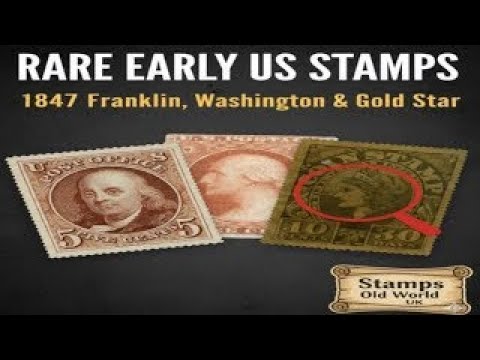
1847 First Issue Scott Numbers
Scott 1: 5-Cent Benjamin Franklin
Scott 1 depicts Benjamin Franklin, whose role as a colonial postmaster and postal reformer made him an appropriate subject for the first United States stamp. The design shows Franklin in profile within an oval frame. The stamp is printed in brown shades, although color can vary considerably because of printing, paper, aging, oxidation, and chemical exposure.
The 5-cent Franklin is usually found used, often with a black town cancellation or a manuscript cancel. Some examples have a red cancellation, which may attract additional interest when the strike is clear and visually appealing. Collectors also study the stamp’s margins, because the 1847 issue was imperforate. Every stamp was separated by cutting, and examples with four balanced margins are much more desirable than those cut into the design.
Scott 2: 10-Cent George Washington
Scott 2 features a left-facing portrait of George Washington in a black frame. The stamp was printed in black and paid the higher-distance letter rate. Like Scott 1, it is imperforate and was issued without perforations or officially applied gum.
Scott 2 is often considered slightly scarcer in premium condition, particularly when it has sharp design detail, strong margins, a light readable cancellation, and fresh color. The stamp also appears on many covers, and an attractive genuine 1847 postal-history cover can be substantially more valuable than the same stamp removed from the envelope.
1847 Stamp Value: Realistic Price Expectations
There is no single fixed “1847 first issue value.” Catalog values are useful benchmarks, but they are not guaranteed selling prices. A catalog may assign a value for a stamp in a specific grade, while dealers and auction houses price individual examples according to eye appeal, demand, certification, and current market conditions.
The following ranges are practical general estimates for genuine examples. They are not a substitute for a current Scott Specialized Catalogue of United States Stamps and Covers, a professional appraisal, or auction comparisons.
| Condition | Scott 1, 5-cent Franklin | Scott 2, 10-cent Washington |
| Used, heavily cancelled or four-margin faults | Approximately $150–$350 | Approximately $150–$400 |
| Used, sound but average example | Approximately $300–$700 | Approximately $300–$900 |
| Used, attractive margins and cancellation | Approximately $700–$2,000 or more | Approximately $800–$3,000 or more |
| Unused or no-cancel example | Often several thousand dollars upward | Often several thousand dollars upward |
| Exceptional unused, original gum, or major rarity | Can reach tens of thousands of dollars | Can reach tens of thousands of dollars |
These ranges are intentionally broad. A stamp with a single clipped margin, thin spot, crease, tear, repair, or questionable cancellation may sell for far less than a sound example. Conversely, a beautifully centered stamp with strong color and expert certification can exceed standard catalog expectations. The most valuable 1847 stamps are not merely old; they combine authenticity, scarcity, quality, and collector appeal.
Why Condition Has Such a Major Effect on Value
Margins and centering
Because Scott 1 and Scott 2 are imperforate, the cutter’s position determined the margins. A stamp cut close to the design may have little or no margin on one side. Four clear margins are highly desirable, especially when the design is not touched. A four-margin stamp with balanced spacing can be worth several times more than a similar stamp cut into the design.
Cancellation quality
A heavy, smudged, or face-obscuring cancellation generally reduces visual appeal. Light town cancels, neat circular datestamps, and unusual red cancellations can increase desirability. Collectors may also value a cancellation for its historical information, particularly if the town is scarce or the date is early.
Paper, color, and surface
Original paper should be examined for thinning, creases, tears, stains, foxing, gum disturbance, and repairs. Brown shades on Scott 1 may range from light tan to deeper red-brown or chocolate-like appearances, but color should be evaluated under proper lighting. Scott 2 should have a crisp black impression without excessive fading or chemical alteration.
Unused status
The 1847 stamps were issued without gum, so terminology can be confusing. An “unused” example may have no cancellation but also no gum, and it should not be judged by the same gum standards used for later United States issues. Some examples have gum added by a previous owner, which can reduce value rather than increase it. Any gum, regumming, or alteration should be disclosed in a professional description.
How to Identify Scott 1 and Scott 2
- Confirm the portrait and denomination. Franklin identifies the 5-cent stamp, while Washington identifies the 10-cent stamp.
- Check the design period. The stamps are imperforate and have the classic 1847 engraved appearance.
- Look for the correct color. Scott 1 is brown or brownish in appearance; Scott 2 is black.
- Inspect the paper and impression. Genuine stamps normally show engraved lines and characteristic period printing, not a modern flat or digitally sharp appearance.
- Measure and compare carefully. Trimming, reperforation, paper additions, and repairs can mislead inexperienced buyers.
- Seek expert authentication. A certificate from the Philatelic Foundation, Professional Stamp Experts, or another respected expertizing service is important for expensive examples.
Do not rely on a smartphone photograph alone. Lighting can alter the apparent color, and image compression can hide repairs or thin spots. Never soak, press, bleach, hinge-remove, or chemically clean an 1847 stamp before it has been evaluated. Amateur treatment can permanently reduce its value.
Scott Catalogue Value Versus Market Value

The Scott Specialized Catalogue generally provides standardized valuation information, but its figures should be interpreted as reference points. The catalog value may reflect a particular condition category and may not match the price a collector receives from a dealer. Dealer offers are normally below retail, while competitive auction bidding can produce either a surprisingly strong result or a disappointing one depending on timing and presentation.
For a meaningful estimate, record the stamp’s Scott number, denomination, cancellation type, margin quality, visible faults, and whether it has a certificate. Compare recent sales of similar examples rather than comparing a fault-free four-margin stamp with a damaged single-margin copy. Auction archives and specialist dealers are especially useful for rare varieties and high-grade examples.
1847 Stamps on Cover and Postal History
A complete cover can add important context and frequently commands a premium. Collectors examine the mailing date, origin and destination, rate paid, markings, route, transit endorsements, and whether the stamp is tied to the envelope by a clear cancellation. A cover mailed during the earliest period of use, or one showing an unusual rate or route, may be far more significant than a loose stamp.
Examples with both Scott 1 and Scott 2, multiple-rate usages, foreign destinations, official postal markings, or scarce small-town origins deserve specialist attention. Do not remove a stamp from an old envelope simply to sell it separately. The cover may contain the principal value, and removal destroys evidence of genuine use.
Buying and Selling an 1847 First Issue
Recommendations for buyers
- Buy only from a reputable dealer, established auction house, or seller offering a clear return privilege.
- Request a certificate for any expensive or supposedly rare example.
- Ask specifically about thins, creases, repairs, regumming, reperforation, and cleaning.
- Compare the photograph with the written condition description.
- Be cautious of unusually cheap “mint” or “perfect” examples, since the market contains repaired and counterfeit material.
Recommendations for sellers
- Do not clean or improve the stamp before valuation.
- Obtain an expert opinion when the item may be worth more than a few hundred dollars.
- Photograph the front and back in neutral lighting.
- Keep any original album page, correspondence, purchase receipt, or family provenance.
- Choose an auction or specialist dealer based on the stamp’s quality and likely audience.
Frequently Asked Questions About the 1847 First Issue
What are the Scott numbers for the first United States stamps issued in 1847?
The 1847 first issue consists of Scott 1, the 5-cent Benjamin Franklin stamp, and Scott 2, the 10-cent George Washington stamp. These are the first nationally issued U.S. postage stamps.
How much is an 1847 Scott 1 5-cent Franklin stamp worth?
A genuine used Scott 1 often falls in the broad range of several hundred dollars, although damaged examples may bring less and premium four-margin examples may bring substantially more. Unused, certified, and exceptionally attractive examples can reach several thousand dollars or tens of thousands.
How much is an 1847 Scott 2 10-cent Washington stamp worth?
A typical sound used Scott 2 may be worth a few hundred dollars, while well-centered examples with desirable cancellations can sell for much more. Unused examples, rare usages, and certified high-quality stamps can command many thousands of dollars.
Does an 1847 stamp with no cancellation have higher value?
Not automatically. An unused stamp can be valuable, but condition and authenticity are critical. Since the issue was released without gum, a no-cancel stamp should be examined for added gum, cleaning, repairs, or cancellation removal.
Are 1847 U.S. stamps rare?
They are historically important and collectible rather than uniformly rare. Common used copies exist, but sound four-margin examples, premium unused stamps, unusual cancellations, and complete postal-history covers are considerably scarcer.
Where can I get an 1847 first issue stamp appraised?
A specialist United States stamp dealer, major philatelic auction house, or recognized expertizing service is the best choice. For valuable examples, obtain a written certificate before selling and compare recent auction results for the same Scott number and condition.
Conclusion
The 1847 first issue is represented by Scott 1 and Scott 2, the landmark Franklin and Washington stamps that began the era of U.S. adhesive postage. Their value ranges from a modest few hundred dollars for an ordinary used example to many thousands for stamps with superb margins, fresh appearance, scarce cancellations, important provenance, or exceptional postal history. The safest approach is to identify the Scott number correctly, preserve the item in its present state, evaluate condition honestly, and obtain expert certification before relying on any quoted price. In 1847 U.S. philately, quality and authenticity—not age alone—determine the final value.
