A “Forever” stamp covers the cost of First-Class Mail postage for a standard one-ounce letter, regardless of any subsequent price increases. This applies even if the price of a First-Class Mail stamp rises after the “Forever” stamp is purchased. This one-ounce limit equates to a typical letter consisting of several sheets of paper within a standard envelope.
The enduring value offered provides a significant advantage, protecting mailers from rising postal rates. This eliminates the need to purchase additional postage for previously purchased stamps when rates increase. Initially introduced in 2007, these stamps offered a convenient solution to fluctuating postal costs, providing a cost-effective option for regular mail correspondence. Their enduring utility makes them a popular choice for both personal and business use.
Further exploration will cover topics such as permissible envelope sizes and weights, international mailing options, and the history of postal rate adjustments in the United States.
Tips for Utilizing First-Class Mail “Forever” Stamps
The following tips offer guidance on maximizing the value and utility of “Forever” stamps for mailing needs.
Tip 1: Verify Weight: Ensure mail pieces do not exceed one ounce. Utilize a postal scale for accuracy, particularly for mail containing multiple pages or heavier stationery. Exceeding the weight limit necessitates additional postage.
Tip 2: Understand Size Restrictions: While a standard letter is typically covered, oversized or unusually shaped envelopes may require additional postage. Consult the postal service guidelines for specific dimensions.
Tip 3: Consider International Mail: “Forever” stamps are generally not valid for international mail. Separate international postage is required.
Tip 4: Stock Up During Price Increases: Purchasing “Forever” stamps before a rate increase allows for cost savings on future mailings.
Tip 5: Combine with Additional Postage: If a mail piece exceeds one ounce, supplemental postage can be added alongside a “Forever” stamp to cover the additional weight.
Tip 6: Proper Addressing: Accurate and legible addressing is crucial for efficient delivery. Use standardized address formats and ensure correct placement of the return address.
Tip 7: Check for Damaged Stamps: Ensure stamps are undamaged and fully adhered to the envelope. Damaged stamps may be rejected.
By following these guidelines, mailers can optimize the benefits of using “Forever” stamps for efficient and cost-effective postal correspondence.
This information provides a practical foundation for understanding and using “Forever” stamps. The following conclusion will offer final thoughts and recommendations.
1. One Ounce

The weight limit of one ounce is fundamental to understanding the utility of “Forever” stamps. This limit determines the scope of their usage and serves as a critical factor in cost calculations for mailings.
- Standard Letter Weight:
One ounce generally corresponds to the weight of a typical letter consisting of a few sheets of standard printer paper placed in a regular envelope. This makes “Forever” stamps ideally suited for everyday correspondence.
- Exceeding the Limit:
Mail exceeding one ounce requires additional postage, calculated based on the excess weight. This can involve purchasing additional postage or using a combination of “Forever” stamps and supplementary postage.
- Utilizing a Postal Scale:
Accurately determining mail weight is crucial. A postal scale provides a precise measurement, ensuring compliance with the one-ounce limit and preventing potential delays due to insufficient postage. Investing in a postal scale is particularly advisable for frequent mailers.
- Cost-Effectiveness:
The one-ounce limit contributes to the cost-effectiveness of “Forever” stamps. By adhering to this limit, mailers can leverage the full value of the stamp and avoid unnecessary postage expenses.
Adhering to the one-ounce limit is integral to maximizing the cost-saving benefits of “Forever” stamps. Understanding this weight restriction and its implications allows for efficient and economical mail management.
2. First-Class Mail

First-Class Mail represents the standard service level for letter-sized mail within the United States Postal Service. Its connection to “forever stamp postage weight” is fundamental, as these stamps are specifically designed for this mail class. Understanding this relationship is crucial for efficient and cost-effective mailing practices.
- Delivery Speed:
First-Class Mail offers expedited delivery, typically within one to three business days, depending on the distance. This rapid delivery timeframe is a key feature for time-sensitive correspondence, making it the preferred choice for personal and business communications. “Forever” stamps, by covering the cost of First-Class Mail postage, facilitate access to this expedited service.
- Weight and Size Limits:
First-Class Mail imposes specific weight and size restrictions. The one-ounce limit for a single “Forever” stamp aligns directly with these restrictions for standard letters. Exceeding these limits requires additional postage, highlighting the importance of understanding the interplay between First-Class Mail parameters and “Forever” stamp usage.
- Cost-Effectiveness:
While offering faster delivery, First-Class Mail remains a relatively economical option for letter-sized mail, especially when using “Forever” stamps. The ability to purchase these stamps at a fixed rate, regardless of future price hikes, provides a significant cost advantage over time.
- Tracking and Forwarding:
First-Class Mail offers options for tracking and forwarding, adding to its value and convenience. While basic First-Class Mail doesn’t include automatic tracking, additional services can be purchased for enhanced monitoring. Furthermore, First-Class Mail pieces are eligible for forwarding if the recipient has moved, ensuring deliverability.
The integration of “Forever” stamps with First-Class Mail provides a practical and cost-effective solution for efficient mail delivery. Utilizing these stamps within the framework of First-Class Mail guidelines optimizes postal services for both personal and business needs.
3. Standard Letters

Standard letters constitute a specific mail category defined by the United States Postal Service, directly impacting the applicability of “forever stamp postage weight.” Understanding the characteristics of standard letters is essential for maximizing the cost-effectiveness and efficiency of “forever” stamps.
- Dimensions:
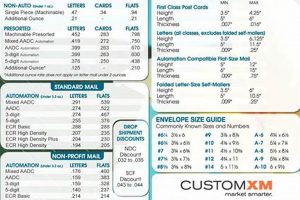
Standard letter dimensions are crucial. Envelopes must meet specific size requirements to qualify for standard letter rates. Exceeding these dimensions may reclassify the mail piece, necessitating additional postage beyond a single “forever” stamp. Typical acceptable dimensions fall within a range of 3.5 inches to 6.125 inches in height, 5 inches to 11.5 inches in length, and a maximum thickness of 0.25 inches.
- Weight:
Weight, as related to “forever stamp postage weight,” is paramount. A single “forever” stamp covers postage for standard letters weighing up to one ounce. Exceeding this weight requires additional postage, calculated based on the excess weight and postal zone. Accurate weighing is essential for cost-effective mailing using “forever” stamps.
- Shape and Rigidity:
Shape and rigidity affect mail processing and, consequently, postage. Standard letters should be uniformly rectangular and relatively flat. Unusual shapes, excessive rigidity, or bulky attachments can lead to surcharges or require alternative mailing methods, potentially negating the cost benefits of “forever” stamps.
- Content:
While generally encompassing paper documents, the content of standard letters also influences postage. Inclusion of items like small, lightweight promotional materials can sometimes remain within the one-ounce limit covered by a “forever” stamp. However, adding heavier objects necessitates additional postage, as with exceeding the weight limit.
Adhering to the standard letter specifications ensures the efficient and cost-effective use of “forever” stamps. Deviation from these standards can result in additional postage expenses, thereby diminishing the inherent value of these stamps. Careful consideration of dimensions, weight, shape, and content is crucial for optimizing postal costs.
4. Domestic Mail

Domestic mail designates postal service within a country’s borders, a key determinant of “forever stamp postage weight” applicability. “Forever” stamps offer postage exclusively for domestic mail within the United States. Attempting to use them for international mail proves ineffective. This distinction stems from varying international postal agreements and rate structures. For instance, a “forever” stamp cannot cover postage for a letter sent from the United States to Canada. Separate international postage is required, reflecting the different costs associated with international delivery.
The domestic focus of “forever” stamps simplifies postal calculations for mail within the United States. Regardless of future domestic rate fluctuations, the stamp maintains its validity for the designated weight. This eliminates the need for supplemental postage for previously purchased stamps due to domestic price increases. However, the limitation to domestic use necessitates alternative postage solutions for international correspondence. Sending a package to a different country, for example, requires specific international postage, dependent on destination and weight. Understanding this distinction is crucial for managing postal expenses effectively.
Restricting “forever” stamps to domestic mail underscores the importance of recognizing postal boundaries. This limitation necessitates separate considerations for international mail, involving distinct postage rates and regulations. Practical application demands awareness of this distinction to avoid insufficient postage and potential delivery delays. Utilizing appropriate postage for each mailing scenario ensures efficient and cost-effective postal operations, both domestically and internationally.
5. Inflation Hedge

“Forever stamp postage weight” possesses a crucial characteristic: it serves as an inflation hedge against rising postal rates. This characteristic is central to its value proposition, offering protection against increasing postage costs and providing long-term cost stability for mailers.
- Preservation of Purchasing Power:
A “forever” stamp retains its postal validity regardless of subsequent price increases. This preserves the purchasing power of the stamp, ensuring its utility for standard one-ounce letters remains consistent over time. For example, a “forever” stamp purchased in 2010 for $0.44 still covers the cost of a one-ounce First-Class Mail letter today, even if the current price has risen significantly. This safeguards against the erosion of value caused by inflation.
- Elimination of Supplementary Postage:
Rate increases do not necessitate purchasing additional postage for previously acquired “forever” stamps. This eliminates the inconvenience and expense of supplementing existing stamps with additional postage when rates rise. This simplifies mailing logistics and ensures cost predictability.
- Long-Term Cost Savings:
Purchasing “forever” stamps before a price increase allows mailers to lock in the current rate for future use. This proactive approach yields long-term cost savings, particularly for frequent mailers. For instance, purchasing a large quantity of “forever” stamps before an anticipated rate hike can result in substantial savings over time.
- Simplified Budgeting:
The fixed cost of “forever” stamps simplifies budgeting for mailing expenses. This predictability facilitates accurate cost projections and avoids unexpected postage increases affecting budgetary constraints. This feature proves particularly valuable for businesses with regular mailing needs.
The inflation hedge offered by “forever stamp postage weight” provides significant long-term value. By preserving purchasing power, eliminating supplementary postage needs, enabling long-term cost savings, and simplifying budget projections, “forever” stamps offer a strategic approach to managing postal expenses amidst fluctuating economic conditions.
Frequently Asked Questions
This section addresses common inquiries regarding “Forever” stamps, providing clarity on their usage and benefits.
Question 1: What is the weight limit for a mailpiece using a single “Forever” stamp?
A single “Forever” stamp covers postage for a one-ounce mailpiece.
Question 2: Can “Forever” stamps be used for international mail?
No, “Forever” stamps are designated for domestic mail within the United States only. Separate international postage is required.
Question 3: What happens if a mailpiece exceeds the one-ounce weight limit?
Additional postage is required, calculated based on the excess weight and the applicable postal zone.
Question 4: Do “Forever” stamps expire?
No, “Forever” stamps remain valid for postage regardless of future price increases.
Question 5: Where can “Forever” stamps be purchased?
They are available at United States Postal Service locations, online through the USPS website, and at various authorized retailers.
Question 6: Can “Forever” stamps be used for any type of mailpiece?
While primarily designed for standard letters, they can also be used for postcards and large envelopes, provided the weight and size restrictions are met. Additional postage may be required for non-standard sizes or weights.
Understanding these aspects of “Forever” stamps ensures their efficient and cost-effective utilization. Proper usage optimizes postal expenses and streamlines mailing processes.
The following section delves further into the historical context and evolution of postal rates.
Forever Stamp Postage Weight
Understanding “forever stamp postage weight” as a one-ounce limit for standard domestic letters within the United States Postal Service’s First-Class Mail category is crucial for cost-effective mailing. This article has explored the significance of this weight limit, its relationship to domestic mail services, and its function as an inflation hedge. Key takeaways include the necessity of adhering to the weight and size restrictions for standard letters, the inapplicability of “forever” stamps to international mail, and the long-term cost benefits derived from utilizing these stamps in the face of rising postal rates. The information presented clarifies the optimal usage scenarios for “forever” stamps and emphasizes their role in efficient mail management.
The enduring value of “forever stamp postage weight” lies in its capacity to provide stability and predictability within a fluctuating postal landscape. As postal rates continue to evolve, the strategic utilization of these stamps becomes increasingly relevant for individuals and businesses seeking to manage postal expenses effectively. Careful attention to the defined parametersone ounce, standard letter size, and domestic usageensures maximum benefit from this valuable postal tool. This knowledge empowers informed decisions regarding postal expenditures, contributing to long-term cost efficiency in correspondence.