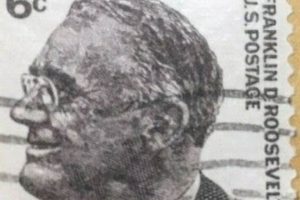
The value of a postage stamp depicting Franklin Delano Roosevelt and issued with a face value of six cents is subject to several factors, including its condition, the presence of any printing errors, and market demand. A stamp in mint condition, particularly if still affixed to its original paper (mint, never hinged), will generally command a higher price than a used example. Variations, such as different printings or plate blocks, can significantly influence a stamp’s desirability and price. Consulting specialized stamp catalogs and seeking expert opinions are crucial for accurate valuations.
Philatelic interest in Roosevelt stamps reflects not only their historical connection to a transformative period in American history but also their aesthetic qualities and relative availability. The six-cent denomination often marked a specific postal rate, potentially for first-class mail or other services during its period of circulation. Understanding the historical context of these stamps, including the postal rates and printing processes of the era, enhances their value to collectors. The Franklin D. Roosevelt era spanned a significant portion of the 20th century, and stamps from this period offer a tangible link to that time.
This discussion will explore the intricacies of determining the value of such stamps, including recognizing key variations, understanding grading standards, and navigating the stamp marketplace. Additionally, we will delve into the historical context of the six-cent Roosevelt stamp, highlighting its significance within American philately and its enduring appeal to collectors.
Tips for Evaluating Roosevelt Six-Cent Stamps
Careful consideration of several factors is essential for accurately assessing the value of stamps featuring Franklin D. Roosevelt with a six-cent denomination.
Tip 1: Condition Assessment: Examine the stamp closely for any signs of wear, such as tears, creases, thin spots, or fading. Mint condition stamps, particularly those never hinged, are typically more valuable.
Tip 2: Centering: Evaluate the placement of the design within the margins of the stamp. Well-centered stamps are generally preferred by collectors.
Tip 3: Gum Condition (If Applicable): For unused stamps, the condition of the original gum is crucial. Undisturbed, original gum adds to the value.
Tip 4: Perforations: Examine the perforations around the edges of the stamp. Clean, intact perforations are desirable. Damage, such as short or missing perfs, can detract from value.
Tip 5: Variety Identification: Consult specialized stamp catalogs to identify any specific varieties or printing errors. Certain variations can significantly increase a stamp’s worth.
Tip 6: Professional Authentication: For potentially valuable stamps, consider seeking professional authentication and grading services. This provides an objective assessment of condition and authenticity.
Tip 7: Market Research: Monitor online stamp marketplaces and auction results to understand current market values for comparable stamps.
By carefully considering these factors, collectors can make informed decisions regarding the acquisition and valuation of these historical artifacts.
This comprehensive approach to evaluating these stamps ensures accurate assessments and fosters a deeper appreciation of their philatelic significance.
1. Condition

Condition stands as a paramount factor influencing the value of a 6-cent Franklin D. Roosevelt stamp. Even minor imperfections can significantly impact a stamp’s desirability and, consequently, its market price. Understanding the various aspects of condition is crucial for accurate assessment and informed collecting decisions.
- Centering
Centering refers to the placement of the stamp’s design within its margins. Ideally, the design should be perfectly balanced, with equal spacing on all sides. Minor off-centering might be acceptable for common stamps, but significant misalignments drastically reduce value, especially for rarer issues. A well-centered 6-cent Roosevelt stamp will typically command a premium.
- Gum
For unused stamps, the presence and condition of the original gum are crucial factors. “Mint, never hinged” (MNH) designates a stamp with undisturbed, original gum that has never been hinged into an album. Hinged stamps, or those with disturbed or regummed gum, are generally less valuable. Given the age of these stamps, finding examples with pristine, original gum can significantly increase their worth.
- Perforations
Stamps are typically perforated to facilitate separation. The condition of these perforations contributes to overall condition. Collectors prefer stamps with intact, cleanly punched perforations. Damaged, short, or missing perforations detract from value. A 6-cent Roosevelt stamp with flawless perforations will be more desirable than one with imperfections.
- Faults
Faults encompass a range of imperfections, including tears, creases, thin spots, stains, and fading. Even minor faults can significantly diminish a stamp’s value. Major faults, like tears affecting the design, render a stamp significantly less desirable. A flawless 6-cent Roosevelt stamp, free of any faults, holds the highest value.
Careful evaluation of these condition factors is essential for accurately assessing the worth of a 6-cent Franklin D. Roosevelt stamp. Condition directly correlates with desirability and market value. Collectors prioritize well-centered stamps with pristine gum, intact perforations, and an absence of faults. Understanding these nuances enables informed decisions in acquiring and valuing these historical artifacts.
2. Centering
Centering plays a crucial role in determining the value of a 6-cent Franklin D. Roosevelt stamp. It refers to the precise placement of the stamp’s design within its perforated margins. A well-centered stamp exhibits equal spacing between the design and all four edges. Even slight deviations can significantly impact a stamp’s desirability and market price. Collectors prioritize well-centered examples, particularly for rarer issues or those in pristine condition. Understanding the nuances of centering is essential for accurate valuation and informed collecting decisions.
- Perfectly Centered
A perfectly centered stamp features the design precisely positioned within the margins, creating visual harmony and balance. This is the ideal scenario and adds significantly to a stamp’s value, especially for rarer varieties like the 6-cent Roosevelt. Such stamps are highly sought after by collectors and often command premium prices.
- Slightly Off-Center
Minor off-centering, where the design is slightly closer to one or two margins, is relatively common. While not ideal, a slightly off-center stamp can still hold considerable value, especially if other condition factors are excellent. The degree of off-centering influences the impact on price; less deviation is generally more acceptable.
- Significantly Off-Center
Stamps with noticeable off-centering, where the design is substantially closer to one or more margins, experience a significant decrease in value. The design may even touch or partially extend beyond the perforations. Such stamps are less desirable to collectors, particularly for key issues like the 6-cent Roosevelt.
- Measuring Centering
Centering is often quantified by measuring the distance between the design elements and the perforations. Collectors and grading services use precise measurements to assess centering, often expressed as fractions or percentages. This quantitative approach ensures objectivity and consistency in evaluating a stamp’s centering.
The importance of centering underscores the meticulous attention to detail within philately. For the 6-cent Franklin D. Roosevelt stamp, centering significantly impacts its value and desirability. A perfectly centered example represents a prized possession for collectors, while off-centering, even slight, can diminish its market worth. This factor, combined with other condition aspects, contributes to the overall assessment of a stamp’s quality and ultimately determines its place within a collection or the broader philatelic market.
3. Gum (if unused)

The presence and condition of original gum significantly influence the value of unused 6-cent Franklin D. Roosevelt stamps. “Original gum” refers to the adhesive applied to the back of the stamp during the manufacturing process. For collectors, original gum serves as evidence of a stamp’s pristine, unused state. Its presence, or absence, directly affects a stamp’s grade and market value.
Several designations describe the condition of original gum. “Mint, never hinged” (MNH) indicates a stamp with undisturbed, original gum that has never been mounted in an album using a stamp hinge. This represents the ideal state for unused stamps and commands the highest prices. “Mint, hinged” (MH) indicates a stamp with original gum that has been hinged. Hinging disturbs the gum, leaving a mark or “hinge thin,” diminishing the stamp’s value compared to an MNH example. Stamps with no gum or regummed gum (where the original gum has been replaced) are generally less desirable and command lower prices.
Consider two hypothetical examples: a 6-cent Roosevelt stamp graded MNH might fetch several times the price of an identical stamp graded MH. This price difference reflects the premium collectors place on pristine, undisturbed examples. The presence of original gum, particularly in undisturbed condition, provides tangible evidence of a stamp’s history and careful handling. This factor, combined with other condition aspects like centering and perforations, contributes significantly to the overall value assessment of a 6-cent Franklin D. Roosevelt stamp. Understanding the nuances of gum condition empowers informed collecting and investment decisions within the philatelic market.
4. Perforations

Perforations, the small holes punched around a stamp to facilitate separation, play a significant role in determining the worth of a 6-cent Franklin D. Roosevelt stamp. While seemingly minor, variations and imperfections in perforations can significantly impact a stamp’s value. Collectors scrutinize perforation quality, gauge (number of perforations per two centimeters), and centering within the stamp’s margins. These factors, combined with overall condition, contribute to a comprehensive assessment of a stamp’s desirability and market price.
- Gauge
Perforation gauge, measured as the number of perforations in a two-centimeter span, serves as a crucial identifier for stamp varieties. Different printing runs of the 6-cent Roosevelt stamp may exhibit variations in gauge. Identifying the correct gauge is essential for accurate cataloging and valuation. Specialized tools, like perforation gauges, aid in precise measurement. Variations in gauge can distinguish between common and scarce varieties, impacting a stamp’s worth.
- Condition
The condition of perforations directly influences a stamp’s grade and value. Collectors seek stamps with clean, fully separated perforations. Imperfections like short perfs (where the perforation holes are incomplete), torn perfs, or perf shifts (where the perforations are misaligned) detract from a stamp’s value. Stamps with intact, well-defined perforations are more desirable and command higher prices.
- Centering
The placement of perforations relative to the stamp’s design also affects its value. Ideally, the perforations should frame the design with even margins. Stamps with perforations cutting into the design, termed “perforation skips” or “into the design,” are less desirable. Collectors prize stamps with well-centered perforations, enhancing the overall aesthetic appeal and increasing market value.
- Types of Perforations
Different types of perforations exist, including line, comb, and roulette. The 6-cent Roosevelt stamp features line perforations, the most common type. Variations within line perforations, such as gauge differences, can still occur. Recognizing these nuances is crucial for accurate identification and valuation. Specialized catalogs provide detailed information regarding perforation types and variations for specific stamp issues.
Perforations, though often overlooked, represent a critical element in assessing the value of a 6-cent Franklin D. Roosevelt stamp. Collectors carefully examine perforation gauge, condition, and centering, recognizing that even minor variations can significantly impact a stamp’s desirability and market price. Understanding the nuances of perforations allows for accurate identification, informed collecting decisions, and a deeper appreciation of the intricacies within philately.
5. Printing errors/variations

Printing errors and variations significantly influence the value of 6-cent Franklin D. Roosevelt stamps. These anomalies, arising from inconsistencies during the printing process, transform otherwise common stamps into rare and desirable collectibles. The extent of the error and its rarity directly correlate with the stamp’s market value. Understanding these variations is crucial for both collectors and investors.
Several types of printing errors can occur. Inverted centers, where the central design element is printed upside down, represent a highly sought-after error. Color omissions or shifts, resulting from ink malfunctions, also create valuable variations. Miscuts, where the stamp is improperly cut during the production process, resulting in irregular shapes or missing design elements, further contribute to rarity. The 1945 6-cent Roosevelt stamp with an inverted center is a prime example. This error dramatically increases the stamp’s value compared to correctly printed examples. Similarly, a 6-cent Roosevelt with a missing color due to an ink malfunction would command a premium in the philatelic market.
Identifying and authenticating printing errors requires meticulous examination. Specialized catalogs and expert opinions are essential resources for verification. The presence of documented and verified printing errors transforms a standard 6-cent Roosevelt stamp from a common item to a potentially valuable asset. This understanding of printing variations and their impact on value is fundamental for navigating the philatelic market and making informed collecting decisions.
6. Issue Date

The issue date of a 6-cent Franklin D. Roosevelt stamp plays a crucial role in determining its value and significance within philately. Different issue dates correspond to distinct print runs, potentially involving variations in printing processes, paper types, perforation gauges, and design details. Understanding these nuances allows collectors to distinguish between common and scarce varieties, impacting a stamp’s market value and historical context.
- First Day of Issue
Stamps acquired on their first day of issue, often marked with a “first day cover” cancellation, hold special significance for collectors. These covers provide a tangible link to the stamp’s historical debut and can command a premium compared to later printings. A 6-cent Roosevelt stamp on a genuine first day cover will generally be more valuable than a loose stamp from a later date.
- Early Printings vs. Later Printings
Early printings of a stamp issue sometimes exhibit variations in design, color, or perforation compared to later printings. These subtle differences can significantly impact value. An early printing of the 6-cent Roosevelt, particularly if identifiable through specific characteristics, might be scarcer and more valuable than later, more common printings.
- Commemorative Issues
Certain 6-cent Roosevelt stamps might have been issued to commemorate specific events or anniversaries. These commemorative issues often have lower print runs than regular postage stamps, contributing to their scarcity and collectibility. A 6-cent Roosevelt stamp issued for a specific commemoration would likely hold greater value than a standard postage stamp of the same denomination.
- Regional Variations
Occasionally, stamps are printed at different facilities or for specific geographic regions, resulting in subtle variations. These regional differences, often detectable through perforation or paper type variations, can be significant to specialized collectors. A 6-cent Roosevelt stamp from a particular printing facility, known for producing a limited quantity or exhibiting unique characteristics, could be more valuable than stamps from other locations.
The issue date, therefore, functions as a critical element in evaluating a 6-cent Franklin D. Roosevelt stamp. By understanding the significance of first day covers, distinguishing between early and later printings, recognizing commemorative issues, and accounting for potential regional variations, collectors can make informed decisions regarding acquisition, valuation, and appreciation of these historical artifacts. The issue date provides a crucial link to a stamp’s historical context and contributes significantly to its overall philatelic importance.
7. Market Demand

Market demand significantly influences the value of a 6-cent Franklin D. Roosevelt stamp. This dynamic interplay between collector interest, availability, and overall market trends dictates the prices these stamps command. Understanding market demand is crucial for collectors and investors seeking to accurately assess and navigate the philatelic marketplace.
- Rarity and Scarcity
Rarity directly impacts market demand. Stamps from smaller print runs, specific printing locations, or featuring rare errors command higher prices due to limited availability. A scarce 6-cent Roosevelt variety, like one with an inverted center, will experience higher demand than a readily available standard issue, driving prices upward.
- Collector Interest and Trends
Collector preferences and prevailing trends play a significant role. Periods of heightened interest in specific historical figures or stamp designs generate increased demand, impacting prices. A surge in popularity of Franklin D. Roosevelt memorabilia could elevate demand for his stamps, including the 6-cent denomination, influencing market value.
- Condition and Quality
Market demand favors high-quality stamps. Examples in pristine condition, with well-centered designs, intact perforations, and original gum, command higher prices. Demand for well-preserved 6-cent Roosevelt stamps outweighs that for damaged or poorly centered examples, impacting valuation accordingly.
- Economic Factors
Broader economic conditions and investment trends can influence demand for collectibles like stamps. During periods of economic stability, investors might allocate resources to tangible assets, driving demand and prices upward. Conversely, economic downturns could dampen demand, affecting valuations across the philatelic market, including the 6-cent Roosevelt stamp.
Market demand for a 6-cent Franklin D. Roosevelt stamp represents a confluence of these factors. Rarity, collector interest, condition, and economic conditions all contribute to the dynamic pricing landscape. Understanding these interconnected elements provides valuable insights for collectors and investors seeking to navigate the complexities of the philatelic market and make informed decisions regarding acquisition, valuation, and potential investment in these historical artifacts.
Frequently Asked Questions
This section addresses common inquiries regarding the valuation and collection of six-cent Franklin D. Roosevelt stamps.
Question 1: How is the value of a six-cent Roosevelt stamp determined?
Several factors contribute to a stamp’s value, including condition, centering, gum condition (if unused), perforations, presence of printing errors or variations, issue date, and market demand. Consulting specialized stamp catalogs and seeking expert opinions are recommended.
Question 2: Where can one find reliable information on stamp values?
Reputable stamp catalogs (such as Scott or Stanley Gibbons), online stamp marketplaces, and professional philatelic appraisers offer valuable resources for researching current market values.
Question 3: Are all six-cent Roosevelt stamps valuable?
Not all six-cent Roosevelt stamps are rare or highly valuable. Common varieties in average condition may have minimal monetary worth. Rarity, condition, and market demand dictate a stamp’s ultimate value.
Question 4: How does one determine if a six-cent Roosevelt stamp has a printing error?
Careful examination and comparison with specialized catalogs can reveal printing errors. Consulting with experienced philatelists or seeking professional authentication is advisable for confirmation.
Question 5: What is the significance of a “first day cover”?
A first day cover is an envelope bearing a stamp postmarked on its first day of issue. These covers hold historical significance and are often more valuable than loose stamps.
Question 6: How should six-cent Roosevelt stamps be stored to preserve their condition?
Stamps should be stored in acid-free albums or mounts, away from direct sunlight, humidity, and temperature fluctuations, to prevent damage and preserve their value.
Careful consideration of these factors contributes to a thorough understanding of the complexities surrounding the valuation and collection of these historical artifacts.
Further exploration of specific topics related to six-cent Franklin D. Roosevelt stamps can enhance collecting knowledge and facilitate informed decisions within the philatelic market.
6-Cent Franklin Roosevelt Stamp Worth
Determining the value of a 6-cent Franklin D. Roosevelt stamp requires a multifaceted approach. Factors such as condition, centering, gum state, perforations, printing variations, issue date, and market demand contribute significantly to a stamp’s worth. Careful examination, research, and consultation with expert resources are essential for accurate valuation. While some 6-cent Roosevelt stamps represent common postal artifacts, others, particularly those exhibiting rare errors or exceptional condition, hold significant philatelic and potential monetary value. Understanding these nuances empowers informed collecting and investment decisions.
The enduring fascination with these stamps reflects not only their historical connection to a transformative period in American history but also the meticulous attention to detail within philately. Continued exploration of specific varieties, printing processes, and market trends enhances appreciation for these miniature historical documents and their enduring significance within the world of stamp collecting. Preservation and careful study of these artifacts contribute to a richer understanding of both philatelic and historical narratives.