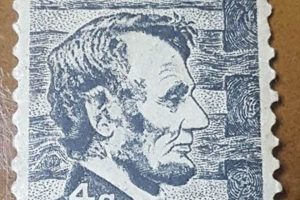
The one-cent postage stamp featuring Abraham Lincoln is an iconic piece of American philately, first issued in 1909 to commemorate the centennial of the 16th president’s birth. Several design variations exist, ranging from the original profile based on Victor David Brenner’s plaque to later versions incorporating the Lincoln Memorial. These stamps provide a visual reminder of Lincoln’s legacy and have become a staple of everyday postal use for over a century.
Representing a common denomination for mailing single letters and postcards domestically, this small adhesive has facilitated countless communications across the nation. Its enduring presence provides a window into changing printing techniques and postal rates throughout the 20th and 21st centuries. Furthermore, the stamp’s subject, a pivotal figure in American history, elevates its significance beyond its purely utilitarian function. The various designs reflect evolving artistic styles and national priorities, offering insights into the era in which they were produced.
This exploration will delve deeper into the historical context surrounding the creation and evolution of this ubiquitous postage stamp, examining specific design variations and their significance within the broader narrative of American history, art, and postal service. Further discussion will encompass collecting and identifying these stamps, providing valuable information for both seasoned philatelists and curious individuals alike.
Tips for Collecting and Identifying One-Cent Lincoln Stamps
Careful examination and research are crucial for understanding the nuances of one-cent Lincoln stamps. These tips offer guidance for both novice and experienced collectors.
Tip 1: Examine the Perforations: Perforation patterns vary across different printings. Identifying these patterns helps narrow down the issue date and potential value. Specialized gauges measure perforations precisely.
Tip 2: Note the Gum Type: Different types of gum were used over the years. Observing the gum’s condition and appearance can assist in authentication and dating.
Tip 3: Consider the Design Variations: Familiarize oneself with the various designs issued, from the original 1909 profile to later depictions incorporating the Lincoln Memorial.
Tip 4: Consult Specialized Catalogs: Reputable philatelic catalogs provide detailed information regarding specific issues, including design variations, print runs, and estimated values.
Tip 5: Utilize a Magnifying Glass: A magnifying glass allows for close inspection of design details, printing flaws, and other identifying characteristics.
Tip 6: Join a Philatelic Society: Connecting with other collectors offers opportunities for sharing knowledge, exchanging stamps, and expanding one’s collection.
Tip 7: Handle Stamps with Care: Proper handling and storage prevent damage and preserve value. Tongs and protective mounts are recommended.
By applying these tips, collectors can develop a deeper appreciation for the historical and artistic significance of these stamps. Careful observation and research unveil hidden details that enhance the collecting experience.
This section provided practical guidance for navigating the complexities of Lincoln one-cent stamp collecting. The following conclusion will summarize key takeaways and emphasize the enduring appeal of these miniature historical artifacts.
1. Postage
Postage represents the core function of the one-cent Lincoln stamp. Its existence facilitates the delivery of mail through a prepaid system, a fundamental component of communication networks. Understanding the relationship between postage and this specific stamp requires exploring various facets of postal operations and their historical context.
- Prepayment and Denomination
Prepaid postage, evidenced by the stamp’s presence, signifies that mailing costs have been covered prior to sending. The one-cent denomination historically represented the standard rate for first-class mail. This prepayment system, essential for efficient mail delivery, distinguishes postal services from other forms of communication.
- Postal Rates and Inflation
Changes in postal rates over time reflect economic fluctuations and inflationary pressures. The one-cent stamp, while initially sufficient for single-piece mail, eventually became inadequate as rates increased. This evolution necessitates the introduction of higher denominations and highlights the interplay between postage costs and economic realities.
- Printing and Distribution
The production and distribution of postage stamps, including the one-cent Lincoln, involve complex logistical operations. From initial design and printing to distribution through post offices nationwide, these processes ensure widespread availability and accessibility for public use. Variations in printing techniques and paper types further contribute to the stamp’s collectibility.
- Facilitating Communication
Postage stamps, exemplified by the one-cent Lincoln, play a crucial role in facilitating communication across geographical boundaries. They enable individuals and businesses to exchange information, conduct transactions, and maintain personal connections. The sheer volume of one-cent stamps used underscores their importance in everyday communication throughout history.
These facets illustrate how the one-cent Lincoln stamp exemplifies the broader concept of postage. This seemingly simple adhesive embodies the complexities of postal operations, economic factors, and the vital role of communication networks in society. Studying its evolution provides insights into the historical development of postal systems and their ongoing adaptation to changing societal needs.
2. Abraham Lincoln
Abraham Lincoln’s image on the one-cent stamp inextricably links the 16th president to a ubiquitous symbol of American communication. This connection transcends mere portraiture; it represents a conscious decision to honor Lincoln’s legacy and embed his image within the fabric of daily life. The choice of Lincoln, a figure associated with national unity and the abolition of slavery, imbues the stamp with symbolic weight. His presence on this small, yet widely circulated, piece of paper serves as a constant reminder of his historical importance.
The impact of featuring Lincoln on the one-cent stamp is multifaceted. Firstly, it ensures his continued visibility across generations. Every stamp affixed represents a subtle reinforcement of his place in national memory. Secondly, the stamp’s widespread use democratizes access to historical figures. Unlike grand monuments or formal portraits, this miniature representation of Lincoln reaches a vast audience, regardless of socioeconomic status or geographic location. For example, during the Civil Rights Movement, the Lincoln image on the stamp served as a quiet yet powerful reminder of the struggle for equality, resonating with those fighting for civil rights.
Understanding the significance of Lincoln’s image on the stamp provides a deeper appreciation for its cultural impact. It reinforces the notion that everyday objects can carry profound historical and symbolic meaning. The stamp transcends its utilitarian function as postage; it acts as a continuous, low-key commemoration of Lincoln’s enduring legacy. This understanding enriches historical awareness and underscores the power of visual representation in shaping collective memory. The continued use of Lincoln’s image reinforces his relevance in contemporary society and prompts reflection on the values he represented.
3. One Cent Value
The “one cent value” associated with the Lincoln stamp represents more than just its monetary worth; it reflects the stamp’s accessibility, its role in mass communication, and its historical context within the evolving landscape of postal rates. Examining this seemingly insignificant denomination reveals insights into economic factors, social trends, and the stamp’s significance within the broader narrative of American history.
- Affordability and Accessibility
The one-cent denomination made postage affordable for a wide segment of the population, democratizing access to mail services. This affordability facilitated communication across socioeconomic lines and played a crucial role in connecting individuals and communities throughout the nation. The low cost encouraged frequent correspondence, fostering personal and business relationships.
- Mass Communication and Commerce
The inexpensive nature of the one-cent stamp enabled mass mailings, including advertising circulars, catalogs, and promotional materials. This facilitated the growth of businesses by expanding their reach to potential customers. The stamp became an integral part of the burgeoning advertising industry and a driver of economic activity.
- Postal Rate History and Inflation
The one-cent value provides a benchmark for understanding the historical trajectory of postal rates. As inflation eroded the purchasing power of the cent, adjustments to postal rates became necessary. Tracking these changes offers insights into broader economic trends and the evolving costs of communication over time. The eventual obsolescence of the one-cent rate for first-class mail signifies broader economic shifts.
- Philatelic Significance of Low Denominations
Within philately, the abundance of one-cent Lincoln stamps, due to their widespread use, generally translates to lower individual values for common varieties. However, specific printing errors or rare variations within this denomination can achieve significant value, attracting collectors seeking unique examples. This dynamic demonstrates the interplay between scarcity and demand within the philatelic market.
In conclusion, the “one cent value” of the Lincoln stamp, while seemingly trivial, holds significant historical, economic, and social implications. Examining this denomination unveils a deeper understanding of postal history, communication trends, and the evolving role of this ubiquitous stamp in American society. It highlights the intersection of economic forces, technological advancements, and the enduring legacy of Abraham Lincoln.
4. Engraving
Engraving plays a crucial role in the creation and appreciation of the one-cent Lincoln stamp. This intricate process, involving the precise incision of an image onto a metal plate, forms the foundation for the stamp’s design and influences its visual characteristics, security features, and overall aesthetic appeal. Understanding the engraving process provides essential context for collectors and enthusiasts seeking to appreciate the artistry and historical significance of these stamps.
The choice of engraving as the primary method for producing the one-cent Lincoln stamp stems from several factors. Engraving offers a high level of detail and precision, enabling the accurate reproduction of intricate designs like portraits and architectural elements. The raised lines created through engraving contribute to tactile qualities, enhancing the stamp’s aesthetic appeal. Furthermore, the complexity of the engraving process adds a layer of security, making counterfeiting more difficult. The earliest versions of the stamp, particularly the 1909 VDB, showcase the fine detail achievable through this method. Later variations, while sometimes employing different printing techniques, still retain design elements rooted in the original engraved imagery.
The impact of engraving extends beyond mere technical execution. The engraver’s skill translates directly into the stamp’s visual appeal and historical representation. The depth and intricacy of the engraved lines contribute to the overall aesthetic quality. Variations in engraving style over different issues reflect evolving artistic trends and technological advancements within the printing industry. Recognizing these nuances adds a layer of appreciation for the artistry involved in creating these miniature works of art. The engraved details, often overlooked by the casual observer, provide a tangible connection to the historical context of their creation. Further research into specific engravers and their contributions offers deeper insights into the evolution of stamp design and production.
5. Philately
Philately, the study and collection of postage stamps, finds a significant subject in the one-cent Lincoln stamp. Its widespread use, numerous variations, and historical context provide ample material for philatelic study. The stamp’s enduring popularity within the collecting community stems from its accessibility, affordability, and connection to a pivotal figure in American history. Exploring the intersection of philately and the one-cent Lincoln stamp illuminates key aspects of both stamp collecting and historical preservation.
- Variety and Specialization
Philately encompasses a wide range of collecting approaches. Specializing in one-cent Lincoln stamps allows collectors to focus on specific design variations, printing errors, or historical periods. For instance, a collector might focus solely on stamps issued during World War II or those exhibiting specific perforation patterns. This focused approach allows for in-depth study and appreciation of nuanced details within a well-defined area of interest.
- Condition and Grading
Assessing the condition of a stamp is crucial in philately. Factors such as centering, gum condition, and the presence of flaws or cancellations influence a stamp’s value. Specialized grading systems provide standardized metrics for evaluating condition. A pristine, well-centered example of a rare variety commands a higher price than a damaged or poorly centered one. This emphasis on condition underscores the importance of careful handling and preservation within philatelic pursuits.
- Historical Context and Research
Philately encourages historical research. Studying the one-cent Lincoln stamp provides insights into printing methods, postal rates, and design evolution. Researching the historical context surrounding specific issues enriches the collecting experience and provides a deeper understanding of the stamp’s significance. Connecting a stamp to a specific historical event or period enhances its value and interest for collectors.
- Community and Exchange
Philately fosters a sense of community among collectors. Philatelic societies, online forums, and stamp shows provide opportunities for sharing knowledge, exchanging stamps, and building collections. The shared interest in one-cent Lincoln stamps facilitates connections among individuals with a common passion. This social aspect contributes to the enjoyment and educational value of philately.
Through these facets, philately enhances understanding and appreciation of the one-cent Lincoln stamp. The detailed study encouraged by philatelic pursuits reveals nuances often overlooked by the casual observer. This intersection of history, art, and meticulous observation elevates the simple act of collecting into a pursuit of knowledge and a celebration of cultural heritage.
6. American History
The one-cent Lincoln stamp stands as a miniature embodiment of American history. Its existence spans over a century, reflecting evolving national narratives, artistic styles, and printing technologies. The stamp’s subject, Abraham Lincoln, remains a central figure in the American historical consciousness, inextricably linked to the Civil War and the abolition of slavery. The stamps continuous presence in daily life reinforces this historical connection, subtly reminding users of Lincoln’s legacy. The very choice to depict Lincoln on a widely circulated piece of currency reflects his enduring importance in the national narrative. For example, the issuance of the first Lincoln stamp in 1909, coinciding with the centennial of his birth, served to solidify his place in the pantheon of American heroes. Later designs, such as those incorporating the Lincoln Memorial, further cemented the connection between the stamp, the president, and key moments in American history.
Furthermore, the one-cent Lincoln stamp offers a unique lens through which to examine broader historical trends. Changes in stamp design, printing methods, and even the adhesive used reflect technological and aesthetic shifts within American society. The increasing use of mechanized printing processes mirrors broader industrial advancements. Even seemingly minor details, such as variations in perforation patterns, can provide insights into manufacturing techniques of specific eras. Moreover, the stamp’s changing postal value reflects economic realities, including periods of inflation and currency devaluation. Analyzing these changes provides a tangible connection to economic and social forces shaping American history. The shift from one-cent postage for standard letters to higher denominations illustrates the impact of inflation on everyday life.
In conclusion, the one-cent Lincoln stamp functions as more than just postage; it serves as a tangible artifact of American history. Studying its evolution offers a unique perspective on changing cultural values, technological advancements, and economic realities. The stamp’s enduring presence underscores Lincoln’s continued relevance in the American historical narrative. Challenges remain in preserving these small but significant pieces of history, particularly given their susceptibility to damage and deterioration. However, their widespread availability allows for continued access and study, ensuring that future generations can connect with the historical narratives embedded within this ubiquitous symbol of American communication.
7. Collectibility
Collectibility significantly contributes to the enduring fascination with the one-cent Lincoln stamp. While its common usage results in vast quantities, creating an impression of ubiquity, certain factors elevate specific stamps to desirable collectibles. Rarity, condition, historical significance, and errors contribute to a stamp’s collectibility, transforming an everyday item into a sought-after artifact.
- Rarity
Rarity drives demand in collecting. Limited print runs, specific plate varieties, and unique errors transform otherwise common one-cent Lincoln stamps into valuable treasures. The 1909 VDB, with its prominent initials of the designer, exemplifies this principle. Its relatively short production period, due to design changes, contributes to its scarcity and desirability among collectors. Similarly, stamps with inverted centers or missing colors, though unintentional errors, achieve significant value due to their rarity.
- Condition
Condition significantly impacts a stamp’s collectibility. Factors such as centering, gum condition (the adhesive on the back), and the absence of tears or creases dramatically influence value. A perfectly centered, pristine example of a common stamp may hold more value than a flawed example of a rarer variety. Collectors often utilize specialized tools and resources to assess condition, employing standardized grading systems to determine a stamp’s quality and potential market value.
- Historical Significance
Historical context adds another layer to collectibility. Stamps issued during specific events, such as wartime or presidential anniversaries, gain added significance. First-day covers, envelopes bearing stamps postmarked on their first day of issue, further enhance historical value. These artifacts offer tangible connections to specific moments in time, increasing their appeal to collectors interested in both philately and history.
- Errors and Varieties
Errors and varieties represent a significant aspect of one-cent Lincoln stamp collecting. Printing errors, such as inverted centers, missing colors, or double impressions, create unique and highly sought-after items. Even minor variations in perforation patterns or paper types can differentiate stamps, adding to their collectibility. Collectors meticulously catalog and study these variations, often utilizing specialized equipment to identify subtle distinctions that contribute to a stamp’s rarity and value.
The convergence of these factors transforms the ubiquitous one-cent Lincoln stamp from a simple postage item into a collectible object of historical and financial significance. The pursuit of rare varieties, pristine condition, and historically significant examples fuels the passion of collectors, contributing to the enduring legacy of this iconic American stamp. The ongoing study and documentation of these stamps within the philatelic community ensures their preservation and contributes to a deeper understanding of printing history, postal operations, and the historical context surrounding their production.
Frequently Asked Questions
This section addresses common inquiries regarding one-cent Lincoln stamps, providing concise and informative responses.
Question 1: What makes certain one-cent Lincoln stamps more valuable than others?
Rarity, condition, and historical significance primarily determine value. Scarcity, driven by limited print runs or unique errors, increases demand. Pristine condition, free from damage or flaws, also elevates value. Association with specific historical events further contributes to desirability and price.
Question 2: How can one determine the authenticity of a one-cent Lincoln stamp?
Authentication involves careful examination of several factors. Perforation patterns, gum type, and design details provide clues regarding a stamp’s authenticity and age. Comparing a stamp to established references in specialized catalogs assists in verifying genuine examples. Consulting experienced philatelists or professional authenticators offers additional assurance.
Question 3: What is the significance of the “VDB” marking on some early one-cent Lincoln stamps?
“VDB” represents the initials of Victor David Brenner, the designer of the original 1909 Lincoln stamp. These initials, initially deemed too prominent, were subsequently removed, making stamps bearing them relatively scarce and thus more collectible.
Question 4: How are one-cent Lincoln stamps graded for condition?
Standardized grading systems employed by philatelic organizations assess condition based on factors such as centering, gum condition, and the presence of flaws. Numerical grades, often ranging from one to seventy, reflect a stamp’s condition, with higher grades indicating superior quality.
Question 5: Where can one acquire one-cent Lincoln stamps for a collection?
Acquisition avenues include stamp dealers, online marketplaces, auctions, and trading with other collectors. Reputable dealers provide expertise and authentication services. Online platforms offer wider access but require careful vetting of sellers. Auctions present opportunities to acquire rare or valuable items.
Question 6: How should one-cent Lincoln stamps be stored to prevent damage?
Proper storage safeguards stamps against damage from humidity, light, and pests. Acid-free albums, protective mounts, and climate-controlled environments prevent deterioration. Handling stamps with tongs minimizes the risk of damage from fingerprints and oils.
Understanding these fundamental aspects of one-cent Lincoln stamps provides a foundation for both novice and experienced collectors. Further research and engagement with the philatelic community enhance appreciation and knowledge of these miniature historical artifacts.
This FAQ section addressed common inquiries. The following section will explore resources available for further research.
Conclusion
Exploration of the one-cent Lincoln stamp reveals its significance extending beyond its utilitarian function. From its initial issuance in 1909, this small adhesive has played a role in American communication, reflecting evolving printing technologies, economic trends, and artistic styles. Its enduring presence provides a tangible link to Abraham Lincoln’s legacy, subtly reinforcing his historical importance in everyday life. The multifaceted nature of this seemingly simple object encompasses historical narrative, artistic expression, and economic indicators. Philatelic interest further elevates the stamp’s importance, transforming it into a collectible artifact worthy of study and preservation. Key aspects explored include design variations, printing processes, historical context, and the factors influencing collectibility.
The one-cent Lincoln stamp, though diminutive in size, offers a window into a larger narrative of American history and culture. Continued study and appreciation of these unassuming artifacts provide valuable insights into the past, prompting reflection on the enduring power of symbolic representation and the intricate connections between seemingly mundane objects and broader historical currents. Preservation efforts ensure accessibility for future generations, fostering continued exploration and understanding of this ubiquitous piece of American history.