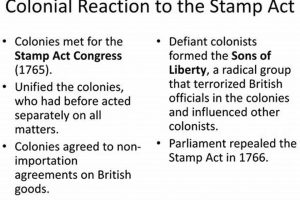
The Stamp Act, a tax levied on paper goods in the American colonies, was enacted by the British Parliament in 1765 and repealed in 1766. This act required colonists to purchase stamps for legal documents, newspapers, pamphlets, playing cards, and other printed materials. These stamps served as proof of payment of the tax.
This legislation played a pivotal role in the escalating tensions between Great Britain and its American colonies. It represented a shift in British colonial policy, moving away from salutary neglect toward more direct control and revenue generation. The colonists viewed the tax as an infringement upon their rights as Englishmen, particularly the right to representation in Parliament (“No taxation without representation”). The widespread resistance and boycotts that followed the acts implementation contributed significantly to the growing movement for American independence. Understanding this period provides critical context for the events leading to the American Revolutionary War.
Exploring the details of this historical period, including the specific provisions of the legislation, the colonial response, and the eventual repeal, offers a deeper understanding of the foundations of the United States. Further examination of key figures, events, and documents related to this era provides valuable insights into the complexities of revolution and the birth of a nation.
Tips for Researching the Stamp Act
Effective research regarding the Stamp Act requires focus and an understanding of available resources. The following tips provide guidance for navigating this historical topic.
Tip 1: Begin with a broad overview. Start with general resources like encyclopedias and textbooks to establish a foundational understanding of the act’s context, purpose, and consequences.
Tip 2: Explore primary sources. Examine original documents from the period, such as letters, diaries, newspapers, and pamphlets, to gain firsthand perspectives on the events surrounding the Stamp Act.
Tip 3: Consider multiple perspectives. Research viewpoints from both the British government and the American colonists to develop a balanced understanding of the historical context.
Tip 4: Investigate the broader context. Research the political, economic, and social climate of the 18th century to understand the factors that led to the Stamp Act’s enactment and its eventual repeal.
Tip 5: Utilize reputable academic resources. Prioritize scholarly articles, books, and online databases to ensure accuracy and reliability of information.
Tip 6: Analyze the long-term effects. Research how the Stamp Act influenced later events, including the American Revolution, and its lasting impact on the relationship between Great Britain and the United States.
By following these tips, researchers can gain a comprehensive and nuanced understanding of this pivotal moment in history. This approach fosters informed analysis and critical thinking regarding the complexities of this era.
Ultimately, a thorough understanding of the Stamp Act allows one to appreciate its profound significance in shaping the course of American history.
1. 1765
The year 1765 holds significant historical importance as the year the Stamp Act was passed by the British Parliament. Understanding the context of this year is crucial for comprehending the act’s impact and the subsequent chain of events leading to the American Revolution.
- Enactment and Implementation
1765 marks both the enactment and implementation of the Stamp Act. Passed in March and effective from November 1st, this legislation aimed to raise revenue from the American colonies by imposing a tax on printed materials. This direct taxation, without colonial representation in Parliament, sparked widespread resentment and resistance.
- Colonial Resistance
The implementation of the Stamp Act in 1765 ignited fervent protests throughout the colonies. Organized boycotts of British goods, coupled with public demonstrations and acts of defiance, exemplified the colonists’ discontent. This year witnessed the formation of groups like the Sons of Liberty, which played a crucial role in mobilizing opposition and escalating the conflict.
- Shift in British Colonial Policy
The Stamp Act of 1765 represents a pivotal shift in British colonial policy. Departing from the previous era of salutary neglect, the British government sought greater control and revenue from the colonies. This change in approach fueled colonial anxieties about British intentions and contributed to the growing sense of alienation.
- Prelude to Revolution
1765 and the Stamp Act serve as a crucial prelude to the American Revolution. The colonial resistance sparked in this year laid the groundwork for future conflicts and contributed significantly to the growing movement for independence. The events of 1765 underscore the importance of understanding this legislation as a catalyst for revolution.
The events of 1765 surrounding the Stamp Act are pivotal in understanding the escalating tensions between Great Britain and its American colonies. The act’s implementation and the subsequent colonial resistance mark a turning point in the relationship, setting the stage for the revolutionary struggle that would follow. Exploring 1765 provides essential context for understanding the origins of the American Revolution.
2. Enactment
Understanding the enactment of the Stamp Act is crucial for comprehending its historical significance. Enactment refers to the process by which a legislative body, in this case the British Parliament, formally approves and legalizes a proposed law. The Stamp Act’s enactment occurred on March 22, 1765, marking a pivotal moment in the relationship between Great Britain and the American colonies. This date signifies the official beginning of the Act’s existence as law, although its enforcement began later on November 1st of the same year. Examining the enactment date allows one to understand the timeline of events leading to the American Revolution and analyze the political climate of the era. The enactment solidified British intentions to exert greater control over colonial finances and governance, a key factor contributing to escalating tensions.
The significance of the enactment date goes beyond simply marking a point in time. It provides a framework for understanding cause and effect. The act’s enactment triggered immediate and widespread resistance in the American colonies. Colonists viewed this new tax as an infringement on their rights as Englishmen, particularly the right to representation in Parliament. The enactment, therefore, serves as a direct catalyst for the protests, boycotts, and formation of revolutionary groups like the Sons of Liberty that followed. These events demonstrate the practical implications of understanding the enactment date as a pivotal point in the progression towards revolution.
In summary, the enactment date of March 22, 1765, represents a critical juncture in the history leading up to the American Revolution. It signifies not only the formal legalization of the Stamp Act but also the crystallization of colonial resistance against British policies. Understanding the enactment date provides valuable context for analyzing the political and social climate of the time and understanding the chain of events that ultimately led to the colonies’ fight for independence. This historical understanding allows for a more nuanced appreciation of the complexities and significance of the American Revolution.
3. March 22nd
March 22nd, 1765, holds significant historical weight as the date the British Parliament enacted the Stamp Act. This date marks a critical turning point in relations between Great Britain and the American colonies, serving as a catalyst for the burgeoning revolution. Understanding the events and implications surrounding this date provides crucial context for comprehending the act’s impact and the subsequent colonial response.
- Formal Enactment
March 22nd signifies the official legalization of the Stamp Act by the British Parliament. While its enforcement wouldn’t commence until November 1st, this date marks the act’s formal existence as law. This official act solidified British intentions to exert greater control over colonial finances, triggering immediate and widespread colonial resistance.
- Catalyst for Resistance
The enactment on March 22nd galvanized colonial opposition. News of the act’s passage quickly spread, fueling protests and boycotts throughout the colonies. This date marks the beginning of organized resistance movements, including the formation of groups like the Sons of Liberty, dedicated to challenging British authority.
- Shift in British Policy
March 22nd underscores a significant shift in British colonial policy. The Stamp Act represented a departure from the previous era of salutary neglect, signifying a more direct approach to colonial governance and revenue generation. This change fueled anxieties about British intentions and contributed to the growing divide between the colonies and the mother country.
- Precursor to Revolution
The events surrounding March 22nd, 1765, served as a clear precursor to the American Revolution. The enactment of the Stamp Act and the immediate colonial resistance it provoked laid the groundwork for future conflicts. This date signifies a key turning point in the relationship between Great Britain and the American colonies, propelling the colonies further along the path toward independence.
In summation, March 22nd represents a pivotal moment in the history leading up to the American Revolution. The enactment of the Stamp Act on this date ignited a firestorm of colonial resistance, marking a significant escalation in the tensions between Great Britain and the American colonies. Understanding the implications of this date provides essential context for comprehending the origins and complexities of the American Revolution.
4. Effective Date
The effective date of the Stamp Act, November 1st, 1765, is a crucial element in understanding the historical impact of this legislation. While the act’s passage in March of the same year signaled British intentions, the effective date marks the point at which the act’s provisions became legally binding in the American colonies. This date signifies the transition from legislative intent to practical implementation, marking a pivotal moment in the escalating tensions between Great Britain and the colonies.
- Implementation of the Tax
The effective date, November 1st, marked the official commencement of the tax on printed materials. From this date forward, colonists were required to purchase and affix stamps to legal documents, newspapers, pamphlets, and various other printed items. This implementation directly impacted daily life and commerce within the colonies, fueling widespread resentment and resistance.
- Catalyst for Organized Resistance
While protests began after the act’s passage, the effective date served as a focal point for more organized and widespread resistance. Groups like the Sons of Liberty intensified their activities, leading boycotts of British goods and engaging in acts of defiance against British authority. The effective date, therefore, marks a significant escalation in the organized colonial response to British policies.
- Economic Disruption
The effective date immediately triggered economic disruption in the colonies. The mandatory purchase of stamps imposed a financial burden on colonists, affecting businesses, legal proceedings, and the dissemination of information. This disruption further exacerbated tensions and highlighted the practical implications of the Stamp Act on colonial life.
- Historical Turning Point
The effective date of the Stamp Act stands as a historical turning point. It marks the concrete implementation of a policy that significantly altered the relationship between Great Britain and the American colonies. The events surrounding this date, particularly the organized resistance and economic disruption, underscore its importance in the progression towards revolution.
The effective date of November 1st provides crucial context for understanding “when is the Stamp Act” beyond simply its passage date. It signifies the moment the act’s provisions became tangible realities for the colonists, directly impacting their lives and fueling the resistance movement that ultimately led to the American Revolution. Examining the effective date illuminates the practical consequences of the Stamp Act and its role as a pivotal event in American history.
5. November 1st
November 1st, 1765, represents the date the Stamp Act, enacted by the British Parliament earlier that year, went into effect in the American colonies. This date holds substantial historical significance, marking the practical implementation of a tax that profoundly impacted colonial life and fueled the growing movement for independence. Understanding the connection between November 1st and the broader question of “when is the Stamp Act” provides crucial context for analyzing the act’s consequences and the escalating tensions between Great Britain and the colonies. The act’s implementation on this date transformed the Stamp Act from a legislative decree into a tangible reality for colonists, forcing them to confront its implications directly.
The implementation of the Stamp Act on November 1st triggered immediate and widespread consequences. Colonists were now required to purchase and affix stamps to various printed materials, including legal documents, newspapers, and commercial papers. This new tax represented a significant financial burden and was perceived as a direct violation of colonial rights, especially given the lack of colonial representation in Parliament. For example, newspapers, vital for disseminating information and fostering public discourse, became more expensive, potentially limiting access to vital news and political commentary. Legal transactions, essential for commerce and personal affairs, also incurred additional costs. These direct impacts on daily life fueled resentment and galvanized opposition to British rule. The boycotts, protests, and formation of resistance groups following November 1st demonstrate the practical significance of this date in escalating the conflict.
In conclusion, November 1st serves as a pivotal component in understanding “when is the Stamp Act.” While the act’s passage earlier in 1765 laid the legal groundwork, its implementation on this date marks the moment it truly impacted colonial life. This date signifies a critical turning point, transforming the Stamp Act from a theoretical measure into a tangible source of conflict. Understanding the practical consequences of the act’s implementation on November 1st provides crucial insights into the escalating tensions, organized resistance, and economic disruption that ultimately contributed to the American Revolution. The events surrounding November 1st, 1765, underscore the importance of this date in understanding the broader historical narrative of the American Revolution.
6. Pre-Revolution
The Stamp Act is firmly situated within the pre-revolutionary period of American history. Understanding this context is essential for grasping the act’s significance as a catalyst for the revolution. The pre-revolutionary period encompasses the escalating tensions between Great Britain and its thirteen American colonies, characterized by growing colonial resistance to British policies. Examining this era illuminates the factors that led to the American Revolutionary War and the eventual declaration of independence.
- Rising Tensions
The pre-revolutionary period witnessed a steady increase in tensions between the colonies and Great Britain. The Stamp Act, enacted in 1765, exacerbated these tensions significantly. Colonial resistance to the act, through boycotts, protests, and the formation of groups like the Sons of Liberty, demonstrated growing dissatisfaction with British rule and contributed to the increasingly strained relationship. The act’s implementation marked a turning point, pushing the colonies closer to open rebellion.
- Shifting Colonial Identity
During the pre-revolutionary era, colonial identity underwent a significant transformation. Initially identifying primarily as British subjects, colonists began to develop a distinct American identity, fueled by grievances against British policies like the Stamp Act. The act’s perceived injustice contributed to a sense of shared colonial experience and solidified a collective resistance against what was seen as oppressive British rule. This evolving identity played a crucial role in the eventual push for independence.
- Economic Grievances
Economic grievances formed a central component of the pre-revolutionary period. The Stamp Act, as a direct tax imposed by the British Parliament without colonial representation, became a symbol of economic exploitation. The act’s financial burden on colonists, coupled with other restrictive trade policies, fueled resentment and contributed to the growing perception that British rule was detrimental to colonial economic interests. This economic discontent played a significant role in motivating colonial resistance.
- Development of Revolutionary Ideology
The pre-revolutionary period witnessed the development and dissemination of revolutionary ideology. The Stamp Act contributed significantly to this process. The act’s perceived violation of colonial rights fueled debates about representation, self-governance, and the legitimacy of British authority. Pamphlets, newspapers, and public speeches circulated these ideas throughout the colonies, fostering a growing intellectual and philosophical basis for revolution. The Stamp Act, therefore, played a key role in shaping the intellectual landscape that ultimately led to the American Revolution.
The Stamp Act’s placement within the pre-revolutionary period underscores its importance as a catalyst for the American Revolution. By examining the act within this broader context of rising tensions, shifting colonial identity, economic grievances, and developing revolutionary ideology, one gains a deeper understanding of its role in shaping the course of American history. The Stamp Act serves not as an isolated incident, but as a pivotal event within the larger narrative of the pre-revolutionary era, directly contributing to the conditions that ultimately led to the colonies’ fight for independence.
7. British policy shift
The Stamp Act of 1765 represents a significant shift in British colonial policy, directly connected to understanding the historical context of “when is the Stamp Act.” Prior to the act, the British government largely adhered to a policy of salutary neglect, allowing the American colonies considerable autonomy in managing their own affairs. This period of relaxed oversight allowed colonial economies to flourish and fostered a sense of self-governance. However, the French and Indian War (1754-1763) significantly altered the financial landscape of the British Empire, leaving it with substantial debt. This financial strain prompted a reassessment of colonial policy, leading to a move away from salutary neglect and towards more direct control and revenue extraction from the colonies. The Stamp Act embodies this policy shift, marking a departure from previous practices and signaling a new era of tighter British control.
The shift in British policy embodied by the Stamp Act had profound consequences. The act, which imposed a direct tax on various printed materials in the colonies, was met with widespread resistance. Colonists viewed the tax as an infringement on their rights as Englishmen, particularly the right to representation in Parliament, given the cry of “No taxation without representation.” This resistance manifested in boycotts of British goods, protests, and the formation of groups like the Sons of Liberty. These actions demonstrate the direct link between the policy shift represented by the Stamp Act and the growing unrest in the colonies. The act served as a catalyst, accelerating the movement towards revolution. For example, the Stamp Act Congress, formed in response to the act, represents an early instance of intercolonial cooperation and laid the groundwork for future unified action against British policies. This demonstrates the practical significance of understanding the policy shift in the context of “when is the Stamp Act.”
In summary, the Stamp Act signifies a critical shift in British colonial policy, moving away from salutary neglect towards more direct control and revenue generation. Understanding this policy shift is essential for comprehending the historical context of “when is the Stamp Act” and its consequences. The act’s implementation and the subsequent colonial resistance demonstrate the direct link between the policy shift and the escalating tensions that ultimately led to the American Revolution. The Stamp Act, therefore, serves as a pivotal example of how a change in policy can have far-reaching and unintended consequences, shaping the course of history. This understanding provides valuable insights into the dynamics of power, resistance, and the complexities of colonial relationships.
Frequently Asked Questions
This section addresses common inquiries regarding the Stamp Act, providing concise and informative responses to enhance understanding of this pivotal historical event.
Question 1: What specific items were taxed under the Stamp Act?
The Stamp Act mandated the purchase of stamps for various printed materials, including legal documents (contracts, wills, licenses), newspapers, pamphlets, playing cards, and even dice.
Question 2: Why did the British government implement the Stamp Act?
The primary motivation behind the Stamp Act was to generate revenue for the British Empire following the substantial debt incurred during the French and Indian War. This marked a departure from the previous policy of salutary neglect.
Question 3: How did the colonists react to the Stamp Act?
The Stamp Act was met with widespread resistance in the American colonies. Colonists organized boycotts of British goods, staged protests, and formed groups like the Sons of Liberty to challenge the act’s implementation. The cry of “No taxation without representation” encapsulated their core grievance.
Question 4: What role did the Stamp Act play in the lead-up to the American Revolution?
The Stamp Act significantly escalated tensions between Great Britain and the American colonies. The act’s perceived injustice fueled colonial resentment and strengthened the movement for greater autonomy and eventual independence. It served as a catalyst, accelerating the progression towards revolution.
Question 5: When was the Stamp Act repealed?
The British Parliament repealed the Stamp Act on March 18, 1766, recognizing the widespread colonial resistance and the potential for further unrest. However, the repeal was accompanied by the Declaratory Act, asserting Parliament’s right to legislate for the colonies in all cases whatsoever.
Question 6: What long-term consequences did the Stamp Act have?
The Stamp Act, despite its repeal, had lasting consequences. It solidified colonial resistance to British policies, fostered a stronger sense of American identity, and contributed significantly to the development of revolutionary ideology. The act’s legacy continues to shape understanding of the events leading to the American Revolution.
Understanding the key aspects of the Stamp Act provides crucial context for analyzing its historical significance. This knowledge enhances comprehension of the political, economic, and social factors that shaped the American Revolution.
Further exploration of primary sources and scholarly analyses can provide deeper insights into this pivotal period in American history.
Conclusion
The examination of “when is the Stamp Act” reveals the crucial importance of timing in understanding historical events. The act’s enactment on March 22nd, 1765, followed by its effective date of November 1st, 1765, and eventual repeal in 1766, demonstrates a clear timeline of escalating tensions, colonial resistance, and British response. This specific timeframe, situated within the broader pre-revolutionary period, underscores the act’s role as a catalyst for the American Revolution. The act’s timing, coupled with the shift in British colonial policy it represented, ignited a firestorm of protest and laid the groundwork for the colonies’ fight for independence. Understanding the specific dates associated with the Stamp Act provides essential context for comprehending its profound impact on the course of American history.
The legacy of the Stamp Act extends far beyond its brief existence. It serves as a potent reminder of the consequences of unchecked power, the importance of representation, and the enduring human desire for liberty. Continued exploration of this pivotal era offers valuable insights into the complexities of revolution and the enduring principles upon which the United States was founded. This understanding remains crucial for navigating contemporary political and social challenges and appreciating the ongoing struggle for freedom and self-determination.