The 1765 act levied a tax on all printed materials in the American colonies, from legal documents and newspapers to playing cards. This required colonists to purchase and affix embossed revenue stamps to these items, demonstrating payment of the tax. The act serves as a prime example of direct taxation imposed by the British Parliament on its colonies without colonial representation.
This taxation without representation fueled colonial resentment and resistance, marking a crucial turning point in the relationship between Great Britain and its American colonies. It galvanized colonial unity and fostered a burgeoning sense of American identity separate from British rule. The resulting protests, boycotts, and formation of groups like the Sons of Liberty laid the groundwork for the organized resistance that would ultimately culminate in the American Revolution. The act demonstrated a fundamental disagreement over the nature of imperial authority and colonial rights, significantly escalating tensions that led to the war for independence.
Further examination reveals the complexities of colonial responses, the role of key figures in the resistance movement, and the lasting impact on the development of American political thought and governance.
Understanding the Stamp Act’s Impact
Examining the Stamp Act offers valuable insights into the origins of the American Revolution. These tips provide guidance for a deeper understanding of its historical context and lasting influence.
Tip 1: Consider the broader context of British imperial policy. The Stamp Act was not an isolated incident but part of a larger system of mercantilist policies designed to benefit Great Britain. Exploring these policies illuminates the underlying tensions between the colonies and the mother country.
Tip 2: Analyze the diverse colonial reactions to the act. Responses varied across different colonies and social groups. Examining these diverse perspectives provides a nuanced understanding of the act’s impact.
Tip 3: Explore the role of propaganda and public discourse. Pamphlets, newspapers, and public speeches played a crucial role in shaping public opinion and mobilizing resistance. Studying these sources reveals how ideas about liberty, representation, and colonial rights were disseminated and debated.
Tip 4: Investigate the formation and activities of resistance groups. Organizations like the Sons of Liberty played a key role in organizing protests and boycotts. Understanding their strategies and impact is crucial for grasping the escalating resistance to British rule.
Tip 5: Examine the legal arguments against the Stamp Act. Colonists argued that taxation without representation violated their fundamental rights as Englishmen. Exploring these legal arguments provides insights into the developing political thought of the era.
Tip 6: Consider the long-term consequences of the Stamp Act crisis. The acts legacy extended far beyond its repeal, contributing to the growing sense of American identity and solidifying colonial resistance to British authority. It laid crucial groundwork for the eventual outbreak of the American Revolution.
By exploring these aspects, one gains a more comprehensive understanding of the Stamp Acts profound significance in shaping the course of American history.
This exploration provides a foundation for further investigation into the events leading up to the American Revolution and the formation of the United States.
1. Taxation without representation

The phrase “Taxation without representation” encapsulates the core grievance at the heart of the Stamp Act’s significance. It signifies the colonists’ fundamental objection to being subjected to taxes levied by the British Parliament without having elected representatives to voice their interests within that body. This principle became a rallying cry, fueling colonial resistance and shaping the narrative that ultimately led to the American Revolution. Understanding its nuances is crucial to grasping the historical weight of the Stamp Act.
- Violation of Rights:
Colonists argued that being taxed without representation violated their fundamental rights as Englishmen. They viewed representation as essential for ensuring that taxes were just and equitable, reflecting the needs and consent of the governed. This perceived infringement of rights ignited widespread outrage and fueled the flames of resistance.
- Economic Burden:
The Stamp Act placed a significant financial burden on the colonists. The tax affected a wide range of printed materials, impacting businesses, legal proceedings, and everyday communication. This economic hardship further exacerbated colonial resentment and motivated collective action against the tax.
- Catalyst for Resistance:
The principle of “No taxation without representation” served as a powerful catalyst for organized resistance. It galvanized colonists from different backgrounds and social classes, uniting them in opposition to British policies. Groups like the Sons of Liberty emerged, mobilizing protests, boycotts, and other forms of resistance.
- Ideological Foundation:
“Taxation without representation” became a cornerstone of American political thought. It articulated a core principle of self-governance and popular sovereignty that would shape the future of the nation. This concept laid the groundwork for the arguments and ideals that ultimately led to the Declaration of Independence and the establishment of the United States.
These facets of “Taxation without representation” highlight its centrality to understanding the Stamp Act’s significance. The convergence of economic hardship, perceived violations of rights, and the articulation of core political principles transformed a tax dispute into a pivotal moment in the struggle for American independence. The Stamp Act, therefore, represents not just a specific tax but a crucial turning point in the relationship between Great Britain and its American colonies, fueled by the fundamental principle of representation in government.
2. Colonial Resistance

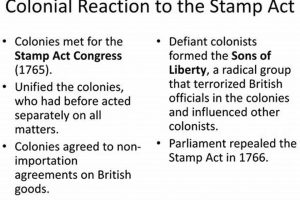
Colonial resistance forms an integral part of the Stamp Act’s historical significance. The Act, viewed as an unjust imposition by the British Parliament, ignited a firestorm of protests and organized opposition throughout the American colonies. This resistance was not a monolithic entity but rather a multifaceted response encompassing boycotts, demonstrations, and the formation of influential groups like the Sons of Liberty. These collective actions demonstrated a growing sense of colonial unity and a shared resentment against British policies perceived as oppressive. The boycotts, targeting British goods, disrupted transatlantic trade and exerted economic pressure on British merchants, forcing them to lobby Parliament for repeal. The Sons of Liberty, through public demonstrations and acts of defiance, further amplified colonial discontent and helped galvanize public opinion against the Stamp Act.
Examples of this resistance include the Stamp Act Congress, where representatives from nine colonies met to formally denounce the Act and petition for its repeal. This unprecedented display of intercolonial cooperation demonstrated the unifying power of the Act and laid the groundwork for future collaborative efforts in the leadup to the American Revolution. Furthermore, individuals like Patrick Henry, through their fiery speeches and resolutions against the Act, played a critical role in mobilizing popular resistance and articulating the colonists grievances. The Virginia Resolves, for example, boldly asserted the principle of “No taxation without representation,” which became a rallying cry for the burgeoning resistance movement.
Understanding the nature and scope of colonial resistance is essential for comprehending the Stamp Acts lasting impact. This widespread opposition not only led to the eventual repeal of the Act but also solidified a sense of shared American identity and fostered a spirit of resistance that ultimately contributed to the outbreak of the American Revolution. The Stamp Act, therefore, serves as a crucial example of how colonial resistance could effectively challenge imperial power and shape the course of history. It demonstrated the power of collective action and underscored the importance of defending fundamental rights and liberties, themes that would resonate throughout the American Revolution and beyond.
3. Unifying the colonies

The Stamp Act’s significance is deeply intertwined with its unintended consequence: unifying the American colonies. Before the Act, colonial identity was largely regional, with limited intercolonial cooperation or shared grievances. The Act, however, transcended these regional boundaries by imposing a universal tax that impacted all colonists. This shared experience of perceived injustice fostered a collective sense of grievance, forging stronger bonds between the colonies and laying the groundwork for future unified action. The Stamp Act Congress of 1765 exemplifies this newfound unity. Representatives from nine colonies convened, marking a significant step towards intercolonial collaboration. This congress provided a platform for colonists to articulate their shared grievances, strategize against the Act, and demonstrate a united front against British policies.
The practical significance of this unity cannot be overstated. The collective resistance orchestrated through boycotts, petitions, and public demonstrations significantly amplified the colonists’ voices and exerted pressure on British merchants and Parliament. The success of these unified efforts in achieving the Act’s repeal demonstrated the potential power of collective action, emboldening the colonies and fostering a stronger sense of shared identity. This nascent sense of unity, fostered by the shared experience of resisting the Stamp Act, proved invaluable in the years leading up to the American Revolution. The networks of communication and collaboration established during this period facilitated the dissemination of revolutionary ideas and coordinated resistance efforts against subsequent British policies.
The Stamp Act’s role in unifying the colonies represents a pivotal shift in the relationship between the colonies and Great Britain. It transformed disparate regional identities into a more cohesive colonial identity, laying the foundation for the coordinated resistance that would ultimately culminate in the American Revolution. The Acts significance, therefore, extends beyond its immediate impact, serving as a catalyst for the development of a shared American identity and the unified struggle for independence.
4. Escalating Tensions
The Stamp Act significantly escalated tensions between Great Britain and its American colonies, marking a critical turning point on the path to revolution. The Act, perceived as a violation of colonial rights and an unjust economic burden, fueled widespread resentment and resistance. This resistance, manifested through boycotts, protests, and the formation of groups like the Sons of Liberty, directly challenged British authority and contributed to a climate of escalating defiance. The British government’s response, characterized by a combination of intransigence and attempts at coercion, further exacerbated the situation. The deployment of British troops to enforce the Act and the imposition of new restrictions on colonial trade served only to heighten tensions and solidify colonial resistance. The Stamp Act Congress, convened in 1765, stands as a testament to the growing intercolonial unity and determination to resist British policies. The resolutions passed by the Congress, denouncing the Act and asserting colonial rights, signaled a significant escalation in the conflict.
The escalating tensions surrounding the Stamp Act had profound practical consequences. The economic disruption caused by colonial boycotts pressured British merchants and contributed to the Act’s eventual repeal in 1766. However, the underlying tensions remained unresolved. The repeal, while celebrated as a victory in the colonies, was accompanied by the Declaratory Act, which asserted Parliament’s right to legislate for the colonies “in all cases whatsoever.” This assertion of parliamentary supremacy did little to appease colonial grievances and served as a constant source of friction. The Stamp Act crisis, therefore, represents a crucial stage in the escalation of tensions that ultimately led to the American Revolution. It established a pattern of colonial resistance and British reaction that would repeat itself in subsequent crises, further deepening the divide between the colonies and the mother country. Events like the Boston Massacre and the Boston Tea Party can be viewed as direct consequences of the escalating tensions ignited by the Stamp Act.
The escalating tensions surrounding the Stamp Act underscore the Act’s significance as a pivotal moment in the relationship between Great Britain and the American colonies. It marked a clear departure from the previous era of relative harmony and laid the groundwork for the revolutionary struggle that would follow. The Act’s legacy lies not only in its immediate impact but also in its contribution to the broader narrative of escalating conflict, resistance, and the eventual pursuit of independence. Understanding this escalating dynamic is crucial for comprehending the complexities of the American Revolution and its origins in the seemingly simple act of taxing printed materials.
5. Precursor to Revolution
The Stamp Act’s role as a precursor to the American Revolution is a central component of its historical significance. The Act’s implementation in 1765 ignited a chain of events that directly contributed to the escalating tensions between Great Britain and its American colonies. It served as a catalyst, exposing and exacerbating underlying grievances related to taxation without representation, restrictions on colonial autonomy, and perceived violations of fundamental rights. The colonial response to the Stamp Act, characterized by widespread resistance through boycotts, protests, and the formation of groups like the Sons of Liberty, foreshadowed the organized resistance that would characterize the later stages of the revolution. The Stamp Act Congress, convened in 1765, provided a platform for intercolonial cooperation and demonstrated a growing sense of unity among the colonies, a crucial ingredient for the eventual success of the revolutionary movement.
The practical significance of understanding the Stamp Act as a precursor to revolution lies in its ability to illuminate the underlying causes of the conflict. The Act’s impact extended beyond its immediate economic consequences. It fostered a sense of shared identity among colonists, solidified opposition to British policies, and contributed to the development of a revolutionary ideology centered on principles of self-governance and individual liberty. The Stamp Act crisis provided a testing ground for strategies of resistance, including boycotts and non-importation agreements, which would prove crucial during the revolution itself. The experience gained during this period, both in terms of organizing resistance and articulating grievances, proved invaluable in the subsequent struggle for independence. Examples include the development of Committees of Correspondence, which facilitated communication and coordination between colonies, and the refinement of arguments against British policies based on principles of natural rights and constitutionalism.
The Stamp Act’s significance as a precursor to revolution lies in its catalytic effect on the relationship between Great Britain and its American colonies. The Act’s implementation exposed fundamental disagreements about the nature of imperial authority and colonial rights, fostering a climate of resistance and setting in motion a chain of events that ultimately culminated in the American Revolution. Recognizing this connection provides critical insights into the origins and development of the revolutionary movement, highlighting the Act’s enduring importance in shaping the course of American history. The legacy of the Stamp Act extends far beyond its repeal, serving as a crucial link between colonial grievances and the eventual struggle for independence.
6. Shifting Political Thought

The Stamp Act’s significance extends beyond its immediate economic and political consequences; it catalyzed a profound shift in American political thought. The Act forced colonists to re-evaluate their relationship with Great Britain and articulate their understanding of fundamental rights, representation, and the nature of political authority. This intellectual ferment laid the groundwork for the ideological justifications of the American Revolution and shaped the development of American political philosophy.
- Emphasis on Natural Rights:
The Stamp Act spurred colonists to articulate their understanding of natural rights, drawing heavily on Enlightenment thinkers like John Locke. Concepts such as the right to life, liberty, and property, previously understood within a British context, were increasingly viewed as inherent and inalienable, independent of British law. The argument that taxation without representation violated these fundamental rights gained traction, providing a powerful philosophical basis for resistance.
- Redefining Representation:
The debate surrounding the Stamp Act prompted a reassessment of the meaning of representation. Colonists challenged the British concept of virtual representation, which held that Parliament represented the interests of all British subjects, regardless of their location or ability to vote. They argued for actual representation, insisting that only elected representatives from their own communities could legitimately legislate on their behalf. This shift in understanding laid the foundation for future demands for self-governance.
- Growing Sense of American Identity:
The shared experience of resisting the Stamp Act fostered a growing sense of collective identity among colonists. As they united in opposition to British policies, they began to see themselves less as subjects of the British crown and more as a distinct people with shared interests and values. This burgeoning American identity provided a powerful impetus for the revolutionary movement.
- Development of Republican Ideals:
The Stamp Act controversy contributed to the development of republican ideals in colonial America. The emphasis on civic virtue, public service, and the common good, as opposed to the perceived corruption and arbitrary power of the British monarchy, gained increasing prominence. This shift in political thought paved the way for the establishment of a republican form of government after independence.
These shifts in political thought, catalyzed by the Stamp Act, profoundly impacted the course of American history. They provided the intellectual framework for the American Revolution, shaping the arguments for independence and informing the principles upon which the new nation would be founded. The Stamp Act’s significance, therefore, lies not only in its immediate political and economic consequences but also in its enduring legacy of transforming American political thought and laying the groundwork for a new era of self-governance.
7. Foundation of American Identity
The Stamp Act’s significance extends beyond its immediate political and economic ramifications; it played a crucial role in forging a nascent American identity. Before the Act, colonial identity was primarily regional, with loyalties tied to individual colonies rather than a unified sense of Americanness. The Act, however, through its perceived injustice and the subsequent collective resistance, fostered a shared sense of grievance and purpose, laying the foundation for a distinct American identity separate from British subjecthood.
- Shared Grievance and Collective Action:
The Stamp Act, by impacting all colonies, created a shared experience of perceived oppression. This shared grievance transcended regional differences and fostered a sense of collective purpose. The unified resistance, through boycotts, petitions, and the Stamp Act Congress, solidified this collective identity and demonstrated the potential power of colonial unity.
- Articulation of Shared Values:
The resistance to the Stamp Act provided a platform for colonists to articulate their shared values regarding representation, liberty, and self-governance. The arguments against taxation without representation, rooted in Enlightenment ideals, resonated across colonial boundaries and contributed to the development of a common political ideology. This shared intellectual foundation further strengthened the burgeoning American identity.
- Distinction from British Identity:
The Stamp Act crisis forced colonists to re-evaluate their relationship with Great Britain. As they resisted British policies, they began to see themselves as distinct from British subjects, possessing their own unique interests and values. This differentiation from British identity marked a crucial step in the development of a distinctly American identity.
- Legacy of Resistance:
The successful resistance to the Stamp Act, culminating in its repeal, left a lasting legacy. It demonstrated the power of collective action and instilled a sense of confidence in the colonies’ ability to challenge British authority. This experience of successful resistance further solidified the burgeoning American identity and emboldened colonists in their pursuit of greater autonomy and, eventually, independence.
The Stamp Act’s significance in the formation of American identity cannot be overstated. The shared experience of resistance, the articulation of common values, and the growing distinction from British identity laid the foundation for the unified struggle for independence that would follow. The Act, therefore, represents a pivotal moment not only in the political and economic history of the colonies but also in the development of a distinct American identity, one forged in the crucible of resistance and shared purpose.
Frequently Asked Questions
This FAQ section addresses common inquiries regarding the Stamp Act, aiming to provide clear and concise information about its historical context, impact, and significance.
Question 1: What specific items were taxed under the Stamp Act?
The Stamp Act taxed a wide range of printed materials, including legal documents (contracts, licenses, wills), newspapers, pamphlets, almanacs, playing cards, and dice. This broad scope ensured that the tax touched nearly every aspect of colonial life.
Question 2: Why did the British Parliament implement the Stamp Act?
The primary motivation was to raise revenue to cover the costs of maintaining a British military presence in North America following the French and Indian War. The British government believed the colonies should contribute to their own defense.
Question 3: How did the colonists react to the Stamp Act?
Colonial reaction was swift and widespread, ranging from boycotts of British goods and organized protests to acts of violence and intimidation against stamp distributors. The formation of groups like the Sons of Liberty played a key role in organizing and amplifying resistance.
Question 4: What role did the Stamp Act Congress play in the growing colonial resistance?
The Stamp Act Congress, convened in 1765, represented a significant step towards intercolonial unity. Representatives from nine colonies met to formally denounce the Act, petition for its repeal, and assert colonial rights. This demonstrated a growing sense of shared grievance and laid the groundwork for future collaborative action.
Question 5: Why was the Stamp Act eventually repealed?
The combination of colonial resistance, including effective boycotts that harmed British merchants, and pressure from British businesses lobbying for the resumption of trade, led to the Act’s repeal in 1766.
Question 6: What was the lasting significance of the Stamp Act?
Although repealed, the Stamp Act’s legacy was profound. It significantly escalated tensions between Great Britain and the colonies, crystallized colonial grievances regarding taxation without representation, fostered a growing sense of American identity, and contributed to the development of revolutionary ideology. It is considered a pivotal event on the path to the American Revolution.
Understanding the Stamp Act’s multifaceted impact provides crucial insights into the origins of the American Revolution and the development of American political thought. This foundational knowledge enhances comprehension of the broader historical narrative and its lasting implications.
Further exploration of specific aspects of the Stamp Act and its context can provide a more nuanced understanding of this critical period in American history.
The Stamp Act Significance
Examination of the Stamp Act reveals its profound impact on the trajectory of American history. Its significance lies not merely in its economic implications as a tax, but rather in its catalytic effect on colonial resistance, the burgeoning sense of American identity, and the developing political thought that ultimately fueled the American Revolution. The Act’s challenge to fundamental rights, particularly the principle of “No taxation without representation,” ignited widespread opposition, unifying the colonies in a shared grievance against British rule. This unified resistance, demonstrated through boycotts, protests, and the formation of influential groups like the Sons of Liberty, effectively challenged British authority and contributed to the Act’s eventual repeal. However, the underlying tensions remained, and the seeds of revolution were sown.
The Stamp Act’s legacy continues to resonate, serving as a potent reminder of the importance of representation, individual liberties, and the power of collective action in shaping the course of history. Further exploration of this pivotal era encourages deeper reflection on the enduring principles of self-governance and the ongoing struggle for a more just and equitable society. The echoes of the Stamp Act’s significance can be heard in contemporary discussions about political representation, civic engagement, and the defense of fundamental rights, underscoring its enduring relevance in shaping the narrative of American democracy.