The 1765 legislation requiring affixed revenue stamps to printed materials like legal documents, newspapers, and pamphlets in the American colonies represents a pivotal moment in pre-Revolutionary history. This levy, imposed by the British Parliament, aimed to generate funds for defense costs in the colonies following the French and Indian War. The targeted items illustrate the broad reach of the act across colonial society, impacting commerce, legal proceedings, and the dissemination of information.
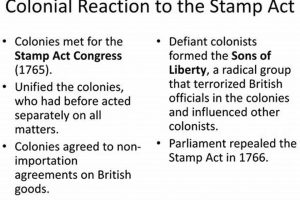
This parliamentary act ignited widespread colonial resistance. Colonists argued that taxation without representation in Parliament violated their fundamental rights. The resulting boycotts, protests, and formation of groups like the Sons of Liberty demonstrated the act’s galvanizing effect on colonial unity and dissent. These actions laid critical groundwork for the burgeoning movement towards independence, directly contributing to the escalating tensions that would culminate in the American Revolution. It serves as a case study in the consequences of perceived unjust governance and the power of collective action.
Exploring the specifics of this historical event, its ramifications, and the diverse colonial responses offers a valuable understanding of the forces that shaped the American Revolution. Further examination of the political climate, economic implications, and key figures involved provides a deeper comprehension of this pivotal era.
Understanding the Stamp Act of 1765
The following tips provide further insight into the Stamp Act, its impact, and historical significance.
Tip 1: Research primary sources. Examining original documents from the period, such as pamphlets, letters, and newspaper articles, offers invaluable firsthand perspectives on colonial reactions and the political climate.
Tip 2: Explore the economic impact. Analyze the act’s financial consequences on various colonial industries and its contribution to growing economic tensions between Great Britain and the colonies.
Tip 3: Consider the role of key figures. Research individuals like Samuel Adams, James Otis, and Patrick Henry to understand their influence on the resistance movement and the shaping of public opinion.
Tip 4: Study the legal arguments. Examining the legal basis for the Stamp Act and the colonists’ counterarguments provides insight into the evolving political philosophies of the time.
Tip 5: Compare and contrast with other acts. Analyzing the Stamp Act alongside other British legislation, such as the Townshend Acts, offers a broader understanding of escalating tensions leading to the Revolution.
Tip 6: Consider the long-term consequences. Explore how the colonial resistance to the Stamp Act contributed to the development of American identity and the eventual fight for independence.
Through these explorations, one can gain a deeper appreciation for the Stamp Act’s profound impact on American history and its role as a catalyst for revolution.
Further research and analysis will contribute to a comprehensive understanding of this crucial period.
1. 1765 Enactment

“1765 enactment” refers specifically to the year the Stamp Act became law. This precise dating provides crucial context for understanding the legislation within the broader historical narrative of growing tensions between Great Britain and its American colonies. The act’s implementation in 1765 followed the French and Indian War, during which Britain incurred significant debt. The British government’s attempt to recoup these costs through direct taxation of the colonies proved a miscalculation, igniting fervent opposition that escalated towards revolution. Pinpointing the year of enactment allows for a deeper examination of the political and economic climate of the time, illuminating the motivations and consequences surrounding the act.
Examining the 1765 enactment reveals the escalating nature of British control over the colonies. Prior to this period, colonial assemblies held significant power over internal affairs. The Stamp Act represented a shift towards more direct parliamentary control, encroaching upon established colonial autonomy. This infringement fueled colonial resentment and underscored the growing divide between the colonies and the mother country. Furthermore, the timing of the act is crucial. Coming on the heels of a costly war, it underscored for colonists the perceived exploitation by Britain, framing the tax not as a necessary measure but as an unjust burden. This perception further fueled resistance and solidified colonial unity against British policies.
Understanding the significance of “1765 enactment” offers a nuanced perspective on the Stamp Act’s impact. It allows for a deeper appreciation of the historical context, the escalating tensions, and the eventual eruption of the American Revolution. Further research into the sociopolitical climate of 1765 and the events immediately preceding and following the Stamp Act’s enactment provides invaluable insight into this pivotal period. This understanding allows for a more comprehensive analysis of the forces that shaped the American Revolution and its lasting impact on the development of the nation.
2. Taxation without representation

The phrase “taxation without representation” encapsulates the core grievance driving colonial resistance to the Stamp Act enacted in 1765. This concept became a rallying cry, articulating the colonists’ fundamental objection to British policies. Understanding this principle is essential to comprehending the escalating tensions that led to the American Revolution. The Stamp Act, by imposing taxes on the colonies without their consent or representation in Parliament, directly embodied this perceived injustice, fueling widespread resentment and organized opposition.
- Violation of fundamental rights
Colonists argued that being subjected to taxation without having elected representatives in the body imposing those taxes violated their fundamental rights as Englishmen. This principle, rooted in British common law and tradition, held that individuals should not be subjected to laws or taxes without the consent of their representatives. The Stamp Act’s disregard for this principle ignited outrage and fueled arguments for greater colonial autonomy. The denial of representation underscored the perceived second-class status of colonists and strengthened calls for self-governance.
- Economic burden
The Stamp Act placed a significant financial strain on colonial businesses, printers, and legal professionals. While the monetary burden itself was substantial, the greater issue lay in the perceived lack of control over colonial finances. The colonists viewed the tax as an exploitative measure imposed by a distant and unaccountable Parliament, exacerbating existing economic grievances. This financial burden, coupled with the lack of representation, further fueled resentment and resistance. The economic implications of the act demonstrated to colonists the tangible consequences of being governed without a voice.
- Catalyst for colonial unity
The shared grievance of “taxation without representation” fostered a sense of unity among the disparate colonies. The Stamp Act galvanized collective action, leading to the formation of organizations like the Sons of Liberty and widespread boycotts of British goods. This newfound sense of shared purpose laid the groundwork for future coordinated resistance against British policies. The act, in essence, inadvertently fostered the development of a cohesive American identity.
- Escalation towards revolution
The Stamp Act, and the principle of “taxation without representation” it embodied, became a major turning point on the path to revolution. The colonists’ steadfast resistance to this perceived injustice signaled their growing willingness to challenge British authority. The subsequent repeal of the Stamp Act, though a victory for the colonies, failed to address the underlying issue of representation, further contributing to the escalating tensions that ultimately led to the American Revolutionary War.
The Stamp Act’s embodiment of “taxation without representation” crystallized colonial grievances and fueled the growing movement towards independence. This principle became a central tenet of the American Revolution, underscoring the importance of self-governance and representative government in the formation of the new nation. The legacy of this principle continues to resonate in contemporary political discourse, highlighting the enduring significance of the Stamp Act in shaping American political thought.
3. Revenue for British crown

The Stamp Act, enacted in 1765, served primarily as a means to generate revenue for the British crown. Following the costly French and Indian War, the British government sought ways to replenish its depleted treasury and cover the ongoing expenses of maintaining a military presence in the American colonies. The act’s focus on revenue generation played a critical role in escalating tensions between Great Britain and the colonies, ultimately contributing to the outbreak of the American Revolution. Examining the financial motivations behind the act provides essential context for understanding colonial resistance and the broader historical narrative.
- Funding colonial defense
The British government argued that the revenue generated by the Stamp Act would be used to fund the defense of the American colonies. This justification, however, failed to resonate with colonists who questioned the necessity of a large standing army in peacetime and resented bearing the financial burden of its upkeep. Colonial assemblies had historically controlled their own finances and viewed the Stamp Act as an infringement on their autonomy. The perceived disconnect between the stated purpose of the act and the colonists’ actual needs further fueled resentment and resistance.
- Direct taxation versus indirect taxation
The Stamp Act represented a shift from indirect taxation, such as duties on imported goods, to direct internal taxation within the colonies. This change in policy had significant implications for colonial perceptions of British authority. Indirect taxes, while still unpopular, were less visible and less directly felt by the average colonist. Direct taxation, such as the stamp tax, brought the issue of British control into sharper focus, exacerbating existing tensions and increasing colonial resistance. The imposition of direct taxes further strengthened arguments for colonial representation in Parliament.
- Financial burden on colonists
The Stamp Act placed a financial burden on a wide range of colonists, from merchants and printers to legal professionals and ordinary citizens. The cost of the stamps, while not exorbitant, was significant enough to generate widespread discontent. The tax impacted various aspects of colonial life, from legal documents and newspapers to playing cards and dice, making its effects tangible for many colonists. This widespread impact contributed to the broad-based nature of the resistance movement.
- Perceived exploitation
The Stamp Act fueled colonial perceptions of exploitation by the British government. Colonists viewed the tax not as a necessary measure for their defense but as a means for Britain to extract revenue from them without their consent. This perception undermined trust in British authority and strengthened arguments for colonial self-governance. The act, in essence, became a symbol of British oppression and fueled the growing movement towards independence.
The revenue-generating purpose of the Stamp Act played a pivotal role in shaping colonial responses and the trajectory towards revolution. The act not only imposed a financial burden but also symbolized deeper issues of representation, autonomy, and the relationship between Great Britain and the colonies. Understanding the financial motivations behind the act provides critical context for interpreting its impact and the subsequent course of American history. The Stamp Act served as a catalyst, bringing long-simmering tensions to the forefront and accelerating the movement towards independence.
4. Colonial resistance ignited

The enactment of the Stamp Act in 1765 directly ignited widespread colonial resistance. This resistance, fueled by the principle of “taxation without representation,” manifested in various forms, from organized boycotts of British goods to public protests and acts of defiance. The Stamp Act served as a catalyst, uniting disparate colonies in opposition to British policies and laying the groundwork for the American Revolution. Understanding the causal relationship between the act’s enactment and the subsequent colonial resistance is crucial for comprehending the escalating tensions that ultimately led to the war for independence.
Several key examples illustrate the direct link between the Stamp Act and colonial resistance. The formation of groups like the Sons of Liberty provided a platform for organized opposition, coordinating boycotts and demonstrations against the act. Public protests, often involving burning effigies of stamp distributors, demonstrated the intensity of colonial anger and resentment. Furthermore, colonial assemblies passed resolutions condemning the act and asserting their right to self-governance. These actions, directly spurred by the Stamp Act’s implementation, demonstrated the growing colonial resolve to resist British policies perceived as unjust and oppressive. The act, intended to generate revenue, inadvertently fueled a movement that would ultimately challenge British rule itself.
The colonial resistance ignited by the Stamp Act represents a pivotal turning point in the relationship between Great Britain and the American colonies. This resistance, born from the principle of “taxation without representation,” laid the foundation for the American Revolution. While the Stamp Act itself was eventually repealed, the resistance it sparked had lasting consequences. It fostered a sense of colonial unity, strengthened arguments for self-governance, and ultimately contributed to the colonists’ willingness to fight for independence. Studying this period underscores the profound impact of seemingly minor legislation on the course of history and highlights the power of collective action in challenging perceived injustice. The legacy of the Stamp Act and the resistance it provoked continues to shape understandings of American political thought and the ongoing struggle for liberty and self-determination.
5. Precursor to Revolution

The Stamp Act, enacted in 1765, stands as a significant precursor to the American Revolution. While not the sole cause, it acted as a catalyst, accelerating existing tensions between Great Britain and the American colonies. Understanding the act’s role as a precursor requires examining its multifaceted impact on colonial society, politics, and economics. This exploration illuminates the act’s contribution to the growing discontent that ultimately culminated in the fight for independence.
- Escalation of Grievances
The Stamp Act exacerbated existing colonial grievances against British rule. Earlier measures, such as the Sugar Act, had already generated resentment, but the Stamp Act, with its direct taxation and perceived violation of colonial autonomy, significantly escalated tensions. It brought the issue of “taxation without representation” to the forefront, crystallizing colonial discontent and galvanizing resistance. The act demonstrated a pattern of British policies perceived as increasingly oppressive, pushing the colonies closer to open rebellion.
- Development of Colonial Unity
The Stamp Act fostered a sense of unity among the thirteen colonies. Faced with a common enemy, colonists from different regions and backgrounds found common ground in their opposition to the act. This shared grievance facilitated communication and collaboration, laying the groundwork for future coordinated resistance efforts. The Stamp Act Congress, convened in 1765, exemplifies this burgeoning intercolonial unity. The act, intended to assert British control, inadvertently strengthened the bonds among the colonies.
- Radicalization of Colonial Politics
The Stamp Act contributed to the radicalization of colonial politics. Groups like the Sons of Liberty, formed in response to the act, employed increasingly confrontational tactics, including protests, boycotts, and intimidation of stamp distributors. This radicalization shifted the political landscape, empowering more radical voices and challenging established colonial elites who favored a more conciliatory approach towards Great Britain. The act, therefore, played a key role in the rise of revolutionary sentiment.
- Erosion of Trust in British Authority
The Stamp Act significantly eroded colonial trust in British authority. The perceived injustice of the act, coupled with the heavy-handed response of the British government, fostered a sense of betrayal and disillusionment among colonists. This erosion of trust undermined the legitimacy of British rule and made the prospect of independence increasingly appealing. The act marked a critical turning point in the relationship between the colonies and the mother country, paving the way for the eventual break.
By examining these facets, the connection between the Stamp Act and the American Revolution becomes clear. The act’s enactment served as a critical turning point, accelerating pre-existing tensions, fostering colonial unity, radicalizing colonial politics, and eroding trust in British authority. While other factors contributed to the revolution, the Stamp Act’s role as a precursor remains undeniable. It exposed fundamental differences in political ideology and set in motion a chain of events that ultimately led to the colonies’ declaration of independence.
6. Repealed in 1766

The repeal of the Stamp Act in 1766 holds significant historical importance, directly linked to its enactment in 1765. While the act’s implementation ignited widespread colonial resistance, its repeal demonstrates the impact of that resistance and the complex relationship between Great Britain and the American colonies. The repeal, however, represents more than just a reversal of policy; it reveals the British government’s attempt to balance its financial needs with the growing unrest in the colonies. Furthermore, the repeal’s limitations underscore the underlying tensions that continued to escalate towards revolution.
Several factors contributed to the British government’s decision to repeal the Stamp Act. Colonial boycotts of British goods significantly impacted British merchants, who pressured Parliament for a change in policy. Simultaneously, colonial protests and acts of defiance demonstrated the intensity of colonial opposition, signaling the potential for further unrest. These combined pressures forced the British government to reconsider the act’s efficacy and the potential consequences of continued enforcement. The repeal, therefore, highlights the power of colonial resistance in influencing British policy, albeit temporarily. However, alongside the repeal came the Declaratory Act, asserting Parliament’s right to legislate for the colonies “in all cases whatsoever,” which ultimately failed to address the core colonial grievance of “taxation without representation.”
The repeal of the Stamp Act, while a victory for the colonies, did not resolve the fundamental issues driving the conflict. The underlying tensions surrounding representation and colonial autonomy remained unresolved, foreshadowing the continued escalation towards revolution. While the repeal offered a temporary reprieve, it ultimately failed to address the root causes of colonial discontent. The subsequent implementation of the Townshend Acts further exacerbated these tensions, demonstrating the limitations of the Stamp Act’s repeal in achieving lasting reconciliation between Great Britain and the American colonies. The repeal, therefore, serves as a crucial historical lesson in the complexities of political compromise and the enduring power of unresolved grievances. It underscores the importance of addressing underlying issues rather than simply reacting to surface-level pressures. The Stamp Act’s legacy, encompassing both its enactment and repeal, provides valuable insights into the forces that shaped the American Revolution.
Frequently Asked Questions
The following addresses common inquiries regarding the Stamp Act of 1765, aiming to provide concise and accurate information about this pivotal piece of legislation.
Question 1: What specific items were subject to the Stamp Act?
The Stamp Act mandated the use of embossed revenue stamps on various printed materials, including legal documents, newspapers, pamphlets, almanacs, playing cards, and dice. This broad application ensured the act touched nearly every facet of colonial life, impacting legal proceedings, commerce, and the dissemination of information.
Question 2: Why did the British Parliament enact the Stamp Act?
The primary motivation behind the Stamp Act was to generate revenue for the British crown following the financially draining French and Indian War. The British government sought to offset the costs of maintaining a military presence in the American colonies, leading to the decision to impose direct taxation.
Question 3: How did the colonists react to the Stamp Act?
Colonial reaction was swift and largely negative. Widespread protests, boycotts of British goods, and the formation of groups like the Sons of Liberty demonstrated the intensity of colonial opposition. The cry of “taxation without representation” encapsulated the core grievance, fueling resistance and laying the groundwork for future revolutionary action.
Question 4: What role did the Stamp Act play in the lead-up to the American Revolution?
The Stamp Act served as a significant catalyst in the escalating tensions between Great Britain and the American colonies. It crystallized colonial grievances regarding representation and self-governance, contributing to the growing movement towards independence. The act’s enactment and the subsequent colonial resistance marked a critical turning point on the path to revolution.
Question 5: Why was the Stamp Act eventually repealed?
Colonial boycotts significantly impacted British merchants, who pressured Parliament for repeal. Coupled with growing unrest in the colonies, these economic pressures led to the act’s revocation in 1766. However, the repeal was accompanied by the Declaratory Act, asserting Parliament’s continued right to legislate for the colonies, leaving the underlying issue of representation unresolved.
Question 6: What is the lasting legacy of the Stamp Act?
The Stamp Act’s legacy lies in its contribution to the development of American political thought and the eventual fight for independence. It highlighted the importance of representation, self-governance, and the dangers of unchecked authority. The act’s impact continues to resonate in contemporary discussions surrounding political rights and the relationship between government and its citizens.
Understanding the Stamp Act is crucial for comprehending the origins of the American Revolution. This brief overview provides a foundation for further exploration of this pivotal period in American history.
Further research and analysis will contribute to a more comprehensive understanding of this crucial era.
The Stamp Act
The 1765 enactment of the Stamp Act proved a pivotal moment in the relationship between Great Britain and the American colonies. This exploration has highlighted the act’s core components: its revenue-generating purpose for the British crown, the resulting cry of “taxation without representation,” and the widespread colonial resistance it ignited. The act’s subsequent repeal in 1766, while a temporary victory for the colonies, failed to address the underlying tensions surrounding representation and autonomy. This examination underscores the Stamp Act’s role as a significant precursor to the American Revolution, demonstrating how a seemingly minor piece of legislation can have profound and lasting consequences.
The Stamp Act serves as a potent reminder of the delicate balance between governance and individual liberties. Further exploration of this era remains crucial for understanding the forces that shaped the American Revolution and the enduring legacy of its ideals. The pursuit of self-governance and the fight against perceived injustice continue to resonate in contemporary political discourse, underscoring the enduring relevance of the Stamp Act’s historical significance. Continued study and reflection on this period offer valuable insights into the ongoing struggle for liberty and the pursuit of a more just and equitable future.