The British Parliament enacted legislation in 1765 requiring all printed materials in the American colonies, including legal documents, newspapers, pamphlets, and even playing cards, to carry a tax stamp. This tax was levied directly on the colonists, meaning it wasn’t a tax on trade between colonies and other nations. Purchased stamps demonstrated proof of payment.
This measure aimed to raise revenue to support the British military presence in North America following the French and Indian War (Seven Years’ War). The British government argued that the colonists benefited from the protection provided by British troops and should therefore contribute to their upkeep. However, the tax was met with widespread resistance in the colonies. Colonists viewed the tax as an infringement on their rights as British subjects since they lacked representation in Parliament. The cry of “No taxation without representation” encapsulated this resentment. This act played a critical role in the growing tension between Great Britain and its American colonies, significantly contributing to the events leading up to the American Revolution.
Further exploration can illuminate the specifics of colonial resistance, the economic impact of the legislation, and its place within the broader context of British imperial policy. Examination of key figures and events surrounding this historical period offers a deeper understanding of its lasting significance.
Tips for Understanding the Stamp Act
Gaining a deeper understanding of the Stamp Act requires exploring its multifaceted nature and the context surrounding its enactment. The following tips offer avenues for further research and reflection.
Tip 1: Explore primary sources. Examining original documents from the period, such as letters, pamphlets, and newspaper articles, offers direct insight into colonial reactions and perspectives on the tax.
Tip 2: Research the political climate in Great Britain. Understanding the financial pressures and political motivations of the British government helps explain the rationale behind the Stamp Act.
Tip 3: Investigate the colonial assemblies’ responses. The actions taken by colonial legislatures and the arguments they presented illustrate the organized resistance that emerged against the tax.
Tip 4: Consider the economic impact. Analyze how the Stamp Act affected different segments of colonial society, including merchants, printers, and ordinary citizens.
Tip 5: Study the Sons of Liberty and other protest groups. Understanding the role of these organizations reveals how popular resistance mobilized and gained momentum.
Tip 6: Compare and contrast the Stamp Act with other British revenue-raising measures. Analyzing acts like the Sugar Act and the Townshend Acts helps place the Stamp Act within a broader pattern of British imperial policy.
Tip 7: Examine the repeal of the Stamp Act. Understanding why the British government ultimately repealed the act provides crucial context for later developments leading to the American Revolution.
By exploring these areas, one can develop a more comprehensive understanding of the Stamp Act’s significance in the unfolding narrative of American history. This exploration allows for deeper appreciation of the complex interplay of political, economic, and social factors that shaped this pivotal era.
This examination sets the stage for a more nuanced understanding of the American Revolution and its lasting legacy.
1. Revenue Generation
A central objective of the Stamp Act was revenue generation for the British Crown. Following the costly French and Indian War, the British government sought ways to replenish its coffers and maintain a military presence in North America. The Stamp Act, a direct tax on the colonies, was intended to contribute to these financial needs. Understanding the revenue aspect of this act is crucial to grasping its larger historical context and its impact on the escalating tensions between Great Britain and the American colonies.
- Funding Imperial Administration
Revenue generated through the Stamp Act was intended to offset the costs of administering the colonies, including the salaries of officials, maintenance of infrastructure, and enforcement of laws. While the British government argued these costs benefited the colonists, the colonists themselves resented paying for administrative oversight they perceived as increasingly intrusive and heavy-handed.
- Maintaining a Standing Army
A significant portion of the anticipated revenue was earmarked for maintaining a standing army in North America. This military presence, justified by the British as necessary for colonial defense, particularly against Indigenous nations, was viewed by many colonists as a tool for suppressing dissent and enforcing unpopular policies. The quartering of troops in colonial homes further exacerbated resentment towards the Stamp Act and its associated costs.
- Offsetting War Debts
The British government accumulated substantial debt during the French and Indian War. The Stamp Act, alongside other revenue-generating measures, was implemented partly to alleviate this financial burden. The colonists, however, felt they were being unfairly burdened with paying for a war they believed benefited the empire as a whole, not just the colonies specifically.
- Direct Taxation vs. Mercantile Policy
The Stamp Act represented a shift from traditional mercantile policies, which focused on regulating trade, to a system of direct internal taxation. This departure was a key factor in colonial resistance. The colonists viewed direct taxation by Parliament, where they lacked representation, as an infringement on their rights as British subjects. This distinction further fueled the growing discontent and contributed to the burgeoning movement for colonial autonomy.
The Stamp Act’s focus on revenue generation proved to be a critical catalyst in the escalating tensions between Great Britain and its American colonies. The act not only highlighted differing views on financial responsibility but also brought into sharp focus fundamental disagreements about representation, colonial autonomy, and the very nature of the relationship between the colonies and the British Empire. The colonial outcry over the Stamp Act foreshadowed the larger conflict that would erupt just over a decade later.
2. Funding Military Presence
The Stamp Act of 1765 aimed, in part, to finance the British military presence in North America following the French and Indian War. This connection between funding the military and the act’s purpose is crucial to understanding the colonial reaction and the escalating tensions that led to the American Revolution. Examining the specific military needs and the colonial perspective on this funding provides further insight.
- Frontier Defense
Maintaining troops along the western frontier was deemed essential to protect colonists from potential conflicts with Indigenous nations and ensure stability in newly acquired territories. The British government argued that this defense directly benefited the colonists and justified their contribution through taxes like the Stamp Act. However, many colonists viewed the perceived threat as exaggerated and resented paying for a military presence they believed primarily served British imperial interests, not their own safety.
- Enforcement of British Policies
The presence of British troops also facilitated the enforcement of unpopular trade regulations and tax laws, including the Stamp Act itself. This enforcement role further fueled colonial resentment, as the military came to be seen as a tool of oppression rather than protection. The use of troops to quell protests and enforce tax collection contributed significantly to the growing animosity between the colonies and the British government.
- Cost of Maintaining Troops
The logistical and financial demands of supplying and quartering troops in the colonies were substantial. The Stamp Act was intended to alleviate these costs. However, the colonists argued that they should not bear the financial burden of a standing army during peacetime, especially without proper representation in Parliament. The forced quartering of soldiers in colonial homes, mandated by the Quartering Act, further exacerbated tensions and underscored the perceived injustice of the Stamp Act.
- Colonial Security Concerns
While the British government emphasized the protective role of the troops, some colonists viewed the substantial military presence as a potential threat to their own liberties. This perception contributed to the growing distrust of British intentions and fueled concerns about potential military overreach. The Stamp Act, seen as funding this potential threat, further solidified colonial resistance to British policies.
The Stamp Act’s purpose of funding the military presence in North America directly contributed to the escalating conflict between the colonies and Great Britain. The colonists’ perception of unfair taxation without representation, coupled with concerns about the role and cost of the military, fueled resistance and laid the groundwork for the American Revolution. The Stamp Act, therefore, serves as a critical example of how financial policies can have significant political and social consequences. Examining this aspect of the act reveals deeper insights into the complex dynamics that shaped this crucial period in American history.
3. Asserting Parliamentary Authority
The Stamp Act of 1765 served as a key instrument for the British Parliament to assert its authority over the American colonies. While ostensibly intended to raise revenue, the act’s deeper purpose lay in demonstrating Parliament’s power to legislate for the colonies in all cases whatsoever, as declared in the Declaratory Act of the same year. Understanding this assertion of authority is crucial to comprehending the colonial reaction and the subsequent escalation of tensions leading to the American Revolution.
- Direct Taxation as a Tool of Control
Implementing direct taxation, as opposed to previous forms of indirect taxation through trade regulations, represented a significant expansion of parliamentary power over colonial affairs. This new form of taxation directly impacted the colonists’ financial lives and served as a tangible assertion of Parliament’s right to levy taxes without colonial consent or representation. The Stamp Act’s direct nature underscored the assertion of authority in a way that previous trade regulations did not.
- Challenging Colonial Charters and Self-Governance
Colonial charters granted a degree of self-governance, including control over internal taxation. The Stamp Act directly challenged these established practices and asserted Parliament’s supremacy in legislative matters. This challenge to colonial autonomy fueled resistance, as colonists viewed the act as an infringement on their traditional rights and a violation of their charters.
- The Declaratory Act and the Supremacy of Parliament
Passed alongside the repeal of the Stamp Act, the Declaratory Act explicitly stated Parliament’s right to legislate for the colonies “in all cases whatsoever.” This act reinforced the message of parliamentary supremacy and clarified that the repeal of the Stamp Act was not a concession of principle but a pragmatic decision. The Declaratory Act emphasized that the core issue of parliamentary authority remained unresolved.
- Implications for Future Legislation
The assertion of parliamentary authority through the Stamp Act set a precedent for future legislative attempts to control the colonies, such as the Townshend Acts. These subsequent acts further exacerbated tensions and demonstrated that the underlying conflict over parliamentary authority remained a central point of contention between Great Britain and the American colonies. The Stamp Act, therefore, foreshadowed the continued struggle over colonial autonomy and parliamentary control that ultimately led to the American Revolution.
The Stamp Act’s significance extends beyond its revenue-raising purpose. Its assertion of parliamentary authority over the colonies ignited widespread resistance and fundamentally altered the relationship between Great Britain and its American colonies. This assertion of power, coupled with the colonial response, played a pivotal role in setting the stage for the American Revolution and the eventual birth of a new nation founded on principles of self-governance and representation.
4. Controlling Colonial Printing
The Stamp Act of 1765, while presented as a revenue-raising measure, also served as a mechanism for controlling colonial printing. By requiring a tax stamp on all printed materials, including newspapers, pamphlets, legal documents, and even playing cards, the British government aimed to limit the dissemination of dissenting opinions and maintain greater control over public discourse in the colonies. This aspect of the act played a significant role in escalating tensions and fueling the movement toward revolution.
The colonial press played a crucial role in shaping public opinion and mobilizing resistance against British policies. Newspapers and pamphlets served as platforms for critical discussion and the dissemination of revolutionary ideas. By imposing a tax on printed materials, the British government sought to curtail this influential medium. The cost of the stamp duty made printing more expensive, potentially limiting the circulation of newspapers and pamphlets critical of British rule. This financial burden disproportionately affected printers and publishers, who often voiced dissenting opinions. Real-life examples include prominent colonial newspapers like the Boston Gazette and the Pennsylvania Journal, which frequently published articles challenging British policies. The Stamp Act directly impacted their operations and their ability to disseminate information. Additionally, the act required legal documents to bear stamps, adding a financial burden to legal proceedings and potentially discouraging colonists from seeking legal redress against British actions.
Understanding the connection between the Stamp Act and the control of colonial printing offers critical insight into the broader context of the American Revolution. The act demonstrates how attempts to control information and suppress dissent can backfire, fueling further resistance and ultimately contributing to the very outcome it sought to prevent. The financial burden imposed on printers and the chilling effect on free expression galvanized colonial opposition, highlighting the importance of a free press in a democratic society. This attempt to control information flow, rather than generating revenue, proved to be a significant miscalculation on the part of the British government and played a crucial role in the escalating conflict that led to the American Revolution. This historical example serves as a potent reminder of the importance of a free press and the dangers of attempting to control the flow of information.
5. Consolidating Imperial Control
The Stamp Act of 1765, while designed to generate revenue, also served as a critical tool for consolidating British imperial control over the American colonies. This act represented a significant shift in British policy, moving from a system of relatively loose regulation to a more direct and assertive form of governance. Examining the specific ways in which the Stamp Act aimed to consolidate imperial control is essential to understanding its role in the escalating tensions that led to the American Revolution.
- Centralized Administration
The Stamp Act facilitated a more centralized administration of the colonies. By requiring all printed materials to bear a tax stamp purchased from British-appointed officials, the act created a new administrative apparatus that extended British authority more directly into colonial life. This centralized system allowed for greater oversight of colonial activities and represented a departure from the previous system of decentralized colonial governance. The establishment of stamp distributors and the enforcement mechanisms necessary to collect the tax strengthened the British administrative presence throughout the colonies.
- Reducing Colonial Autonomy
The act directly challenged existing colonial charters and legislative practices, reducing colonial autonomy. Colonial assemblies had historically exercised significant control over their internal affairs, including taxation. The Stamp Act bypassed these established structures, asserting Parliament’s supreme authority to levy taxes. This infringement on colonial self-governance fueled resentment and contributed to the growing perception that the British government aimed to exert greater control over colonial affairs, disregarding established colonial practices and traditions.
- Suppression of Dissent
By taxing newspapers and pamphlets, the Stamp Act aimed to control the flow of information and suppress dissenting voices. The increased cost of printing could potentially limit the circulation of publications critical of British policies, hindering the ability of colonists to organize and express opposition. This attempt to control public discourse further inflamed colonial resistance, solidifying the perception of the Stamp Act as a tool of oppression rather than a legitimate revenue measure. The act’s impact on the colonial press served to galvanize opposition and unite diverse factions against a common perceived threat.
- Projecting Power and Authority
The very act of imposing a direct tax on the colonies, coupled with the enforcement mechanisms put in place, served as a powerful symbol of British authority. The presence of stamp distributors and the potential for legal penalties for non-compliance projected an image of British power and control. This demonstration of authority, however, backfired, fueling colonial resistance and pushing the colonies closer to open rebellion. The Stamp Act, meant to reinforce British control, inadvertently became a symbol of oppression and a catalyst for the movement toward independence.
The Stamp Act’s role in consolidating imperial control significantly contributed to the escalating tensions between Great Britain and the American colonies. While the British government intended the act to strengthen its authority and generate revenue, it ultimately fueled colonial resistance and laid the groundwork for the American Revolution. The act’s unintended consequences underscore the complex interplay of political, economic, and social factors that shaped this pivotal period in American history. By examining the act’s multiple purposes, including its role in consolidating imperial control, one gains a deeper appreciation for the forces that drove the colonies toward independence and the birth of a new nation.
Frequently Asked Questions about the Stamp Act
This section addresses common inquiries regarding the Stamp Act’s purpose and its implications.
Question 1: Why did the British government implement the Stamp Act?
The primary motivation was to generate revenue to offset the costs of maintaining a military presence in North America following the French and Indian War. The British government also aimed to assert Parliamentary authority over the colonies.
Question 2: What types of items were subject to the stamp tax?
The tax applied to a wide range of printed materials, including legal documents, newspapers, pamphlets, playing cards, and various commercial papers. This broad application ensured the tax touched nearly every aspect of colonial life.
Question 3: How did the colonists react to the Stamp Act?
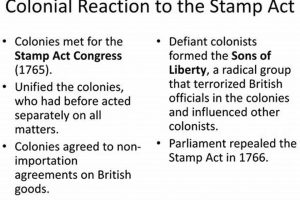
The act was met with widespread resistance, including boycotts of British goods, protests, and the formation of groups like the Sons of Liberty. Colonists argued that the tax violated their rights as British subjects since they lacked representation in Parliament.
Question 4: What was the “No Taxation Without Representation” cry about?
This slogan encapsulated the colonists’ core grievance. They argued that being taxed by Parliament without elected representatives violated their fundamental rights as Englishmen. This principle became a cornerstone of the American Revolution.
Question 5: Why was the Stamp Act eventually repealed?
Colonial resistance, including boycotts that harmed British merchants, pressured Parliament to repeal the act in 1766. However, the repeal was accompanied by the Declaratory Act, asserting Parliament’s right to legislate for the colonies “in all cases whatsoever.”
Question 6: What is the lasting significance of the Stamp Act?
The Stamp Act is considered a pivotal event leading up to the American Revolution. It crystallized colonial grievances about taxation and representation, intensifying the conflict between Great Britain and its American colonies and laying the groundwork for future resistance to British policies.
Understanding the Stamp Act is essential for comprehending the origins of the American Revolution. Further research into primary sources and historical analyses provides a more nuanced understanding of this pivotal period.
Exploring the broader context of British imperial policies and colonial responses offers further insight into the events that shaped the American Revolution.
The Stamp Act
The Stamp Act of 1765, enacted to generate revenue for the British Crown following the French and Indian War, became a pivotal point in the relationship between Great Britain and its American colonies. While intended to fund the British military presence in North America and assert parliamentary authority, the act ignited widespread colonial resistance. The tax on printed materials, seen as a direct infringement on colonial rights and autonomy, fueled protests and boycotts. The cry of “No Taxation Without Representation” encapsulated the colonists’ central grievance, highlighting the fundamental disagreement over representation and governance that lay at the heart of the escalating conflict. The act’s impact extended beyond its financial implications, serving as a catalyst for the growing movement toward independence.
The Stamp Act serves as a powerful reminder of the unintended consequences of political decisions and the importance of understanding historical context. Further exploration of this period, including the perspectives of both British policymakers and colonial resistors, offers valuable insights into the complexities of power, governance, and the pursuit of liberty. The legacy of the Stamp Act resonates far beyond its eventual repeal, shaping the course of American history and contributing to the foundational principles upon which the United States was built.