The 1765 enactment by the British Parliament imposed a tax on all printed materials in the American colonies, including legal documents, newspapers, pamphlets, and playing cards. These materials were required to bear an embossed revenue stamp, purchased from authorized distributors, as proof of payment. This act aimed to raise revenue for the British Empire following the costly French and Indian War, with the funds designated to support the ongoing presence of British troops in the colonies.
This legislation is considered a pivotal event leading up to the American Revolution. It sparked widespread colonial resistance, fueled by the perception of “taxation without representation” as colonists lacked elected representation in the British Parliament. The resulting protests, boycotts, and formation of groups like the Sons of Liberty demonstrated the growing discontent and solidified colonial unity against British policies. The act underscored fundamental disagreements about governance and representation, contributing significantly to the escalating tensions between Great Britain and its American colonies.
Further exploration of this period will reveal the complexities of colonial resistance, the economic and political implications of British policies, and the eventual path to American independence. Topics to consider include the Stamp Act Congress, the role of key figures such as Samuel Adams and Patrick Henry, and the subsequent repeal of the act in 1766.
Tips for Understanding the Stamp Act of 1765
Gaining a comprehensive understanding of the Stamp Act requires examining its various facets and its impact on colonial America. The following tips offer guidance for a more thorough exploration.
Tip 1: Contextualize the Act: Examine the financial pressures on the British Empire following the French and Indian War. Understanding the need to fund a standing army in the colonies illuminates the British rationale behind the act.
Tip 2: Explore Colonial Grievances: Focus on the concept of “taxation without representation,” the central grievance driving colonial resistance. Analyze why colonists felt unjustly burdened by a Parliament in which they lacked a voice.
Tip 3: Investigate Forms of Resistance: Research the diverse methods of colonial resistance, from organized boycotts of British goods to the more radical actions of groups like the Sons of Liberty. Consider the effectiveness of each approach.
Tip 4: Analyze the Stamp Act Congress: Study the significance of the Stamp Act Congress as an early example of colonial unity. Explore the resolutions and petitions drafted by this assembly and their impact on the British government.
Tip 5: Consider the Act’s Repeal: Examine the factors that led to the repeal of the Stamp Act in 1766, including colonial resistance and pressure from British merchants affected by the boycotts. Recognize that the repeal did not resolve the underlying tensions.
Tip 6: Study Key Figures: Research individuals like Samuel Adams, Patrick Henry, and Benjamin Franklin, examining their roles in opposing the Stamp Act and shaping colonial public opinion.
By considering these points, one can develop a deeper appreciation for the Stamp Act’s significance as a catalyst for the American Revolution. This historical event provides valuable insights into the complexities of colonial governance, the development of American identity, and the enduring principles of representative government.
Further research into the events surrounding the Stamp Act will provide an even richer understanding of this pivotal era in American history.
1. Taxation of Printed Materials
The taxation of printed materials formed the core of the Stamp Act of 1765. This tax targeted a broad range of items essential to colonial life, including newspapers, pamphlets, legal documents, licenses, and even playing cards. Each of these items required an embossed revenue stamp, purchased from designated distributors, as proof of payment. This comprehensive approach ensured that the tax touched nearly every aspect of colonial commerce and legal proceedings, maximizing revenue generation for the British Crown. The specific targeting of printed materials is significant because these items played a crucial role in disseminating information and facilitating political discourse in the colonies. By taxing these materials, the British government not only aimed to raise revenue but also exerted control over the flow of information and potentially stifled dissent.
Examples of the tax’s impact are abundant. Newspapers, vital for spreading news and opinions, faced increased production costs, potentially limiting their reach and influence. Legal documents, essential for commerce and land ownership, became more expensive, adding a financial burden to everyday transactions. The tax on pamphlets, frequently used to disseminate political ideas, directly impacted the ability of colonists to share and discuss their grievances against British policies. This aspect of the Stamp Act ignited particular resentment as it was perceived as a direct attempt to suppress colonial political expression. The broad scope of the tax, affecting everything from commercial transactions to personal correspondence, ensured widespread impact and contributed to the unified colonial resistance that followed.
Understanding the central role of the taxation of printed materials in the Stamp Act provides critical insight into the escalating tensions between Great Britain and its American colonies. The tax was not merely a revenue-generating measure; it represented a direct challenge to colonial autonomy and freedom of expression. The resulting resistance, fueled by the perception of unjust taxation and the infringement on fundamental rights, became a pivotal moment in the journey toward American independence. Studying this aspect of the Stamp Act underscores the importance of access to information and the power of a free press in a democratic society. It also highlights how seemingly small economic measures can have profound political and social consequences.
2. Revenue for British Crown
The Stamp Act of 1765 served primarily as a revenue-generating measure for the British Crown. Following the costly French and Indian War, the British treasury faced significant debt, and maintaining a standing army in the American colonies required substantial funding. The act aimed to directly address these financial pressures by imposing a tax on the colonies, a move that ultimately ignited widespread colonial resistance and fueled the growing tensions between Britain and its American subjects.
- Funding the British Military Presence in the Colonies
A significant portion of the revenue generated by the Stamp Act was intended to support the British military presence in North America. This included the cost of maintaining troops, fortifications, and supplies. The British government argued that this military presence provided essential protection for the colonies against potential threats from Native American tribes and European rivals. However, colonists questioned the necessity of such a large standing army during peacetime and resented bearing the financial burden of its upkeep, especially without direct representation in the British Parliament.
- Offsetting War Debt
The Seven Years’ War, also known as the French and Indian War in North America, placed a considerable strain on British finances. The Stamp Act aimed to alleviate some of this financial pressure by drawing revenue directly from the colonies. While the British government viewed this as a reasonable measure, colonists argued that they had already contributed significantly to the war effort and should not be subjected to additional taxes without their consent. This disagreement over financial responsibility further exacerbated the growing divide between Britain and the colonies.
- Centralized Control over Colonial Finances
The Stamp Act represented an attempt by the British government to exert greater control over colonial finances. Previously, colonial assemblies had enjoyed a degree of autonomy in managing their own revenue. The Stamp Act, imposed directly by Parliament, bypassed these local assemblies and signaled a shift towards more centralized control, a development that colonists viewed as a threat to their self-governance and a violation of their traditional rights.
- The Issue of “Taxation Without Representation”
The cry of “No taxation without representation” encapsulated the core colonial grievance against the Stamp Act. Colonists argued that being taxed by a Parliament in which they lacked elected representation was a violation of their fundamental rights as British subjects. They insisted that only their own elected assemblies had the authority to levy taxes. This fundamental disagreement over representation and the power of taxation fueled widespread resistance to the Stamp Act and laid the groundwork for the future struggle for independence.
The Stamp Act’s focus on generating revenue for the British Crown, while intended to address pressing financial needs, ultimately backfired by exacerbating existing tensions with the American colonies. The act’s implications extended far beyond mere financial matters; it touched upon fundamental issues of representation, self-governance, and the relationship between Britain and its colonies. The colonial resistance that followed the implementation of the Stamp Act demonstrated the depth of colonial discontent and served as a critical turning point in the events leading up to the American Revolution.
3. Colonial Resistance Ignited
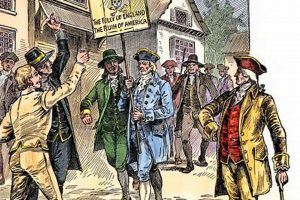
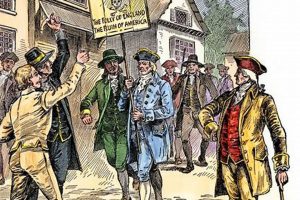
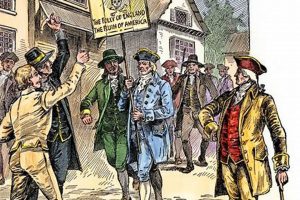
The Stamp Act of 1765 proved to be a catalyst for widespread colonial resistance, marking a critical turning point in the relationship between Great Britain and its American colonies. The act, which imposed a tax on all printed materials, ignited a firestorm of protest across the colonies. This resistance stemmed not solely from the financial burden of the tax itself, but more significantly from the perceived violation of fundamental rights and principles of self-governance. The colonists viewed the act as an instance of “taxation without representation,” arguing that they should not be subjected to taxes imposed by a Parliament in which they lacked elected representatives. This core grievance fueled a range of responses, from organized boycotts of British goods to more radical actions undertaken by groups like the Sons of Liberty.
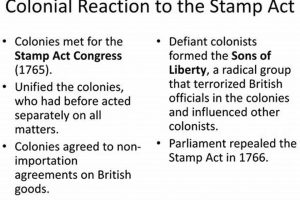
The forms of resistance varied across the colonies. Organized boycotts, spearheaded by colonial merchants, proved particularly effective in applying economic pressure on British businesses. These boycotts disrupted trade and contributed to the eventual repeal of the Stamp Act. Simultaneously, public demonstrations, often involving burning effigies of British officials, expressed popular discontent and served as a powerful form of symbolic protest. The Sons of Liberty, a more radical organization, engaged in direct action, including intimidation of tax collectors and destruction of stamped paper. The Stamp Act Congress, convened in October 1765, represented a unified colonial response, demonstrating a growing sense of collective identity and shared grievances against British policies. The resolutions drafted by the Congress articulated colonial objections to the act and asserted the principle of “no taxation without representation,” further galvanizing resistance.
The colonial resistance sparked by the Stamp Act demonstrated a deep-seated resentment of British policies perceived as unjust and infringing upon colonial autonomy. While the act itself was eventually repealed in 1766 due to a combination of colonial pressure and economic considerations within Great Britain, the resistance it ignited had lasting consequences. The Stamp Act crisis fostered a sense of unity among the colonies, established important precedents for future resistance, and fundamentally altered the relationship between Great Britain and its American subjects. The act’s legacy extends beyond its repeal; it solidified colonial opposition to British policies and laid the groundwork for the eventual struggle for independence. The experience of resisting the Stamp Act provided valuable lessons in organizing collective action, articulating grievances, and challenging perceived injustices, lessons that would prove essential in the years leading up to the American Revolution.
4. "No Taxation Without Representation"
The Stamp Act of 1765 is inextricably linked to the rallying cry of “No taxation without representation.” This powerful slogan encapsulated the core colonial grievance against British policies and became a central theme of the escalating tensions leading to the American Revolution. The act’s imposition of a tax on all printed materials without colonial consent, in the eyes of the colonists, violated fundamental rights as British subjects. The absence of colonial representation in the British Parliament meant that colonists had no voice in the decisions regarding taxation, a principle considered essential to liberty and self-governance. Exploring the facets of “No taxation without representation” reveals its profound impact on colonial resistance and its role in shaping the course of American history.
- Violation of Fundamental Rights
Colonists viewed the Stamp Act as a direct violation of their rights as British subjects. They argued that the right to be taxed only by one’s own elected representatives was a cornerstone of British liberty. The act’s imposition without colonial consent represented a breach of this fundamental right, fueling resentment and solidifying resistance. This principle drew upon historical precedents and legal traditions that emphasized the importance of consent in matters of taxation.
- Principle of Self-Governance
Colonial assemblies had historically exercised a degree of autonomy in managing their own affairs, including taxation. The Stamp Act, imposed directly by the British Parliament, circumvented these established practices and challenged the principle of colonial self-governance. Colonists perceived this as a deliberate attempt to undermine their autonomy and exert greater control over colonial affairs, further fueling discontent and resistance. The act’s implications extended beyond mere taxation, raising fundamental questions about the balance of power between the British government and its colonies.
- Unification of Colonial Grievances
“No taxation without representation” served as a unifying cry, bringing together diverse colonies with shared grievances against British policies. While individual colonies had previously expressed discontent with specific measures, the Stamp Act and the principle it violated provided a common cause, fostering a sense of collective identity and shared purpose. This newfound unity strengthened colonial resistance and laid the foundation for future coordinated action against British rule.
- Catalyst for Resistance
The slogan “No taxation without representation” became a powerful mobilizing force, inspiring various forms of resistance against the Stamp Act. It provided a clear and concise articulation of colonial grievances, resonating with a broad spectrum of colonial society. From organized boycotts to public demonstrations and the formation of groups like the Sons of Liberty, the principle of “No taxation without representation” fueled and legitimized colonial resistance, ultimately contributing to the act’s repeal.
The principle of “No taxation without representation” played a pivotal role in shaping the colonial response to the Stamp Act of 1765. This powerful slogan encapsulated fundamental colonial grievances regarding rights, representation, and self-governance. The act’s violation of this principle ignited widespread resistance, marking a critical turning point in the relationship between Great Britain and its American colonies. The legacy of “No taxation without representation” extends far beyond the Stamp Act itself, resonating through the American Revolution and shaping the very foundations of American political thought.
5. Precursor to Revolution
The Stamp Act of 1765 stands as a significant precursor to the American Revolution. While not the sole cause, it acted as a catalyst, exacerbating existing tensions between Great Britain and its American colonies. The acts core tenetstaxation without representation, perceived infringement on colonial autonomy, and the subsequent widespread resistancelaid critical groundwork for the revolution that would follow. Examining the causal link between the Stamp Act and the revolution reveals its profound impact on the course of American history. The acts immediate consequence was widespread colonial resistance, manifested through boycotts of British goods, public demonstrations, and the formation of protest groups like the Sons of Liberty. These actions demonstrated a growing colonial unity and resolve against perceived British oppression.
The Stamp Act Congress, convened in 1765, represents a tangible example of this burgeoning unity. Representatives from nine colonies met to formally denounce the act and assert their rights as British subjects. This collective action served as an important precedent for future intercolonial cooperation and laid the foundation for the Continental Congresses that would later coordinate the revolution. The act’s economic impact also played a significant role. The boycotts of British goods, coupled with petitions and protests, placed substantial pressure on British merchants and Parliament. This economic pressure contributed to the eventual repeal of the Stamp Act in 1766, a victory for the colonies, but one that failed to address the underlying issue of representation and colonial autonomy. The repeal, while celebrated, did not quell the growing discontent; rather, it emboldened colonial resistance and established a precedent for challenging future British policies.
Understanding the Stamp Act as a precursor to revolution requires recognizing the shift in colonial perspectives it engendered. The act crystallized colonial grievances, transforming what had been localized disputes into a unified movement against perceived British tyranny. This shift in perspective, fueled by principles of liberty and self-governance, proved essential in mobilizing support for the revolution. While other factors, such as subsequent British policies like the Townshend Acts and the Intolerable Acts, further fueled the flames of rebellion, the Stamp Act holds a distinct place as an early catalyst. It provided a crucial training ground for colonial resistance, fostering unity, developing strategies of protest, and ultimately shaping the ideological foundations of the American Revolution. The legacy of the Stamp Act serves as a potent reminder of how seemingly minor legislative acts can have far-reaching and unintended consequences, ultimately reshaping the political landscape and setting the stage for profound historical change.
6. Repealed in 1766
The repeal of the Stamp Act in 1766 represents a crucial turning point in the escalating tensions between Great Britain and its American colonies. While the act itself lasted a mere 14 months, its impact proved profound, igniting widespread colonial resistance and solidifying opposition to British policies perceived as unjust. Examining the repeal and its surrounding circumstances provides critical insight into the dynamics that ultimately led to the American Revolution. The repeal demonstrates the power of unified colonial resistance and the economic pressures faced by Great Britain. However, it also reveals the underlying unresolved issues of representation and colonial autonomy that continued to fuel discontent and ultimately contributed to the outbreak of war.
- Economic Pressures and the British Mercantile System
Colonial boycotts of British goods played a significant role in the decision to repeal the Stamp Act. These boycotts, organized by colonial merchants and supported by a broad segment of the population, disrupted transatlantic trade and negatively impacted British merchants. These merchants, facing financial losses, exerted pressure on Parliament to repeal the act, demonstrating the influence of economic interests in shaping British policy. This pressure revealed vulnerabilities within the British mercantile system and highlighted the colonies’ growing economic power.
- Parliamentary Debates and Shifting Public Opinion
The repeal of the Stamp Act was not without its detractors within the British government. Parliamentary debates surrounding the repeal revealed divisions within British political circles regarding colonial policy. Arguments for and against repeal focused on issues of sovereignty, economic consequences, and the potential for future colonial unrest. These debates reflect the complexities of the situation and the challenges faced by the British government in balancing imperial control with colonial demands.
- Declaratory Act and the Assertion of Parliamentary Supremacy
Simultaneous with the repeal of the Stamp Act, the British Parliament passed the Declaratory Act. This act asserted Parliament’s absolute authority to legislate for the colonies “in all cases whatsoever.” While seemingly contradictory to the repeal, the Declaratory Act aimed to reassert British sovereignty and counter the growing colonial assertiveness. This act served as a clear message that while Parliament may have conceded on the Stamp Act, it maintained ultimate control over colonial affairs. This assertion of parliamentary supremacy did little to quell colonial discontent and foreshadowed future conflicts over colonial autonomy.
- A Temporary Reprieve, Not a Resolution
The repeal of the Stamp Act offered a temporary reprieve, but it failed to address the fundamental issues fueling colonial resistance. The underlying tension regarding representation and colonial self-governance remained unresolved. The colonists celebrated the repeal as a victory, demonstrating their ability to effectively challenge British policies, but the underlying resentment continued to simmer. This temporary reprieve merely postponed the inevitable confrontation, setting the stage for future conflicts over British policies and ultimately contributing to the outbreak of the American Revolution.
The repeal of the Stamp Act in 1766, while a significant event, represents more of a pause than a resolution in the growing conflict between Great Britain and its American colonies. The repeal underscores the complexities of the relationship, highlighting the economic pressures, political maneuvering, and unresolved issues that ultimately led to the American Revolution. While the repeal itself demonstrated the power of colonial resistance, the simultaneous passage of the Declaratory Act underscored the British government’s determination to maintain control over its colonies. This combination of concession and reassertion of power set the stage for future conflict, highlighting the deep-seated tensions that would ultimately erupt into revolution.
7. Lasting Impact on Colonies
While repealed just a year after its enactment, the Stamp Act of 1765 exerted a lasting impact on the American colonies, significantly shaping their relationship with Great Britain and contributing to the growing movement toward independence. The act’s legacy extends beyond the immediate protests and boycotts it engendered, profoundly influencing colonial political thought, intercolonial unity, and the development of strategies for resisting perceived British oppression. Exploring the multifaceted impact of the Stamp Act reveals its crucial role in the events leading up to the American Revolution.
- Heightened Colonial Unity and Political Awareness
The Stamp Act fostered a sense of shared grievance and purpose among the colonies. Faced with a common threat, colonists from diverse backgrounds and regions united in opposition to the act. This newfound unity manifested in the Stamp Act Congress, where representatives from different colonies convened to coordinate resistance. The act also elevated political awareness among colonists, sparking discussions about rights, representation, and the nature of British rule. This heightened political consciousness proved crucial in mobilizing support for future resistance efforts.
- Development of Resistance Strategies and Tactics
The resistance to the Stamp Act provided valuable experience in organizing collective action. Colonists experimented with various tactics, including boycotts, petitions, public demonstrations, and the formation of groups like the Sons of Liberty. These experiences proved invaluable in later resistance movements against British policies, providing a foundation for the organized and effective resistance that characterized the American Revolution. The Stamp Act effectively served as a training ground for future revolutionary leaders and activists.
- Erosion of Trust in British Governance
The Stamp Act severely damaged colonial trust in the British government. The act, perceived as a violation of fundamental rights and an affront to colonial autonomy, fueled skepticism about British intentions and the fairness of British rule. This erosion of trust created a growing divide between the colonies and the mother country, making reconciliation increasingly difficult and paving the way for more radical calls for independence.
- Solidification of Core Revolutionary Ideals
The principles of “no taxation without representation” and the right to self-governance, central to colonial resistance against the Stamp Act, became core tenets of the American Revolution. The act solidified these ideals within the colonial consciousness, providing a powerful ideological framework for justifying resistance and ultimately, independence. The Stamp Act’s legacy thus extends beyond the immediate political and economic consequences, shaping the very philosophical foundations of the American nation.
The Stamp Act, while short-lived, left an indelible mark on the American colonies. Its impact extended far beyond the immediate crisis, contributing to the growing rift between Great Britain and its American subjects. By fostering colonial unity, developing resistance strategies, eroding trust in British rule, and solidifying core revolutionary ideals, the Stamp Act played a crucial role in shaping the events that ultimately led to the American Revolution. Examining the act’s lasting impact provides critical insight into the complexities of the era and the factors that propelled the colonies toward independence.
Frequently Asked Questions about the Stamp Act of 1765
The following addresses common inquiries regarding the Stamp Act, providing concise yet comprehensive answers to facilitate a deeper understanding of this pivotal historical event.
Question 1: What specific items were taxed under the Stamp Act?
The Stamp Act mandated a tax on a wide array of printed materials used in the colonies, encompassing legal documents (contracts, wills, licenses), newspapers, pamphlets, almanacs, playing cards, and even dice.
Question 2: Why did the British government implement the Stamp Act?
The primary motivation was financial. The British government sought to alleviate war debts incurred during the French and Indian War and to fund the continued presence of British troops in the American colonies.
Question 3: How did the colonists react to the Stamp Act?
The act sparked widespread resistance, manifested through boycotts of British goods, public protests, formation of groups like the Sons of Liberty, and the convening of the Stamp Act Congress.
Question 4: What is the significance of “No taxation without representation”?
This slogan encapsulated the core colonial grievance. Colonists argued that being taxed by a Parliament in which they lacked elected representation violated their fundamental rights as British subjects.
Question 5: Why was the Stamp Act eventually repealed?
Colonial resistance, particularly the effective boycotts of British goods, coupled with pressure from British merchants experiencing financial losses, led to the act’s repeal in 1766.
Question 6: What is the lasting legacy of the Stamp Act?
Despite its repeal, the Stamp Act fostered colonial unity, developed resistance strategies, and solidified core revolutionary ideals, ultimately contributing to the movement toward American independence. It highlighted the fundamental disagreements about representation and governance that would eventually lead to the American Revolution.
The Stamp Act serves as a crucial case study in the dynamics of colonial resistance and the escalating tensions that culminated in the American Revolution. Further exploration of this period reveals the complex interplay of economic interests, political ideals, and historical circumstances that shaped the course of American history.
Continue exploring the impact of the Stamp Act by examining its connection to other key events of the era, such as the Townshend Acts and the Boston Tea Party, to gain a more comprehensive understanding of the path to American independence.
The Stamp Act of 1765
Examination of the 1765 Stamp Act reveals its significance as a pivotal event in the prelude to the American Revolution. Imposing a tax on printed materials within the American colonies ignited widespread resistance fueled by the principle of “no taxation without representation.” This resistance, manifested through boycotts, protests, and the formation of unified political bodies like the Stamp Act Congress, demonstrated the growing discontent with British rule and the burgeoning sense of colonial identity. While the act’s repeal in 1766 offered a temporary reprieve, the underlying tensions regarding representation and colonial autonomy remained unresolved. The experience of resisting the Stamp Act solidified colonial resolve, fostered intercolonial unity, and developed strategies for future resistance, ultimately laying the groundwork for the struggle for independence.
The Stamp Act’s legacy extends far beyond its brief existence. It serves as a potent reminder of the profound consequences of seemingly minor legislative acts and the power of collective action in challenging perceived injustice. The act’s emphasis on principles of representation and self-governance continues to resonate within contemporary political discourse, underscoring its enduring relevance in shaping the course of American history and the very foundations of American political thought. Further exploration of this era provides valuable insights into the complexities of colonial governance, the development of American identity, and the enduring struggle for liberty and self-determination.