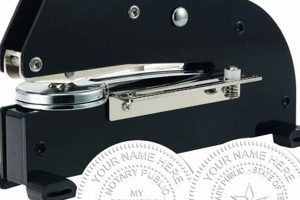
A notary public requires an official seal, often an embosser or a rubber stamp, to authenticate official acts. This tool creates a unique, identifiable impression on documents, signifying the notary’s involvement and validating the act’s legality. An example would be the imprint left on a signed affidavit, verifying the signer’s identity and sworn statement.
The official seal plays a crucial role in deterring fraud and ensuring document authenticity. Its use provides an added layer of security and legality to notarial acts, protecting the involved parties and maintaining public trust. Historically, seals have served as symbols of authority and validation, evolving from wax seals to the modern embossers and stamps we see today. Their continued use reflects the ongoing need for secure and verifiable documentation in various legal and business transactions.
Obtaining this essential tool varies by jurisdiction and often involves specific procedures through authorized vendors or government agencies. The following sections will explore the acquisition process in detail, covering common requirements, available options, and relevant regulations.
Tips for Obtaining a Notary Seal
Acquiring a notary seal requires careful consideration and adherence to specific regulations. The following tips provide guidance for this process.
Tip 1: Research State-Specific Requirements: Regulations governing notary seals vary significantly. Begin by contacting the commissioning authority within one’s jurisdiction (often the Secretary of State’s office) to determine precise requirements for seal type, permitted vendors, and necessary documentation.
Tip 2: Choose the Correct Seal Type: Seals typically include embossers, rubber stamps, or in some cases, electronic seals. Ensure the chosen type complies with jurisdictional mandates. Embossers create a raised impression, while rubber stamps require an ink pad. Electronic seals are increasingly common, particularly for digitally signed documents.
Tip 3: Select a Reputable Vendor: Authorized vendors specialize in providing official notary supplies. Verify vendor legitimacy through the commissioning authority to ensure the seal meets all legal requirements. Comparison shopping can reveal differences in price and quality.
Tip 4: Provide Accurate Information: Ordering a seal requires providing precise details such as the commissioned name, jurisdiction, and expiration date of the notary commission. Double-check all information for accuracy to avoid delays or the need for replacements.
Tip 5: Safeguard the Seal: Notary seals are official tools and should be treated accordingly. Store the seal securely to prevent unauthorized use or theft. Misuse can have serious legal ramifications.
Tip 6: Understand Renewal Procedures: Notary commissions, and consequently seals, have expiration dates. Familiarize oneself with the renewal procedures and timelines within one’s jurisdiction to ensure a smooth transition and continued ability to perform notarial acts.
Tip 7: Dispose of Old Seals Properly: When replacing a seal due to expiration or damage, dispose of the old seal responsibly. Defacing or destroying the old seal prevents potential misuse.
By following these guidelines, individuals can obtain the correct seal, comply with regulatory requirements, and uphold the integrity of their notarial acts. A properly obtained and utilized seal contributes to the reliability and trustworthiness of notarized documents.
The following section will conclude this discussion with a summary of key points and a final emphasis on the importance of proper seal acquisition and usage.
1. State Regulations

State regulations play a crucial role in determining where and how one obtains a notary stamp. These regulations aim to maintain the integrity of notarial acts, prevent fraud, and ensure public trust in notarized documents. Understanding these stipulations is essential for compliance and proper execution of notarial duties.
- Approved Vendors:
Each state designates specific vendors authorized to produce and distribute notary seals. This ensures that the seals meet state-specific requirements, including format, content, and security features. For instance, some states may require vendors to verify a notary’s commission before fulfilling an order. Purchasing from an unauthorized vendor may result in an invalid seal, rendering notarial acts performed with it legally questionable.
- Permitted Seal Types:
States often mandate the type of seal permitted for use. Some states may require an embosser, creating a raised impression, while others may allow rubber ink stamps. Increasingly, states are adopting electronic seals for use with digital documents. Using an unapproved seal type can invalidate notarizations and lead to legal challenges.
- Required Seal Content:
State regulations typically dictate the specific information that must be included on the notary seal. This often includes the notary’s name, commission number, state of commission, and expiration date. Adherence to these requirements is crucial for proper identification and verification of the notary’s authority.
- Renewal Procedures:
Notary commissions, and therefore notary seals, have expiration dates. State regulations outline the procedures and timelines for renewing a commission and obtaining a new seal. Failure to renew a commission and acquire a valid seal renders a notary unable to legally perform notarial acts.
Adhering to state regulations regarding notary seals is paramount for maintaining the legal validity of notarial acts. Understanding and complying with these stipulations ensures that notaries can perform their duties effectively and uphold the public trust associated with their office. Non-compliance can invalidate notarizations, leading to legal complications and potential repercussions for both the notary and the parties relying on the notarized documents. Consulting the Secretary of State’s website or the relevant commissioning body provides specific guidelines for each jurisdiction.
2. Authorized Vendors
Authorized vendors represent the critical link between notaries public and the legally required tools of their office, specifically the notary stamp. Obtaining a stamp from an authorized vendor ensures compliance with state regulations and upholds the legal validity of notarized documents. Understanding the role of these vendors is essential for any individual seeking to become a notary or maintain their current commission.
- Compliance with State Regulations
Authorized vendors operate under the direct guidance and approval of state regulatory bodies, typically the Secretary of State or a similar agency. This oversight ensures that the stamps they produce adhere to state-specific mandates regarding format, content, and security features. For example, a vendor authorized in California would produce stamps compliant with California law, which might differ from requirements in Texas or New York. This compliance is paramount for the legality of notarial acts.
- Quality and Security
Authorization often involves stringent quality control measures, ensuring the stamps are durable, produce clear impressions, and incorporate necessary security features to prevent counterfeiting. Embossers, for example, must create a sharp, legible imprint, while ink stamps require tamper-evident ink. These quality standards safeguard the integrity of notarized documents and protect against fraudulent activity.
- Verification of Commission
Many authorized vendors implement procedures to verify a notary’s commission before fulfilling an order. This crucial step prevents unauthorized individuals from obtaining a notary stamp and performing illegal notarial acts. This process might involve cross-referencing provided information with state databases or requiring submission of official documentation.
- Accountability and Recourse
Purchasing from an authorized vendor provides a layer of accountability and recourse if issues arise with the stamp. Should a defect exist or a discrepancy with state regulations be discovered, the vendor can be held responsible and provide a remedy. This safeguard is typically absent when purchasing from unauthorized sources.
The role of authorized vendors is integral to the process of obtaining a legally compliant notary stamp. Their adherence to state regulations, commitment to quality and security, verification procedures, and accountability mechanisms provide essential safeguards for the integrity of notarial acts and the public trust they represent. Utilizing an authorized vendor is not merely a suggestion but a critical requirement for performing legally valid notarizations.
3. Seal Types
Notary seal type significantly impacts the process of obtaining a legally compliant stamp. Seal type dictates not only the appearance of the notarial impression but also influences vendor selection and adherence to jurisdictional requirements. Understanding the various types and their implications is crucial for acquiring the correct stamp and performing valid notarizations.
- Embossers
Embossers create a raised, three-dimensional impression on the document. This tactile mark provides a high level of security against alteration. They often require more specialized equipment and typically cost more than rubber stamps. Many jurisdictions prefer or mandate embossers for their perceived enhanced security and permanence. As such, vendors specializing in embossers often have rigorous verification procedures and adhere to strict manufacturing standards.
- Rubber Stamps
Rubber stamps apply ink to the document surface, creating a flat, two-dimensional impression. While less tamper-evident than embossers, they offer a more economical option and are generally easier to use. Some jurisdictions permit the use of rubber stamps, particularly for situations where an embosser is impractical. Vendors offering rubber stamps may have a broader range of options and potentially faster turnaround times.
- Electronic Seals
Electronic seals are increasingly utilized for digital documents and remote online notarization (RON). These seals generate a digital representation of the notary’s official seal, incorporating security features such as digital signatures and timestamps. Regulations surrounding electronic seals are evolving rapidly, and their use depends heavily on state-specific laws and technological infrastructure. Vendors providing electronic seals must adhere to stringent digital security protocols and comply with relevant e-notarization regulations.
- State-Specific Variations
Jurisdictional regulations significantly influence permissible seal types. Some states explicitly mandate a particular type, while others offer more flexibility. This directly impacts vendor selection, as not all vendors offer every type of seal. Furthermore, states may impose specific requirements on seal design, size, and content, further influencing vendor options and compliance considerations.
Seal type represents a crucial element in the process of obtaining a notary stamp. Choosing the correct type depends heavily on state regulations, practical considerations, and the nature of the notarial acts to be performed. Understanding these variations and their implications ensures compliance, facilitates proper vendor selection, and contributes to the legal validity and security of notarized documents.
4. Required Information

Acquiring a notary stamp necessitates providing specific information to the vendor. This required information ensures the stamp’s legality, accuracy, and compliance with state regulations. Accuracy is paramount; errors can invalidate the stamp and subsequent notarial acts. The following facets detail the typical information required and its importance.
- Full Legal Name
The full legal name of the commissioned notary, as it appears on the commission certificate, is essential. This ensures the stamp accurately reflects the individual’s official notarial authority. Providing a nickname or an abbreviated version of the name can lead to inconsistencies and legal challenges. For example, if the commission certificate lists “Elizabeth Ann Smith,” the stamp should not read “Liz Smith” or “E. Smith.” This precise naming convention maintains clarity and avoids potential disputes regarding the notary’s identity.
- Commission Number and Expiration Date
The commission number and expiration date, as assigned by the commissioning authority, are crucial elements of the required information. These details demonstrate the validity of the commission and the time frame within which the notary is authorized to perform official acts. Including these elements on the stamp allows for easy verification of the notary’s status. For instance, a stamp lacking an expiration date could be used after the commission expires, leading to invalid notarizations. Accurate inclusion of this information safeguards the integrity of the notarial process.
- State of Commission
The state of commission identifies the jurisdiction within which the notary holds authority. This information clarifies the geographical limitations of the notary’s power. A notary commissioned in California, for example, cannot legally perform notarial acts in Nevada. Clearly stating the state of commission on the stamp prevents jurisdictional confusion and ensures the notary acts within their legal boundaries. This specificity reinforces the legal validity of the notarization.
- Required Wording or Seal Design
Some jurisdictions mandate specific wording or design elements on the notary stamp. These stipulations might include the state seal, specific phrases like “Notary Public,” or a prescribed layout. Adherence to these requirements is critical for the stamp’s legality and acceptance by other authorities. For example, a stamp lacking the required state seal might be rejected by a county recorder. Complying with these state-specific mandates ensures the stamp fulfills its intended legal function.
Accurate provision of this required information directly impacts the validity and functionality of the notary stamp. Each element plays a specific role in verifying the notary’s identity, authority, and jurisdiction. Failure to provide accurate details can render the stamp invalid, jeopardizing the legality of subsequent notarial acts and potentially leading to legal challenges. Therefore, meticulous attention to detail and verification of information are essential when ordering a notary stamp.
5. Secure Storage

Secure storage of a notary stamp constitutes a critical aspect of maintaining the integrity and legality of notarial acts. While the acquisition of a stamp from an authorized vendor initiates the process, its subsequent safeguarding represents an ongoing responsibility with significant legal ramifications. The connection between secure storage and the source of the stamp lies in the potential consequences of misuse or unauthorized access. A legally obtained stamp, if compromised, can be employed for fraudulent purposes, undermining the very system it is designed to uphold. For instance, a stolen notary stamp could be used to forge signatures on property deeds or fabricate legal documents, leading to significant financial and legal repercussions for the victims.
The importance of secure storage as a component of responsible stamp ownership cannot be overstated. State regulations often mandate specific security measures, such as storing the stamp under lock and key when not in use. This practice minimizes the risk of theft or unauthorized access, protecting both the notary and the public from potential fraud. Failure to adhere to these security protocols can result in disciplinary action against the notary, including revocation of their commission. Furthermore, it can lead to civil liability if the misused stamp results in demonstrable harm. Consider a scenario where an employee with access to an unsecured notary stamp uses it to fraudulently notarize a contract, leading to financial losses for the company. The notary, in this case, could be held liable for the damages due to negligent storage practices.
In conclusion, the secure storage of a notary stamp represents a fundamental responsibility inextricably linked to its legitimate acquisition. It serves as a crucial safeguard against potential fraud and misuse, protecting the integrity of notarial acts and the public trust they represent. Understanding and adhering to secure storage practices, as mandated by state regulations, is not merely a matter of compliance but a critical component of ethical and responsible notarial practice. Failure to do so can lead to severe consequences, including legal repercussions and damage to professional reputation. The location from which a notary obtains their stamp, while important for initial compliance, ultimately holds less significance than the ongoing vigilance required to protect and secure that stamp throughout its use.
Frequently Asked Questions
This section addresses common inquiries regarding the acquisition and use of notary seals, providing clarity on regulatory requirements and practical considerations. Understanding these aspects is crucial for compliance and the proper execution of notarial duties.
Question 1: What is the difference between a notary stamp and a notary seal?
While often used interchangeably, some jurisdictions distinguish between the two. A “stamp” typically refers to an ink-based impression, whereas a “seal” may encompass embossers or other methods of official marking. Consulting state-specific regulations clarifies the appropriate terminology and permitted methods.
Question 2: Can one purchase a notary stamp before receiving a commission?
Generally, vendors require proof of commission before fulfilling an order. This safeguards against unauthorized individuals obtaining and misusing official seals.
Question 3: What information is typically required to order a notary stamp?
Vendors typically require the notary’s full legal name, commission number, expiration date, and state of commission. Additional information, such as required wording or design elements, may also be necessary.
Question 4: What happens if a notary stamp is lost or stolen?
Reporting a lost or stolen stamp to the commissioning authority is crucial. This notification prevents potential misuse and allows for the issuance of a replacement. Additional steps, such as filing a police report, may also be advisable.
Question 5: Are there specific requirements for storing a notary stamp?
Secure storage practices are essential. Many jurisdictions mandate storing the stamp under lock and key when not in use to prevent unauthorized access and misuse. Specific regulations regarding storage should be consulted within the relevant jurisdiction.
Question 6: Can a notary use an old stamp after their commission expires?
Using an expired stamp is legally prohibited. Upon commission expiration, a new stamp reflecting the updated commission information is required. Proper disposal of the old stamp is essential to prevent misuse.
Acquiring and maintaining a notary stamp requires adherence to specific regulations and responsible practices. Understanding these aspects ensures compliance, protects against potential fraud, and upholds the integrity of notarial acts.
The following sections will provide further detail regarding specific state regulations, vendor selection, and recommended security practices.
Where Do You Get a Notary Stamp
Locating and acquiring a notary stamp represents a critical step in establishing or maintaining a notary public commission. This process necessitates careful consideration of state-specific regulations, authorized vendor selection, appropriate seal type, accurate information provision, and secure storage practices. Each element plays a crucial role in ensuring the legality, validity, and integrity of notarial acts. From understanding the nuances of embossers versus rubber stamps to adhering to mandated security protocols, the acquisition and management of a notary stamp signify a commitment to responsible and ethical conduct within the public trust.
The significance of proper stamp acquisition extends beyond mere compliance. It reflects a dedication to upholding the public trust inherent in the notarial office. Protecting the stamp from misuse safeguards individuals and businesses from potential fraud, preserving the integrity of legal documents and transactions. As technology evolves and regulations adapt, maintaining current knowledge of best practices remains essential for notaries public committed to performing their duties with diligence and upholding the high ethical standards of their profession. The process of obtaining a notary stamp, therefore, represents not just a logistical necessity but a fundamental component of responsible and legally sound notarial practice.